
Healthcare AI & ERP / Patients and access
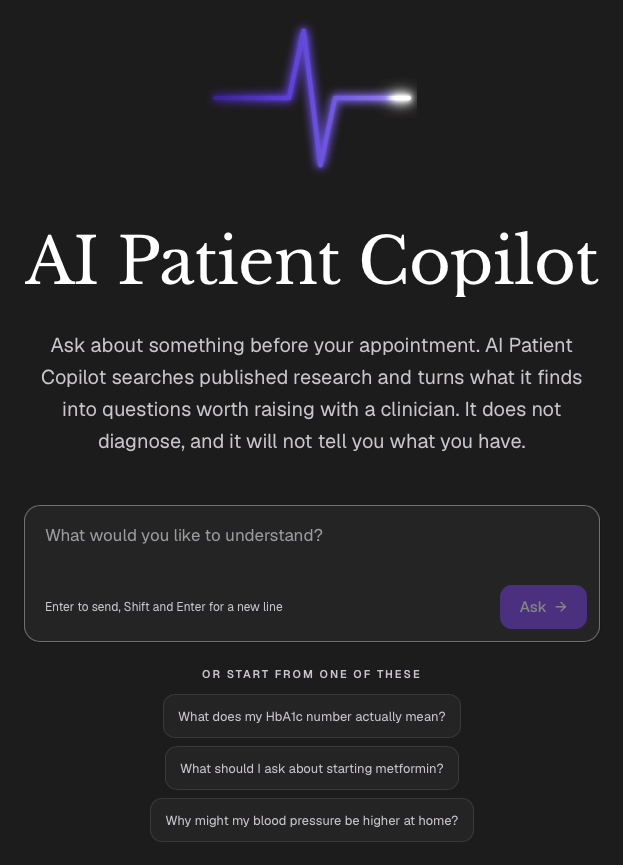
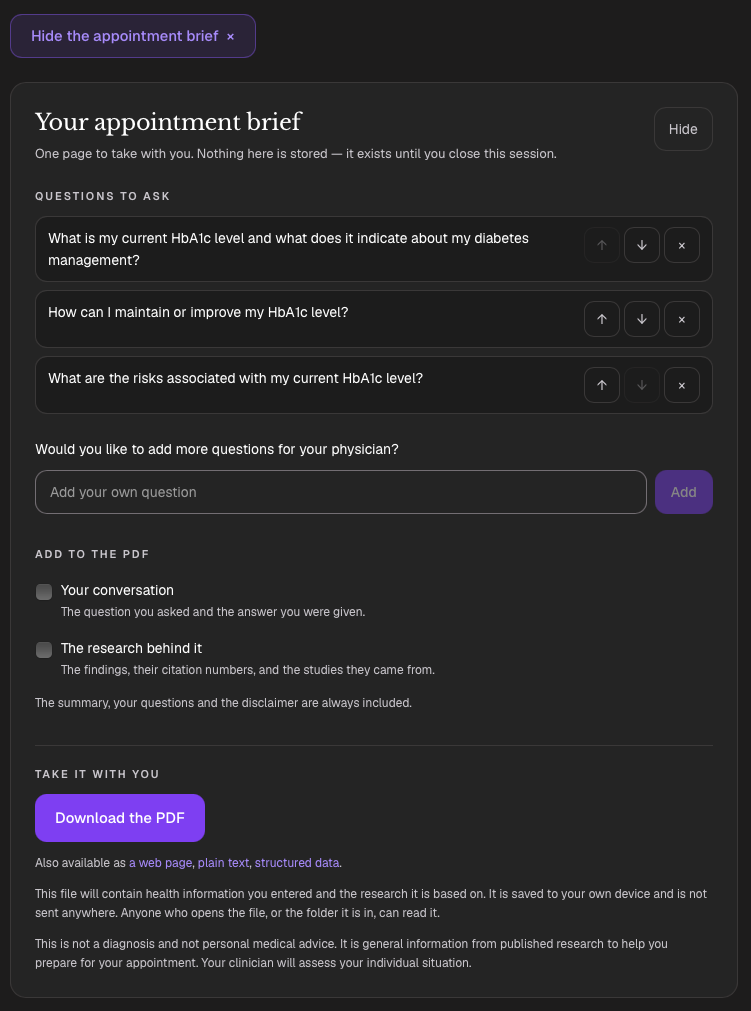
Synapse is built for the fifteen minutes in a waiting room before an appointment. A patient asks a question in their own words, such as "what does my HbA1c number actually mean?", and Synapse searches published medical research, explains what it found in plain language with a citation for every claim, and turns that into questions worth raising with their clinician. The patient leaves with an appointment brief to take into the room. The output is deliberately questions for a doctor, not answers about the patient.
The user is a patient with an appointment coming up, a condition they only partly understand, and questions they don't know how to phrase. The long-term goal is clinical software deployed in hospital and clinic waiting rooms, so the eventual customers are health systems and clinics that want patients to arrive better prepared and get more out of short consultations.
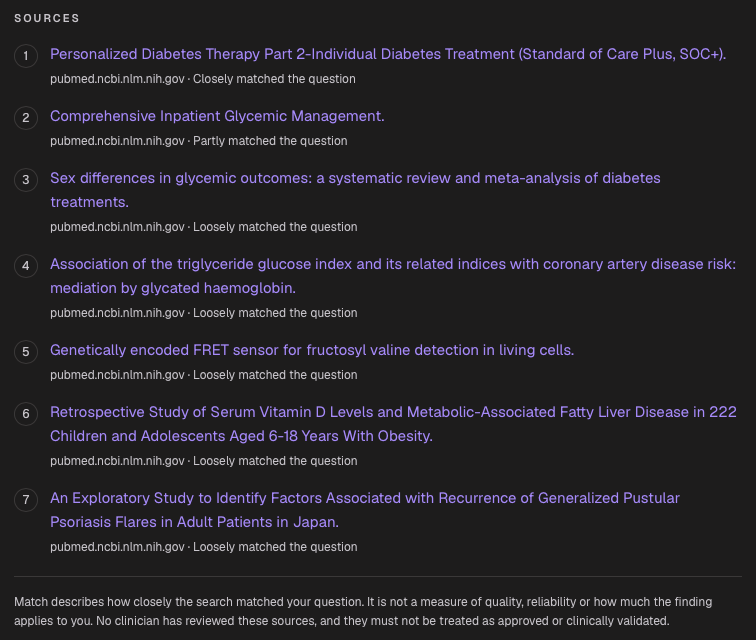
What sets Synapse apart is what it refuses to do, enforced in code and tested. It will not diagnose, triage, advise on medications, or interpret a patient's own results. It checks every quote against the passage it claims to come from, withholds any claim it can't support, and when too little evidence survives, it says "I don't have good evidence for that" instead of filling the gap. If a question describes something potentially urgent, such as chest pain, slurred speech or trouble breathing, it stops, retrieves nothing, and directs the person to emergency help, including on follow-up questions. Retrieval combines keyword and vector search over PubMed research, and a governance process that automation can't bypass controls which sources may be used.
The engineering is substantial: about 29,600 lines of code across 129 modules, 1,451 passing tests, an offline evaluation harness, citation verification, accessibility checks and automated quality gates. The project is also unusually candid about its status. It is pre-clinical: no clinician has yet reviewed its sources, evaluation cases or outputs, so it is not medically validated, FDA cleared or HIPAA compliant, and its evaluation harness refuses to let synthetic results be presented as validation. The documentation sets out the specific remaining steps (clinical review, approved sources, a labeled evaluation set, thresholds set from measured performance, and regulatory and privacy review) alongside a safety case, a system card and a limitations document.
Start a free trial
Fill in the details below and we'll set up your free trial of AI Patient Copilot on synthetic data and email you access.