
Healthcare AI & ERP / Clinicians
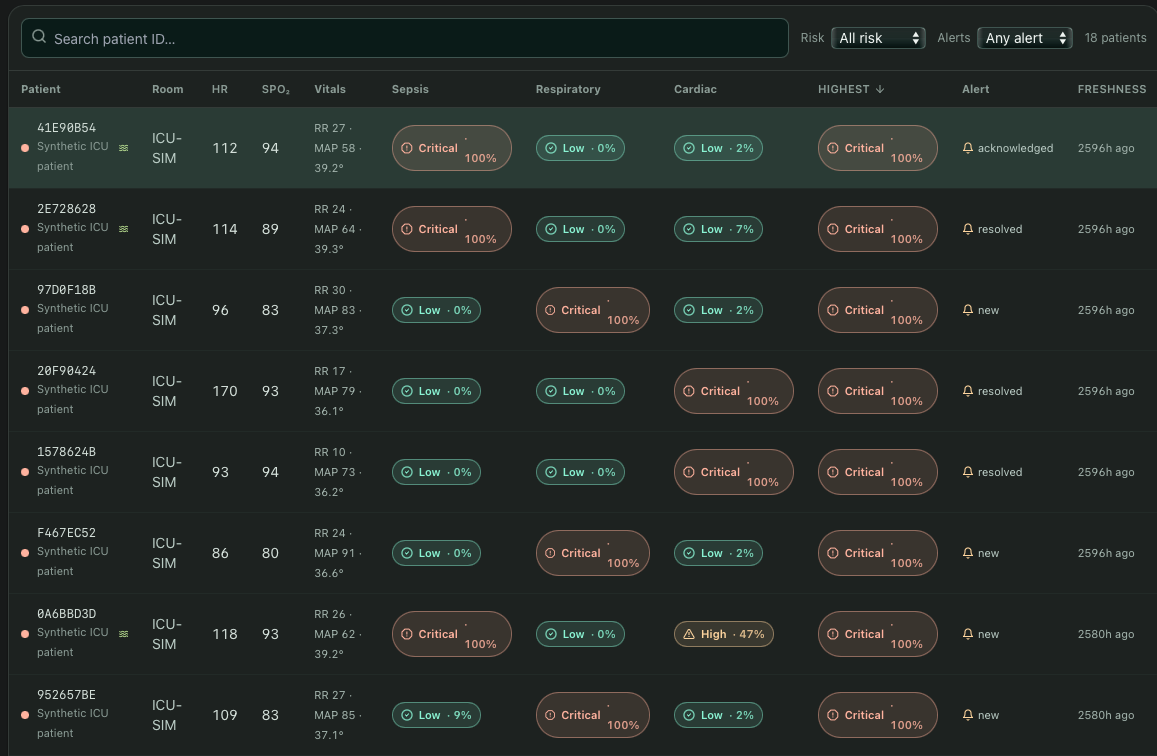
AegisICU watches a live stream of ICU patient data, including vital signs and lab results, and estimates each patient's risk of three kinds of deterioration: sepsis, respiratory failure and cardiac instability. These conditions often show early warning signs hours ahead, hidden in subtle trends across many measurements. AegisICU surfaces those trends on a real-time dashboard, raises an alert when risk crosses a threshold, and explains each estimate in plain language grounded in the patient's actual data.
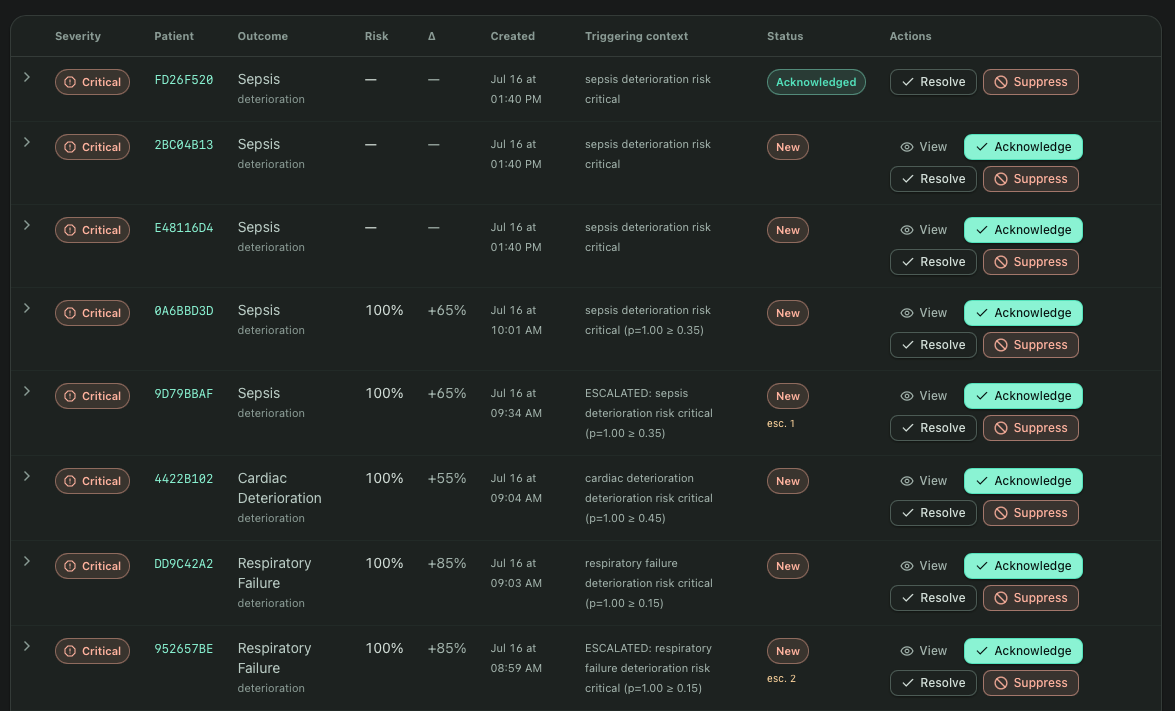
It is designed for ICU clinicians and rapid-response teams who monitor many patients at once, and for hospital clinical-informatics teams evaluating early-warning systems. The dashboard has a command-center view of every patient, a detailed patient view with live charts and risk cards, an alert worklist for triage, and a model-operations page showing how the models perform. Four roles control who can do what, and every action is logged.
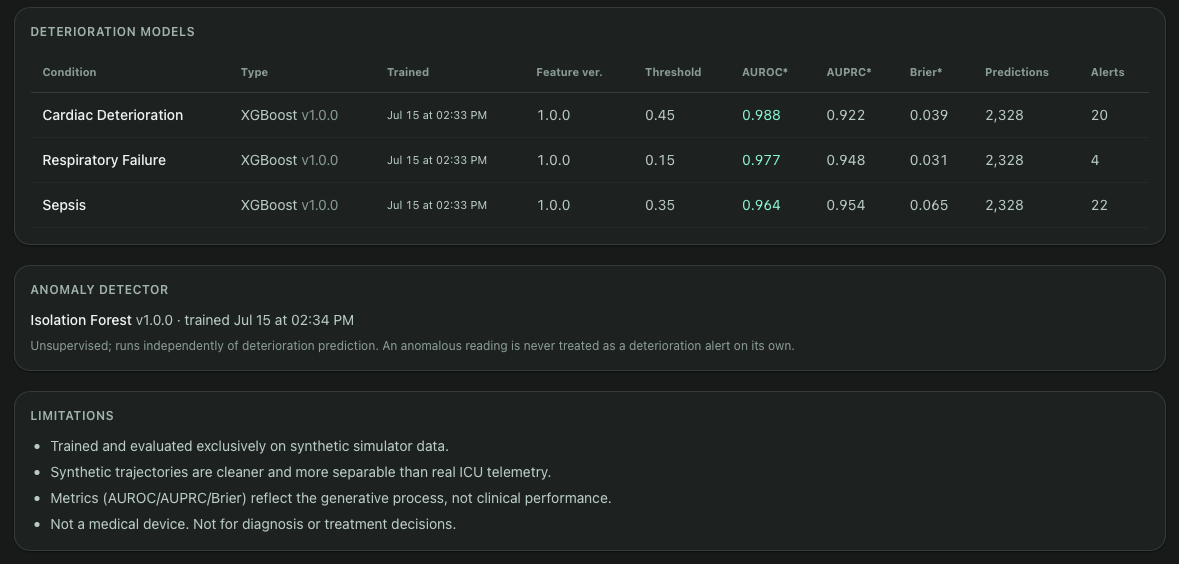
Patient data streams through Kafka (Redpanda locally), is turned into time-window features such as trends, variability and shock index, and is scored by three calibrated XGBoost models plus a separate anomaly detector. The same feature code is used for training and for live scoring, and safeguards stop the models from seeing information they shouldn't (data leakage). Because alert fatigue is a real problem in ICUs, the alert engine requires risk to persist before alerting, applies cooldowns, removes duplicates, escalates when needed and resolves alerts automatically. Explanations use only the patient's own data and model outputs, are screened for prohibited language, and never diagnose or recommend treatment; if an AI-written explanation fails the screen, a safe built-in explanation takes over.
The project includes 112 backend tests, 17 front-end tests, an end-to-end browser test, a CI pipeline, and a one-command demo with a five-minute guided walkthrough. A reference AWS architecture maps the system onto managed services such as Kinesis, Aurora, SageMaker and Bedrock. It is clearly labeled as an engineering prototype: all patient data is randomly generated, so its performance numbers reflect the simulation, not real-world clinical accuracy. It is not a medical device, makes no HIPAA claim and is not ready for hospital deployment. The roadmap includes retraining on de-identified public ICU data with proper validation.
Start a free trial
Fill in the details below and we'll set up your free trial of ICU Patient Deterioration Prediction on synthetic data and email you access.