
Multicloud AI & ERP / Agentic AI & Cloud AI Infrastructure
Why it matters
Agents move AI from answering questions to doing work: resolving tickets, reconciling invoices, running investigations. That power needs a proper runtime with isolation, identity, memory and tracing, not a script on a VM.
How it works
The agent loop
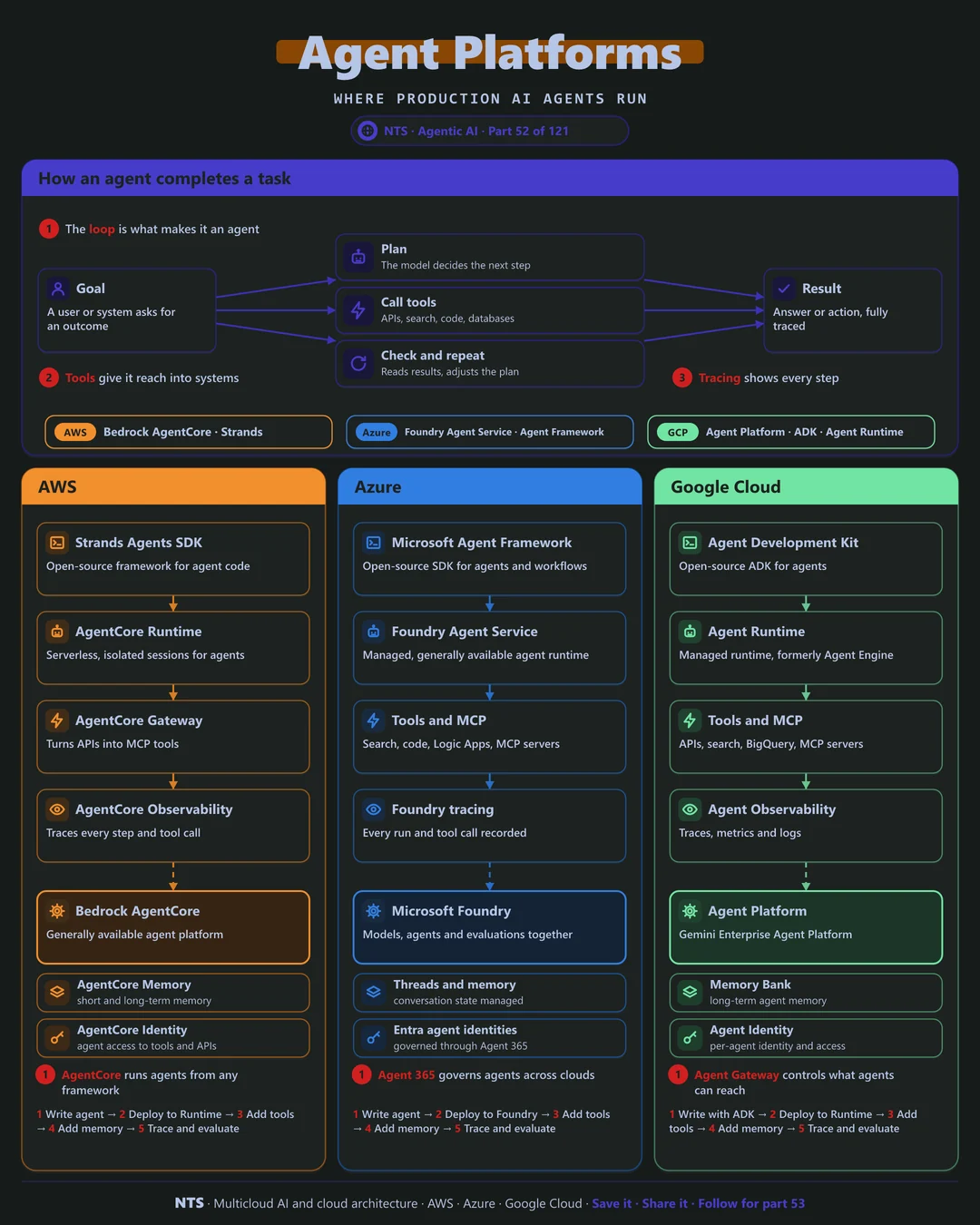
A user or system sets a goal. The model plans the next step, calls a tool such as an API, search or database, reads the result and adjusts the plan, repeating until the goal is met. Every step is traced, so you can see why the agent did what it did.
What a managed runtime adds
Isolated sessions per user, scaling, memory across conversations, tool gateways, agent identity for secure access and observability. These are the pieces teams otherwise spend months building.
AWS, Azure and Google Cloud compared
| AWS | Azure | Google Cloud | |
|---|---|---|---|
| Agent platform | Amazon Bedrock AgentCore | Foundry Agent Service | Agent Platform (Agent Runtime) |
| Open-source SDK | Strands Agents | Microsoft Agent Framework | Agent Development Kit (ADK) |
| Tool gateway | AgentCore Gateway | Tools and MCP in Foundry | Agent Gateway |
| Memory | AgentCore Memory | Threads and memory | Memory Bank |
| Observability | AgentCore Observability | Foundry tracing | Agent Observability |
What makes each cloud different
AWS
Bedrock AgentCore, generally available since October 2025, runs agents from any framework with isolated sessions, memory, a gateway that turns APIs into MCP tools, identity and observability. Strands is AWS's open-source agent SDK.
Azure
Foundry Agent Service is generally available, and the Microsoft Agent Framework unifies Semantic Kernel and AutoGen ideas into one SDK for agents and workflows. Agent 365 governs agents across clouds.
Google Cloud
Google's Agent Platform pairs the open-source ADK with Agent Runtime (formerly Agent Engine), Memory Bank, Agent Identity and Agent Gateway, all under the Gemini Enterprise Agent Platform.
Design decisions that matter
- 01Managed runtime for production agents
Isolation, scaling and tracing built in.
- 02Start narrow
One clear task with measurable outcomes.
- 03Trace every step
You will need to explain agent actions.
- 04Humans approve risky actions
Payments, deletes and external messages.
Common mistakes we see
- Agents with every tool. More tools mean more confusion and risk.
- No evaluation. Agents regress silently as models change.
- Shared service credentials. Agents act with far more access than needed.
A practical 30-day plan
- Week 1
Pick one task and define success metrics.
- Week 2
Build the agent with the cloud's SDK and two or three tools.
- Week 3
Deploy to the managed runtime with identity and tracing.
- Week 4
Pilot with real users and evaluate trajectories.
How NTS helps
NTS designs and builds production AI agents on Bedrock AgentCore, Foundry Agent Service and Google's Agent Platform, from use-case selection and tool integration to identity, evaluation and governance.
What you get
- An agent platform on AgentCore, Foundry Agent Service or Vertex AI Agent Engine
- Tools and integrations with your systems
- Identity, permissions and audit for agents
- Evaluation and monitoring for agent behavior
Typical outcomes
- Real tasks automated end to end
- Agents your security team approves
- A repeatable way to launch new agents
How we work with you
- 1Assess
A focused review of your AI agent platform across AWS, Azure and Google Cloud. We look for the gaps we find most often: agents with every tool, no evaluation and shared service credentials.
- 2Design
A target architecture and roadmap built on the decisions that matter most: managed runtime for production agents, start narrow, trace every step and humans approve risky actions.
- 3Build
Hands-on delivery alongside your team. We pick one task and define success metrics, build the agent with the cloud's SDK and two or three tools, deploy to the managed runtime with identity and tracing, and finally pilot with real users and evaluate trajectories.
- 4Run and improve
We monitor agent performance, add tools and improve behavior using real interaction data.
Why teams choose NTS for AI agent platform
- Agents in production, not demos
We build agents with the reliability your business needs.
- Secure by design
Agents get only the permissions they need, with full audit trails.
- Platform thinking
Shared foundations let you launch many agents safely.
Book a free 30-minute review
Talk to an NTS architect about your AI agent platform on AWS, Azure and Google Cloud.