
Multicloud AI & ERP / Cloud Migration, Integration & AI Operations
Why it matters
Microsoft's AI stack moved quickly this year, with renames, new services and retirements. Teams building on Azure need to know which names changed, which services are new and which deadlines are coming.
How it works
The big themes
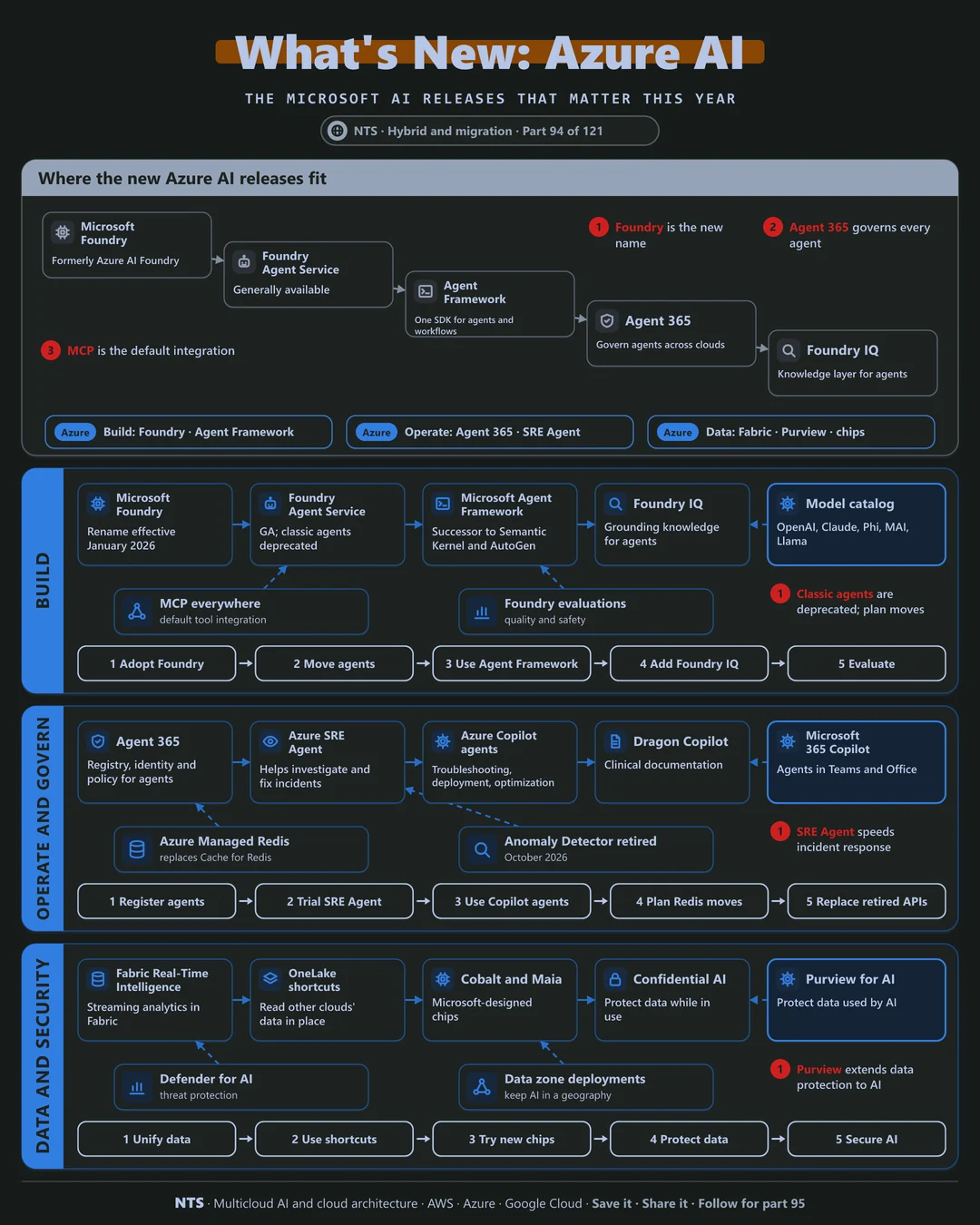
Foundry is the new home for models and agents: Azure AI Foundry became Microsoft Foundry (effective January 2026), Foundry Agent Service is GA and classic agents are deprecated. The Microsoft Agent Framework unifies Semantic Kernel and AutoGen ideas. Agent 365 governs agents across clouds, and MCP is the default integration layer.
At a glance
| Build | Operate and govern | Data and security | |
|---|---|---|---|
| Headline release | Microsoft Foundry (rename, Jan 2026) | Agent 365 | Fabric Real-Time Intelligence |
| Agents | Foundry Agent Service (GA) | Azure SRE Agent | Purview for AI |
| Developer tools | Microsoft Agent Framework | Azure Copilot agents | OneLake shortcuts |
| Retired or changing | Classic agents deprecated | Azure Cache for Redis tiers (2027-2028) | Anomaly Detector (retired Oct 2026) |
What stands out
Build
Microsoft Foundry brings OpenAI, Claude, Phi, MAI and open models together with the GA Foundry Agent Service, Foundry IQ for knowledge and the Microsoft Agent Framework for agents and workflows.
Operate and govern
Agent 365 registers, secures and governs agents across clouds, the Azure SRE Agent helps investigate incidents and Azure Copilot agents assist with troubleshooting, deployment and optimization. Plan moves from Azure Cache for Redis to Azure Managed Redis.
Data and security
Fabric Real-Time Intelligence and OneLake shortcuts strengthen the data side, Purview extends data protection to AI and Defender for AI adds threat protection; Anomaly Detector users must migrate.
Design decisions that matter
- 01Update names and SDKs
Foundry and Agent Framework.
- 02Migrate classic agents
To Foundry Agent Service.
- 03Register agents in Agent 365
Governance before scale.
- 04Plan Redis and Anomaly Detector moves
Deadlines are fixed.
Common mistakes we see
- Building on deprecated agents. Rework later.
- Ignoring retirement dates. Outages when services end.
- Ungoverned agent growth. Agent 365 exists for a reason.
A practical 30-day plan
- Week 1
Inventory affected services and SDKs.
- Week 2
Move one agent to Foundry Agent Service.
- Week 3
Register agents in Agent 365.
- Week 4
Schedule Redis and Anomaly Detector migrations.
How NTS helps
NTS helps Azure clients adopt Microsoft Foundry and Agent 365, migrate classic agents and retiring services such as Azure Cache for Redis and Anomaly Detector, and govern AI across the estate.
What you get
- A briefing on the latest Azure and Microsoft AI services
- Use-case fit for Microsoft Foundry, Copilot and agents
- Pilot projects on new capabilities
- An adoption roadmap
Typical outcomes
- Faster value from Microsoft AI investments
- Clear priorities for AI adoption
- Safe use of new Azure capabilities
How we work with you
- 1Assess
A focused review of your Azure AI adoption across AWS, Azure and Google Cloud. We look for the gaps we find most often: building on deprecated agents, ignoring retirement dates and ungoverned agent growth.
- 2Design
A target architecture and roadmap built on the decisions that matter most: update names and SDKs, migrate classic agents, register agents in Agent 365 and plan Redis and Anomaly Detector moves.
- 3Build
Hands-on delivery alongside your team. We inventory affected services and SDKs, move one agent to Foundry Agent Service, register agents in Agent 365, and finally schedule Redis and Anomaly Detector migrations.
- 4Run and improve
We brief your team every quarter on new Azure AI services and update your roadmap.
Why teams choose NTS for Azure AI adoption
- Microsoft ecosystem expertise
We connect Azure AI with Microsoft 365 and Fabric.
- Hype filtered out
We separate production-ready services from previews.
- Hands-on proof
Pilots validate value quickly.
Book a free 30-minute review
Talk to an NTS architect about your Azure AI adoption on AWS, Azure and Google Cloud.