
Multicloud AI & ERP / Cloud AI Applications & Industry AI Solutions
Why it matters
Translating support tickets, detecting sentiment in reviews and extracting entities from emails are high-volume tasks. Purpose-built APIs do them at a fraction of LLM cost, with consistent outputs and simpler compliance.
How it works
A language pipeline
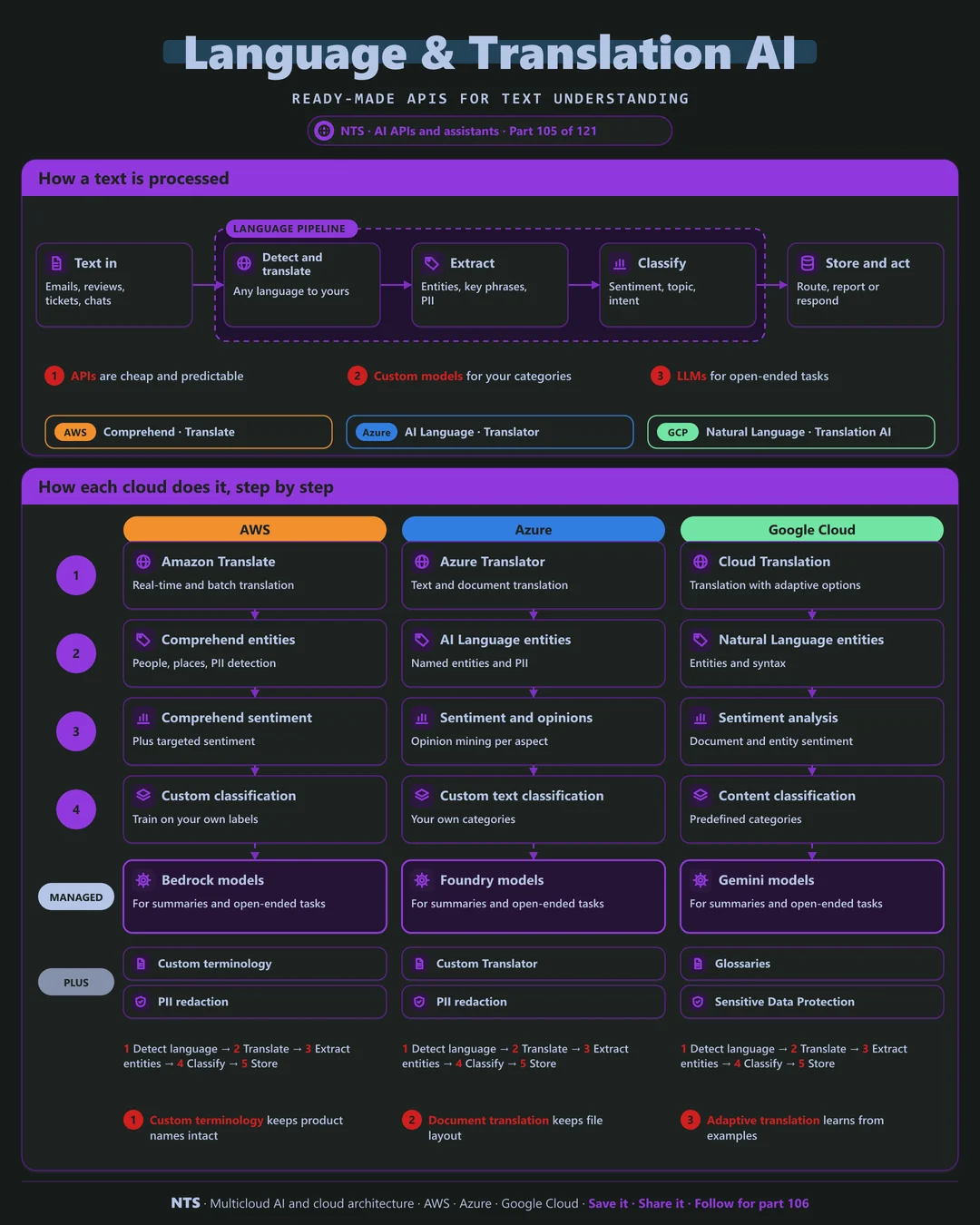
Text arrives from emails, reviews, tickets or chats. It is detected and translated, then entities and personal data are extracted, the text is classified for sentiment, topic or intent, and the result is stored or routed to the right team.
AWS, Azure and Google Cloud compared
| AWS | Azure | Google Cloud | |
|---|---|---|---|
| Translation | Amazon Translate | Azure Translator | Cloud Translation |
| Entities and PII | Amazon Comprehend | Azure AI Language | Natural Language API |
| Sentiment | Comprehend sentiment | Sentiment and opinion mining | Sentiment analysis |
| Custom classification | Comprehend custom classifiers | Custom text classification | Custom models in Agent Platform |
| Terminology control | Custom terminology | Custom Translator | Glossaries, adaptive translation |
What makes each cloud different
AWS
Amazon Translate supports real-time and batch translation with custom terminology for product names, and Comprehend extracts entities, PII and sentiment with custom classifiers for your own categories.
Azure
Azure Translator handles text and document translation that keeps file layout, and Azure AI Language offers entities, PII, opinion mining and custom classification.
Google Cloud
Google Cloud Translation offers adaptive translation that learns from examples and glossaries, and the Natural Language API provides entities, syntax and sentiment.
Design decisions that matter
- 01APIs for common tasks
LLMs for open-ended ones.
- 02Control terminology
Brand and product names stay correct.
- 03Redact PII early
Before storage and analytics.
- 04Custom classifiers for your categories
Routing that matches your business.
Common mistakes we see
- LLMs for simple translation at scale. Higher cost and less consistency.
- Ignoring domain terms. Mistranslated product names.
- Storing raw text with PII. Avoidable privacy risk.
A practical 30-day plan
- Week 1
Pick a high-volume text stream.
- Week 2
Add translation and PII redaction.
- Week 3
Add sentiment and classification.
- Week 4
Route results and measure time saved.
How NTS helps
NTS builds language and translation pipelines on AWS, Azure and Google Cloud for support, reviews and compliance, choosing between APIs and LLMs to balance quality and cost.
What you get
- Translation pipelines for documents, apps and support
- Custom glossaries and terminology
- Quality checks with human review
- Multilingual AI assistants
Typical outcomes
- Faster launches in new languages
- Lower translation costs
- Consistent terminology everywhere
How we work with you
- 1Assess
A focused review of your language and translation AI across AWS, Azure and Google Cloud. We look for the gaps we find most often: LLMs for simple translation at scale, ignoring domain terms and storing raw text with PII.
- 2Design
A target architecture and roadmap built on the decisions that matter most: APIs for common tasks, control terminology, redact PII early and custom classifiers for your categories.
- 3Build
Hands-on delivery alongside your team. We pick a high-volume text stream, add translation and PII redaction, add sentiment and classification, and finally route results and measure time saved.
- 4Run and improve
We maintain glossaries, review quality and add new languages as you expand.
Why teams choose NTS for language and translation AI
- Brand voice preserved
Glossaries and reviews keep translations accurate and on-brand.
- Fast global reach
Automated pipelines translate content in minutes.
- Cost-effective quality
Human review only where it adds value.
Book a free 30-minute review
Talk to an NTS architect about your language and translation AI on AWS, Azure and Google Cloud.