
Multicloud AI & ERP / Cloud Networking, Edge & Zero Trust for AI
Why it matters
Every service call starts with a name lookup. Broken DNS takes down applications that are otherwise healthy, leaked internal names help attackers map your estate, and hybrid environments fail in confusing ways when cloud and on-premises resolvers do not agree.
How it works
Public and private zones
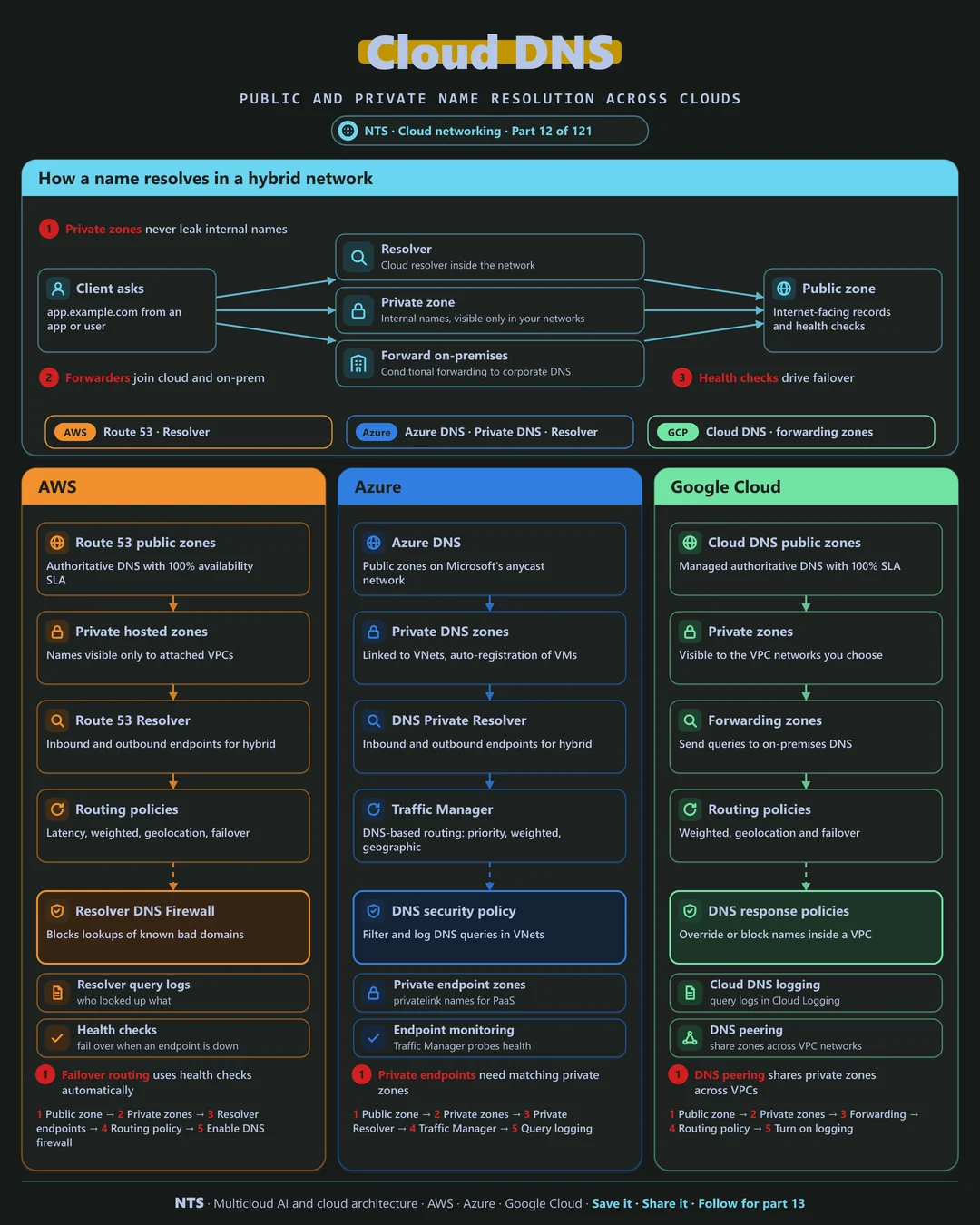
Public zones answer for internet-facing names. Private zones hold internal names and are visible only inside the networks you attach them to. Keeping the two separate means internal service names never appear on the internet.
Hybrid resolution
In hybrid estates, cloud workloads need on-premises names and vice versa. Resolver endpoints and conditional forwarding pass queries between cloud DNS and corporate DNS. Health-checked routing policies then add failover, latency-based and weighted routing on top.
AWS, Azure and Google Cloud compared
| AWS | Azure | Google Cloud | |
|---|---|---|---|
| Public DNS | Route 53 | Azure DNS | Cloud DNS |
| Private zones | Private hosted zones | Private DNS zones | Private zones |
| Hybrid resolver | Route 53 Resolver endpoints | DNS Private Resolver | Forwarding zones, server policies |
| Traffic routing | Routing policies with health checks | Traffic Manager | Routing policies |
| DNS filtering | Resolver DNS Firewall | DNS security policy | Response policies |
| Availability SLA | 100% | 100% | 100% |
What makes each cloud different
AWS
Route 53 combines authoritative DNS with rich routing policies (latency, weighted, geolocation, failover) driven by health checks. Resolver endpoints connect VPCs with on-premises DNS, and Resolver DNS Firewall blocks lookups of known malicious domains.
Azure
Azure separates public Azure DNS, Private DNS zones linked to virtual networks with automatic VM registration, and the DNS Private Resolver for hybrid. Private endpoints depend on matching privatelink zones, the most commonly missed step in Azure designs.
Google Cloud
Cloud DNS offers public and private zones, forwarding zones to on-premises resolvers and DNS peering to share zones across VPC networks. Response policies override or block names inside a VPC, useful for security and migrations.
Design decisions that matter
- 01Split public and private zones
Internal names never live in public DNS.
- 02One hybrid resolution design
Central resolver endpoints instead of per-team forwarding.
- 03Records as code
Manage DNS in the same pipeline as infrastructure.
- 04Filter and log queries
DNS logs reveal compromised hosts quickly.
Common mistakes we see
- Manual record changes. Typos in production DNS cause outages that look like app failures.
- Missing private endpoint zones. Services resolve to public IPs and traffic leaves the private network.
- Long TTLs before migrations. Cutovers take hours instead of minutes.
A practical 30-day plan
- Week 1
Inventory zones, records and resolvers across clouds and sites.
- Week 2
Design the hybrid resolution pattern and build resolver endpoints.
- Week 3
Move records into code and enable query logging.
- Week 4
Add DNS filtering and health-checked failover for key services.
How NTS helps
NTS designs DNS for hybrid and multicloud estates: private zones, resolver endpoints, private endpoint integration, traffic routing and DNS security, all managed as code.
What you get
- A domain and zone strategy across clouds and on-premises
- Hybrid DNS resolution between data centers and clouds
- DNSSEC and protected registrar accounts
- Health-checked routing for failover
Typical outcomes
- No more DNS-caused outages from manual edits
- Seamless name resolution across hybrid networks
- Faster, automatic failover
How we work with you
- 1Assess
A focused review of your DNS across AWS, Azure and Google Cloud. We look for the gaps we find most often: manual record changes, missing private endpoint zones and long TTLs before migrations.
- 2Design
A target architecture and roadmap built on the decisions that matter most: split public and private zones, one hybrid resolution design, records as code and filter and log queries.
- 3Build
Hands-on delivery alongside your team. We inventory zones, records and resolvers across clouds and sites, design the hybrid resolution pattern and build resolver endpoints, move records into code and enable query logging, and finally add DNS filtering and health-checked failover for key services.
- 4Run and improve
We manage DNS as code, audit records and registrar access, and test failover routing regularly.
Why teams choose NTS for DNS
- Small service, big blast radius
We treat DNS as critical infrastructure because every outage story seems to involve it.
- Hybrid resolution done right
We make private names resolve correctly across offices, VPNs and every cloud.
- Failover that works
Health checks and routing policies are tested, not assumed.
Book a free 30-minute review
Talk to an NTS architect about your DNS on AWS, Azure and Google Cloud.