
Multicloud AI & ERP / Cloud Networking, Edge & Zero Trust for AI
Why it matters
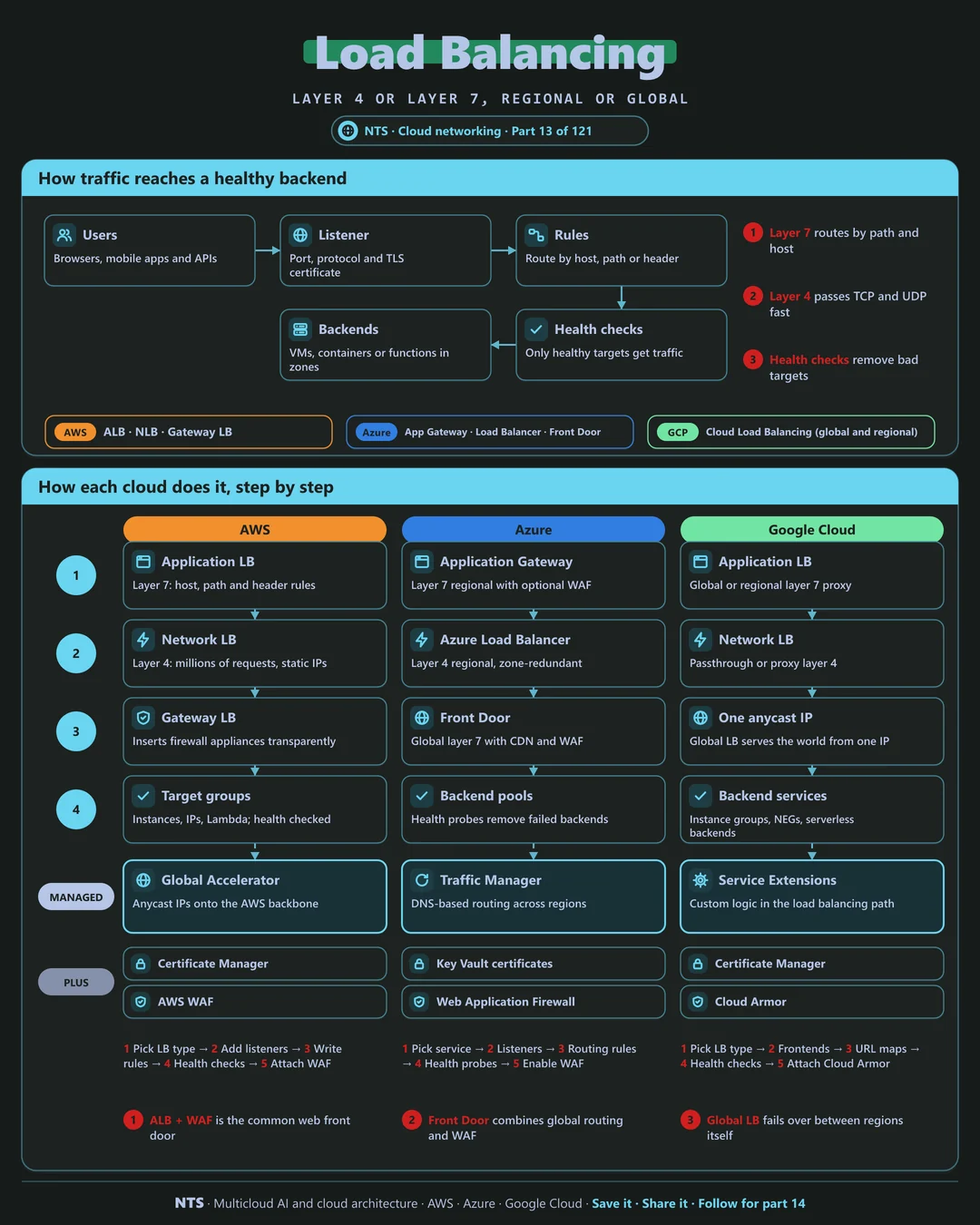
Load balancers spread traffic, remove unhealthy servers, terminate TLS and often host the web application firewall. Choosing the wrong type leads to missing features, extra hops, higher latency or a single regional point of failure.
How it works
Layer 4 or layer 7
Layer 7 load balancers understand HTTP: they route by host, path or header, terminate TLS and can attach a WAF. Layer 4 load balancers pass TCP and UDP connections with very low latency and static IPs, ideal for non-HTTP protocols and extreme throughput.
Regional or global
Regional load balancers serve one region across its zones. Global load balancers present one address worldwide, send users to the nearest healthy region and fail over between regions automatically. Health checks are the heart of both: only healthy targets receive traffic.
AWS, Azure and Google Cloud compared
| AWS | Azure | Google Cloud | |
|---|---|---|---|
| Layer 7, regional | Application Load Balancer | Application Gateway | Regional Application Load Balancer |
| Layer 4 | Network Load Balancer | Azure Load Balancer | Network Load Balancer |
| Global layer 7 | CloudFront with ALB, Global Accelerator | Front Door | Global Application Load Balancer |
| Appliance insertion | Gateway Load Balancer | Gateway Load Balancer | Network virtual appliances |
| Attached WAF | AWS WAF | Azure WAF | Cloud Armor |
| Certificates | Certificate Manager | Key Vault certificates | Certificate Manager |
What makes each cloud different
AWS
AWS offers the Application, Network and Gateway Load Balancers per region, with Global Accelerator adding anycast IPs onto the AWS backbone and CloudFront providing global HTTP delivery. ALB plus AWS WAF is the most common web front door.
Azure
Azure splits regional layer 7 (Application Gateway), regional layer 4 (Azure Load Balancer) and global layer 7 with CDN and WAF (Front Door). Traffic Manager adds DNS-based routing across regions.
Google Cloud
Google Cloud's global Application Load Balancer serves the whole world from a single anycast IP and fails over between regions on its own, a genuine architectural advantage. Cloud Armor attaches WAF and DDoS policies directly to it.
Design decisions that matter
- 01Layer 7 for web and APIs
Use host and path routing, TLS termination and a WAF.
- 02Global entry for global users
One address, nearest healthy region, automatic failover.
- 03Meaningful health checks
Check a real dependency path, not just a static page.
- 04Certificates managed and auto-renewed
No manual certificate uploads.
Common mistakes we see
- Health checks that always pass. Broken backends keep receiving traffic.
- One load balancer per microservice. Cost and sprawl; use host and path rules.
- No WAF on public endpoints. Common web attacks reach the application directly.
A practical 30-day plan
- Week 1
Map public endpoints, protocols and user locations.
- Week 2
Consolidate onto the right load balancer types with shared rules.
- Week 3
Attach WAF policies and managed certificates.
- Week 4
Improve health checks and test zone and region failover.
How NTS helps
NTS designs traffic management across AWS, Azure and Google Cloud: load balancer selection, global failover, WAF policies and certificate automation, tested with real failover drills.
What you get
- The right load balancer choice for each application
- Health checks and timeouts tuned to your services
- TLS termination and certificate automation
- Global failover across regions
Typical outcomes
- Fewer user-facing errors during deployments
- Smooth scaling during traffic spikes
- Regional failover without manual steps
How we work with you
- 1Assess
A focused review of your load balancing across AWS, Azure and Google Cloud. We look for the gaps we find most often: health checks that always pass, one load balancer per microservice and no WAF on public endpoints.
- 2Design
A target architecture and roadmap built on the decisions that matter most: layer 7 for web and APIs, global entry for global users, meaningful health checks and certificates managed and auto-renewed.
- 3Build
Hands-on delivery alongside your team. We map public endpoints, protocols and user locations, consolidate onto the right load balancer types with shared rules, attach WAF policies and managed certificates, and finally improve health checks and test zone and region failover.
- 4Run and improve
We review traffic patterns, capacity and certificates, and adjust routing as applications evolve.
Why teams choose NTS for load balancing
- Traffic engineering experience
We pick between layer 4, layer 7 and global options based on your real traffic.
- Health checks that catch real failures
We tune checks so bad instances leave quickly and healthy ones stay.
- Ready for peak days
We test load balancer behavior under load before launches and campaigns.
Book a free 30-minute review
Talk to an NTS architect about your load balancing on AWS, Azure and Google Cloud.