
Multicloud AI & ERP / Cloud Networking, Edge & Zero Trust for AI
Why it matters
Managed services are reachable on public endpoints by default. Even with authentication, that exposes them to credential attacks and makes data exfiltration harder to stop. Private connectivity keeps traffic on the provider's backbone and lets you switch public access off entirely.
How it works
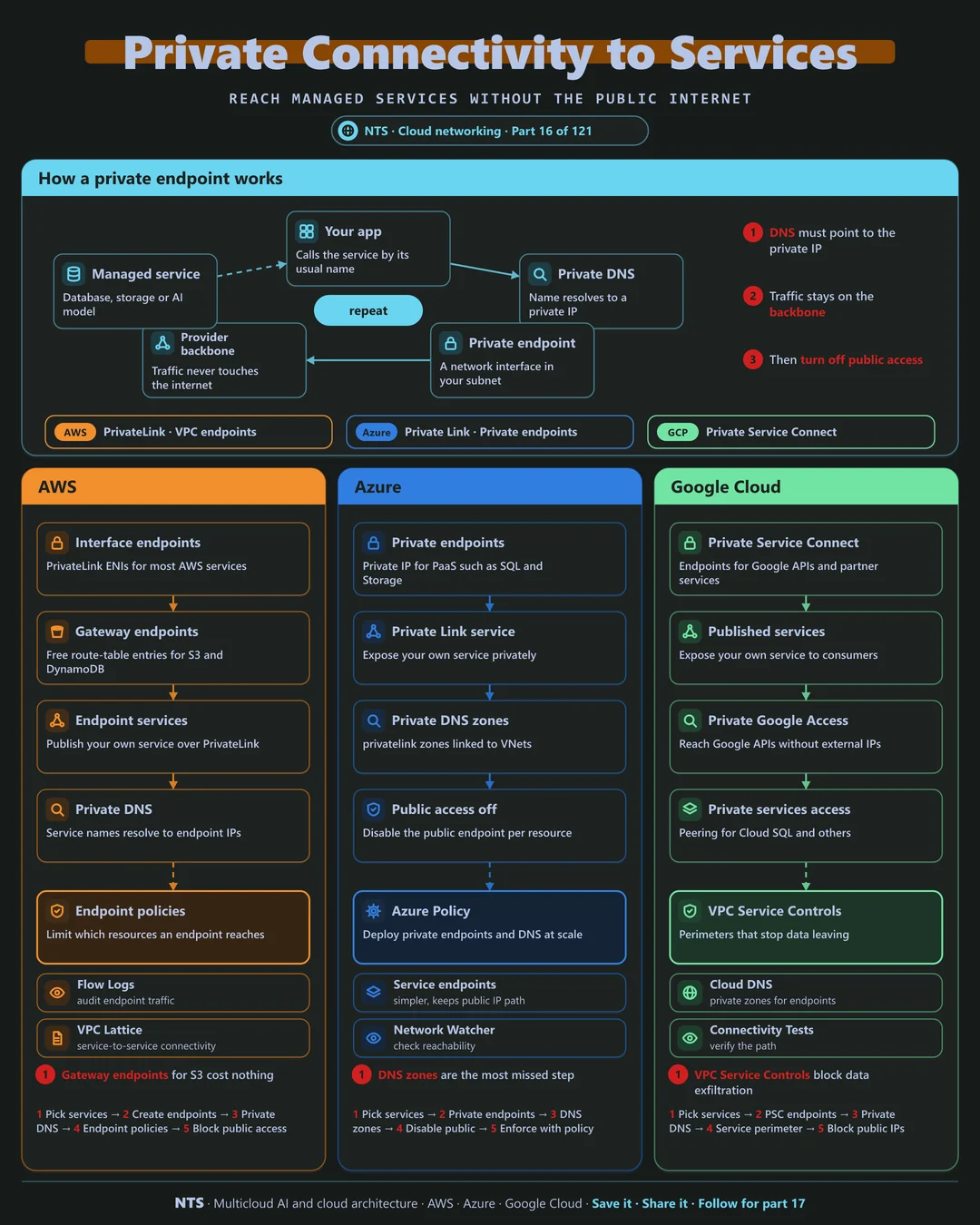
How a private endpoint works
A private endpoint is a network interface in your subnet with a private IP that represents the managed service. Private DNS makes the service's normal name resolve to that private IP, so applications need no code changes. Traffic then travels across the provider's backbone, never the internet.
Then close the front door
Once private access works, disable public network access on the service. Endpoint policies and service perimeters can further restrict which resources an endpoint reaches, stopping data from leaving to an attacker's account.
AWS, Azure and Google Cloud compared
| AWS | Azure | Google Cloud | |
|---|---|---|---|
| Private endpoints | Interface endpoints (PrivateLink) | Private endpoints (Private Link) | Private Service Connect |
| Free endpoints for storage | Gateway endpoints for S3, DynamoDB | Service endpoints | Private Google Access |
| Publish your own service | Endpoint services | Private Link service | Published services |
| Exfiltration control | Endpoint policies | Policies, network rules | VPC Service Controls |
| DNS integration | Private DNS for endpoints | privatelink DNS zones | Cloud DNS private zones |
What makes each cloud different
AWS
AWS PrivateLink provides interface endpoints for most services and gateway endpoints for S3 and DynamoDB at no charge. Endpoint policies limit which buckets or resources an endpoint can reach, closing a common exfiltration path.
Azure
Azure private endpoints cover PaaS services such as SQL, Storage, Key Vault and Microsoft Foundry. The most common failure is DNS: each service needs its privatelink DNS zone linked to the right networks. Azure Policy can deploy endpoints and DNS automatically.
Google Cloud
Google Cloud's Private Service Connect reaches Google APIs and partner services privately, and VPC Service Controls draws a perimeter around projects so data cannot be copied out even with valid credentials, a strong control for sensitive and AI workloads.
Design decisions that matter
- 01Private endpoints for all data services
Databases, storage, secrets and AI models first.
- 02Automate private DNS
Policy or IaC creates zones and records with each endpoint.
- 03Disable public access afterwards
Private and public should not coexist.
- 04Add exfiltration controls
Endpoint policies or service perimeters.
Common mistakes we see
- Endpoint without DNS. Traffic silently keeps using the public endpoint.
- Leaving public access on. The private path adds nothing if the public one stays open.
- Per-team endpoint sprawl. Centralize shared endpoints in a hub where possible.
A practical 30-day plan
- Week 1
List managed services and how each is reached today.
- Week 2
Create private endpoints and DNS for data and AI services.
- Week 3
Disable public access and add endpoint policies or perimeters.
- Week 4
Enforce the pattern with policy for new resources.
How NTS helps
NTS implements private connectivity across AWS, Azure and Google Cloud: endpoint design, DNS automation, service perimeters and policy enforcement, so sensitive data and AI traffic never touch the internet.
What you get
- Private endpoints for databases, storage and AI services
- DNS configured so private endpoints resolve correctly
- Policies that block public endpoints by default
- Service-provider patterns for sharing your own services privately
Typical outcomes
- Sensitive services removed from the internet
- Lower data exposure risk
- Audit-ready private access patterns
How we work with you
- 1Assess
A focused review of your private connectivity across AWS, Azure and Google Cloud. We look for the gaps we find most often: endpoint without DNS, leaving public access on and per-team endpoint sprawl.
- 2Design
A target architecture and roadmap built on the decisions that matter most: private endpoints for all data services, automate private DNS, disable public access afterwards and add exfiltration controls.
- 3Build
Hands-on delivery alongside your team. We list managed services and how each is reached today, create private endpoints and DNS for data and AI services, disable public access and add endpoint policies or perimeters, and finally enforce the pattern with policy for new resources.
- 4Run and improve
We extend private access to new services and accounts, and monitor for any public endpoint drift.
Why teams choose NTS for private connectivity
- No public paths to sensitive data
We keep traffic to platform services on private networks.
- DNS done right
We fix the resolution issues that make private endpoints fail in practice.
- Scales across accounts
Our patterns work for hundreds of accounts, not just one.
Book a free 30-minute review
Talk to an NTS architect about your private connectivity on AWS, Azure and Google Cloud.