
Multicloud AI & ERP / Cloud Networking, Edge & Zero Trust for AI
Why it matters
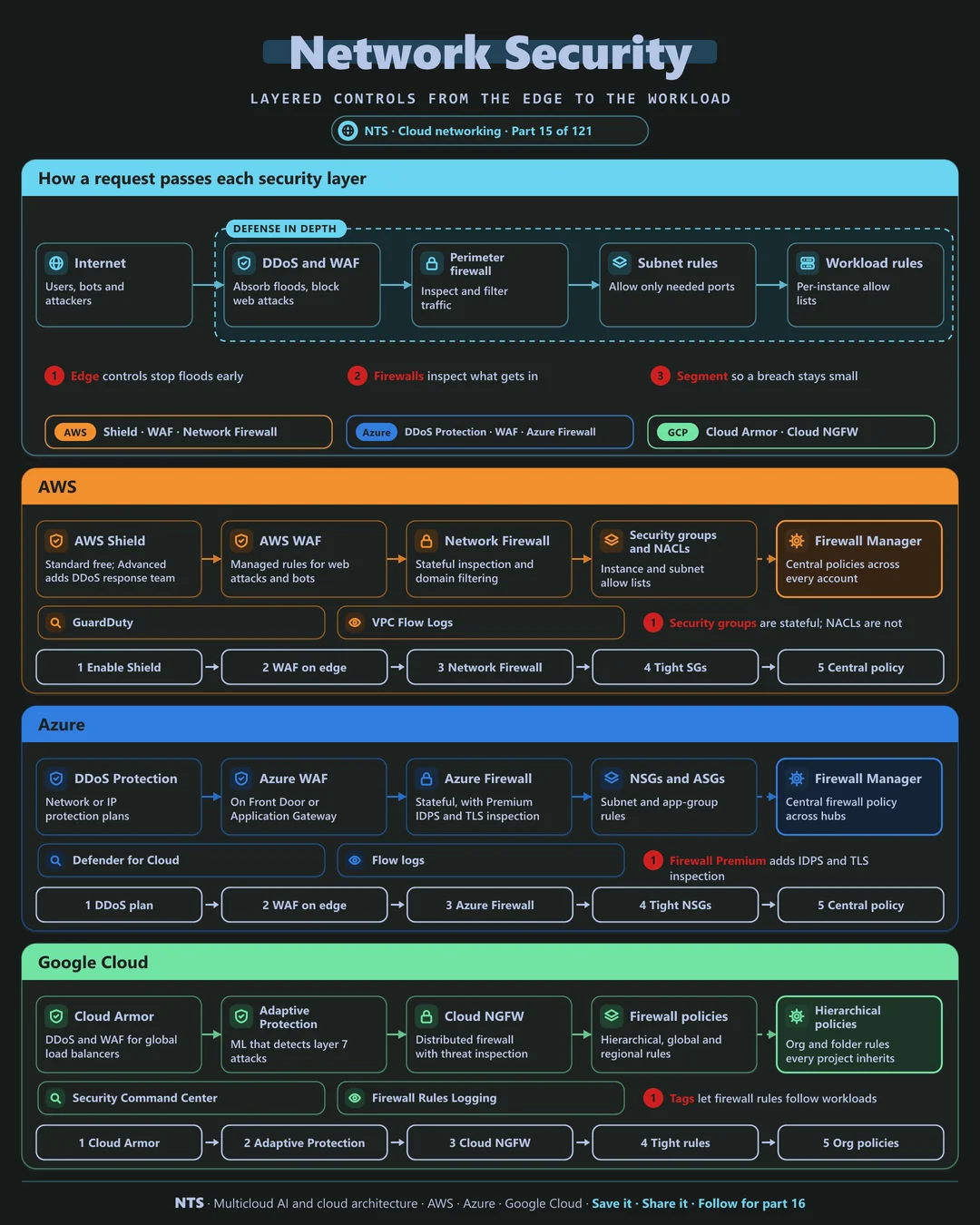
Attackers look for the weakest layer. DDoS floods target availability, web attacks target applications, and once inside, attackers move sideways through flat networks. Layered controls mean each one only has to catch what the previous one missed.
How it works
Four layers
At the edge, DDoS protection absorbs floods and a WAF blocks web attacks. At the perimeter, a stateful firewall inspects traffic between networks and to the internet. At the subnet, rules allow only the ports each tier needs. At the workload, per-instance rules and tags enforce least privilege between services.
Central policy, local enforcement
Managing rules network by network does not scale. Each cloud offers central firewall management that pushes consistent policy to every account or project while enforcement stays close to the workload.
AWS, Azure and Google Cloud compared
| AWS | Azure | Google Cloud | |
|---|---|---|---|
| DDoS protection | AWS Shield | Azure DDoS Protection | Cloud Armor |
| Web application firewall | AWS WAF | Azure WAF | Cloud Armor |
| Managed firewall | AWS Network Firewall | Azure Firewall | Cloud NGFW |
| Workload rules | Security groups, NACLs | NSGs, application security groups | Firewall rules with tags |
| Central management | Firewall Manager | Firewall Manager | Hierarchical firewall policies |
| Threat insight | GuardDuty | Defender for Cloud | Security Command Center |
What makes each cloud different
AWS
AWS layers Shield, WAF and Network Firewall with stateful security groups at the instance level. Firewall Manager applies policies across every account in the organization, and GuardDuty spots malicious traffic patterns.
Azure
Azure Firewall Premium adds intrusion detection and prevention and TLS inspection, while NSGs and application security groups segment subnets and app tiers. Firewall Manager governs policies across hubs and subscriptions.
Google Cloud
Google Cloud's Cloud NGFW is a distributed firewall with threat inspection, configured through hierarchical policies from the organization down and secure tags that follow workloads. Cloud Armor's Adaptive Protection uses machine learning to detect layer 7 attacks.
Design decisions that matter
- 01Defense in layers
Edge, perimeter, subnet and workload controls together.
- 02Deny by default
Allow only the ports and sources each tier needs.
- 03Central policy management
One policy, pushed to every account or project.
- 04Inspect egress too
Outbound filtering stops data exfiltration and command-and-control.
Common mistakes we see
- Overly broad rules. Open ranges added for a test and never removed.
- Security only at the edge. Once inside, attackers move freely.
- No rule reviews. Unused and shadowed rules pile up and hide real risks.
A practical 30-day plan
- Week 1
Enable DDoS protection and a WAF on public endpoints.
- Week 2
Deploy the managed firewall for egress and inter-network traffic.
- Week 3
Tighten workload rules and remove broad ranges.
- Week 4
Centralize policy management and schedule rule reviews.
How NTS helps
NTS designs and implements layered network security on AWS, Azure and Google Cloud: DDoS and WAF, managed firewalls, segmentation and centrally managed policy, aligned with your compliance needs.
What you get
- Segmentation with security groups, NSGs and firewall rules
- Central firewalls with egress filtering
- WAF and DDoS protection for public applications
- Network policy as code with automated checks
Typical outcomes
- A smaller attack surface
- Faster security approvals for new applications
- Clean network security audits
How we work with you
- 1Assess
A focused review of your cloud network security across AWS, Azure and Google Cloud. We look for the gaps we find most often: overly broad rules, security only at the edge and no rule reviews.
- 2Design
A target architecture and roadmap built on the decisions that matter most: defense in layers, deny by default, central policy management and inspect egress too.
- 3Build
Hands-on delivery alongside your team. We enable DDoS protection and a WAF on public endpoints, deploy the managed firewall for egress and inter-network traffic, tighten workload rules and remove broad ranges, and finally centralize policy management and schedule rule reviews.
- 4Run and improve
We review rules, retire unused ones and update protections as new threats and services appear.
Why teams choose NTS for cloud network security
- Defense in depth
We layer controls so one mistake never exposes everything.
- Least privilege for networks
We open only the paths applications actually need.
- Readable rules
We replace sprawling, unexplained rules with documented, reviewed policy.
Book a free 30-minute review
Talk to an NTS architect about your cloud network security on AWS, Azure and Google Cloud.