
Multicloud AI & ERP / Cloud Networking, Edge & Zero Trust for AI
Why it matters
As accounts and projects multiply, ad-hoc peering creates a mesh nobody fully understands. Traffic bypasses inspection, routes conflict, and adding a new network means touching dozens of others.
How it works
Hub and spoke
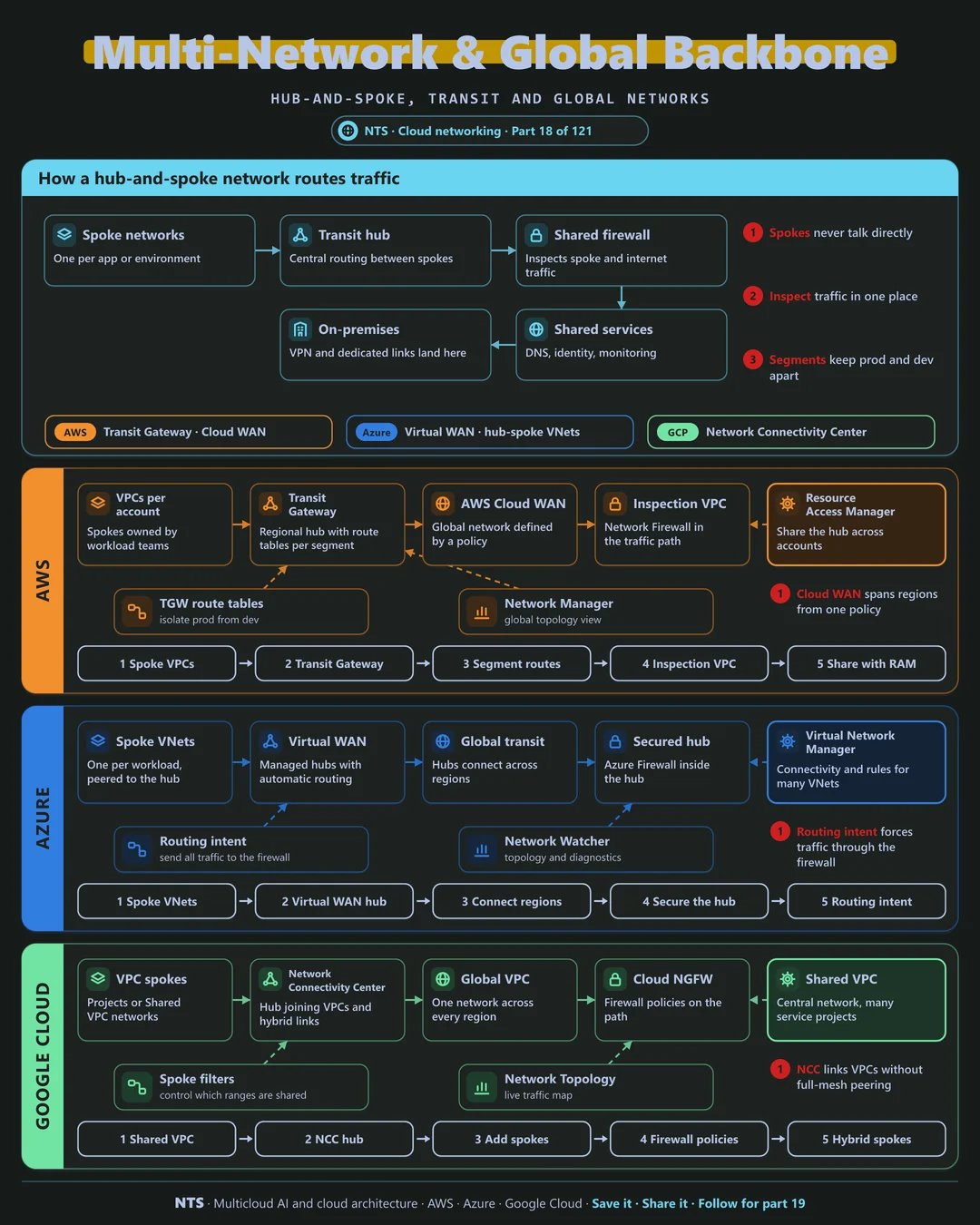
Workload networks become spokes that connect only to a central hub. The hub holds shared services, the firewall and hybrid connections. Spokes never talk directly; traffic between them passes through the hub, where it can be inspected and logged.
Segments and global backbones
Route tables in the hub create segments, keeping production, non-production and partners apart. Managed global backbones extend the same model across regions defined by a single policy.
AWS, Azure and Google Cloud compared
| AWS | Azure | Google Cloud | |
|---|---|---|---|
| Regional hub | Transit Gateway | Virtual WAN hub or hub VNet | Network Connectivity Center |
| Global backbone | AWS Cloud WAN | Virtual WAN global transit | Global VPC |
| Central inspection | Inspection VPC with Network Firewall | Secured hub with Azure Firewall | Cloud NGFW policies |
| Sharing across accounts | Resource Access Manager | Virtual Network Manager | Shared VPC |
| Segmentation | TGW route tables | Routing intent, route tables | Spoke filters, separate VPCs |
What makes each cloud different
AWS
AWS Transit Gateway is the regional hub, with route tables per segment and Resource Access Manager sharing it across accounts. AWS Cloud WAN defines a global network from one policy document, spanning regions automatically.
Azure
Azure Virtual WAN provides managed hubs with automatic routing, and a secured hub places Azure Firewall inside. Routing intent forces all traffic through the firewall, and Virtual Network Manager manages connectivity for many VNets centrally.
Google Cloud
Google Cloud's global VPC already spans regions, so many estates need fewer networks. Shared VPC centralizes networking for many projects, and Network Connectivity Center joins VPCs and hybrid links without full-mesh peering.
Design decisions that matter
- 01Hub and spoke from the start
Even with three networks, plan for thirty.
- 02Inspect east-west traffic
Spoke-to-spoke traffic passes the central firewall.
- 03Segment by environment
Production and non-production use separate routing domains.
- 04Automate spoke onboarding
New networks join the hub through code.
Common mistakes we see
- Full-mesh peering. Unmanageable beyond a handful of networks.
- Uninspected spoke-to-spoke traffic. Attackers move laterally unseen.
- Shared services in a spoke. Creates hidden dependencies between teams.
A practical 30-day plan
- Week 1
Map existing networks, peerings and traffic flows.
- Week 2
Build the hub with inspection and shared services.
- Week 3
Migrate spokes from peering to the hub.
- Week 4
Add segmentation and automate onboarding of new spokes.
How NTS helps
NTS designs multi-network architectures on AWS, Azure and Google Cloud: hubs, global backbones, central inspection and segmentation, plus migration from tangled peering meshes.
What you get
- A global network design across regions and clouds
- Transit or cloud WAN configuration
- Cross-cloud links with routing policies
- Network monitoring across the whole backbone
Typical outcomes
- Fast, predictable connectivity between regions
- Simpler routing with fewer moving parts
- Lower data transfer costs through better paths
How we work with you
- 1Assess
A focused review of your multi-network and global backbone across AWS, Azure and Google Cloud. We look for the gaps we find most often: full-mesh peering, uninspected spoke-to-spoke traffic and shared services in a spoke.
- 2Design
A target architecture and roadmap built on the decisions that matter most: hub and spoke from the start, inspect east-west traffic, segment by environment and automate spoke onboarding.
- 3Build
Hands-on delivery alongside your team. We map existing networks, peerings and traffic flows, build the hub with inspection and shared services, migrate spokes from peering to the hub, and finally add segmentation and automate onboarding of new spokes.
- 4Run and improve
We manage routing changes, capacity and costs as new regions and clouds join the network.
Why teams choose NTS for multi-network and global backbone
- Global scale experience
We design networks that span continents without becoming unmanageable.
- Cross-cloud by default
We connect AWS, Azure and Google Cloud with clean, documented routing.
- Simplicity at scale
We reduce peering sprawl into a few well-understood hubs.
Book a free 30-minute review
Talk to an NTS architect about your multi-network and global backbone on AWS, Azure and Google Cloud.