
Multicloud AI & ERP / Cloud Networking, Edge & Zero Trust for AI
Why it matters
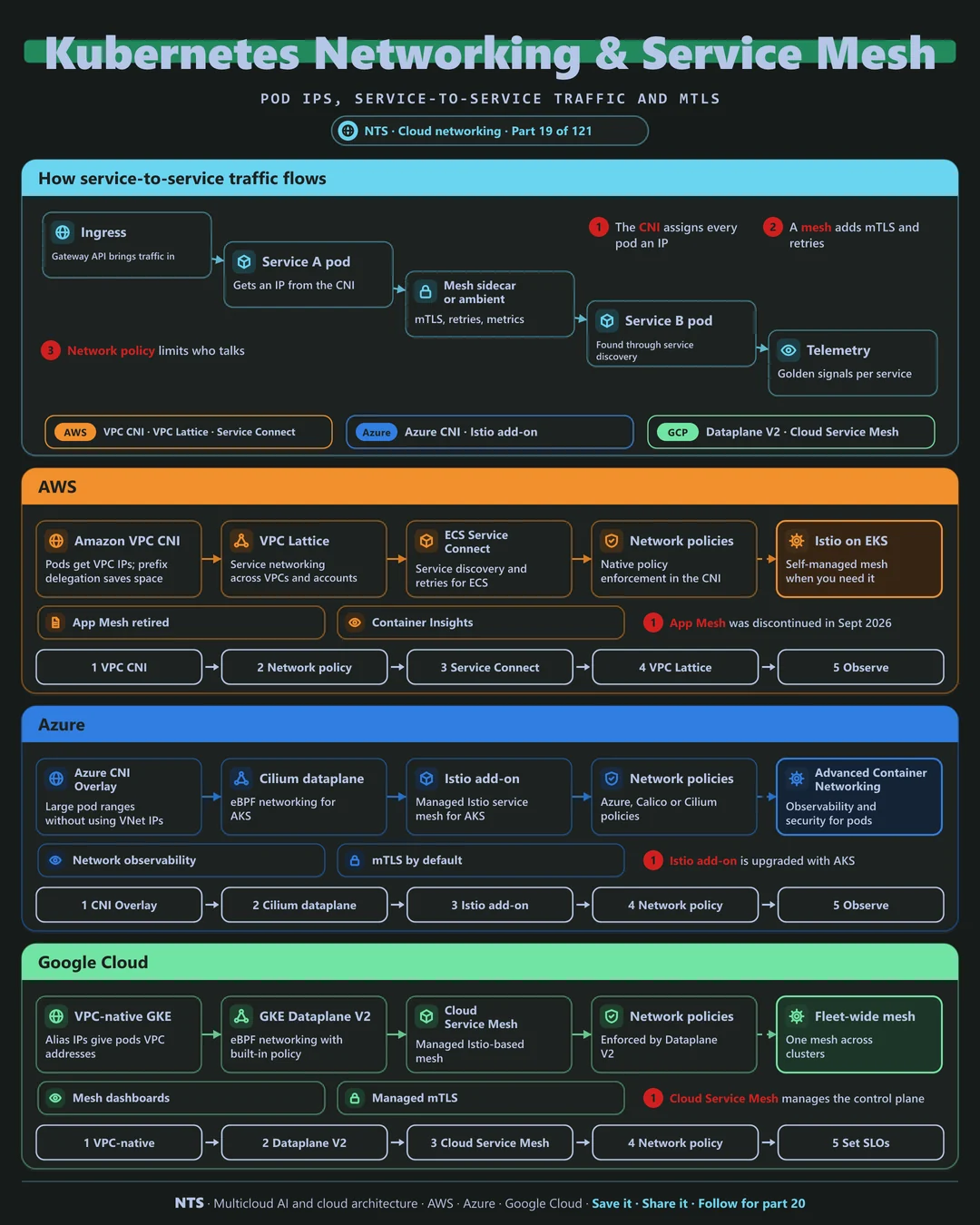
Kubernetes networking choices affect IP consumption, security and reliability. Without network policies any pod can reach any other, and without encryption between services, internal traffic is readable by anyone who gets a foothold.
How it works
Pod networking and policy
The CNI plugin gives each pod an IP address, either from the cloud network itself or from an overlay. Network policies then restrict which pods may talk to which, the Kubernetes equivalent of firewall rules.
Service mesh when you need it
A service mesh adds mutual TLS, retries, timeouts and traffic shifting to every call, plus golden-signal metrics per service. Sidecar and newer ambient designs both work. Add a mesh when you need those features across many services, not by default.
AWS, Azure and Google Cloud compared
| AWS | Azure | Google Cloud | |
|---|---|---|---|
| Pod networking | Amazon VPC CNI | Azure CNI Overlay, Cilium | VPC-native, Dataplane V2 |
| Network policy | VPC CNI network policies | Azure, Calico or Cilium policies | Dataplane V2 policies |
| Managed mesh | Istio (self-managed) | Istio add-on for AKS | Cloud Service Mesh |
| Service networking | VPC Lattice, ECS Service Connect | App Gateway for Containers | GKE Gateway |
| Retired option | App Mesh (discontinued 2026) | Open Service Mesh (retired) | Not applicable |
What makes each cloud different
AWS
On AWS the VPC CNI gives pods real VPC addresses, with prefix delegation to save space. AWS App Mesh was discontinued in September 2026; the replacements are ECS Service Connect for ECS and VPC Lattice for service-to-service connectivity, or a self-managed Istio for full mesh features.
Azure
AKS offers Azure CNI Overlay for large pod ranges, a Cilium dataplane with eBPF and the managed Istio add-on, which Microsoft upgrades with the cluster. Advanced Container Networking Services add flow logs and security per pod.
Google Cloud
GKE clusters are VPC-native by default, and Dataplane V2 brings eBPF networking with built-in policy enforcement. Cloud Service Mesh is Google's managed Istio-based mesh, with managed certificates and SLO dashboards per service.
Design decisions that matter
- 01Plan pod IP space
Use overlays or prefix delegation before IPs run out.
- 02Network policies from day one
Default deny, then allow what services need.
- 03Mesh only when justified
mTLS, retries and traffic shifting across many services.
- 04Retire App Mesh now
Move to Service Connect, VPC Lattice or Istio.
Common mistakes we see
- Running out of pod IPs. Clusters stop scheduling when subnets fill.
- No network policies. Every pod can reach every other pod.
- Mesh everywhere by default. Adds latency and operations cost without clear benefit.
A practical 30-day plan
- Week 1
Review IP usage, network policies and any App Mesh use.
- Week 2
Apply default-deny policies in non-production, then production.
- Week 3
Plan App Mesh migration or mesh adoption where justified.
- Week 4
Roll out mTLS and per-service golden-signal dashboards.
How NTS helps
NTS designs Kubernetes networking on EKS, AKS and GKE: CNI and IP planning, network policies, service mesh adoption and App Mesh migration, with observability built in.
What you get
- A CNI and ingress design for your clusters
- Network policies that isolate namespaces
- Service mesh with mTLS where it adds value
- Traffic management for canary releases
Typical outcomes
- Isolated workloads inside shared clusters
- Encrypted traffic between services
- Lower-risk releases with gradual rollouts
How we work with you
- 1Assess
A focused review of your Kubernetes networking and service mesh across AWS, Azure and Google Cloud. We look for the gaps we find most often: running out of pod IPs, no network policies and mesh everywhere by default.
- 2Design
A target architecture and roadmap built on the decisions that matter most: plan pod IP space, network policies from day one, mesh only when justified and retire App Mesh now.
- 3Build
Hands-on delivery alongside your team. We review IP usage, network policies and any App Mesh use, apply default-deny policies in non-production, then production, plan App Mesh migration or mesh adoption where justified, and finally roll out mTLS and per-service golden-signal dashboards.
- 4Run and improve
We upgrade networking components and the mesh safely, and tune policies as services change.
Why teams choose NTS for Kubernetes networking and service mesh
- Mesh only where it pays
We add a service mesh when it solves real problems, not by default.
- Zero trust inside clusters
mTLS and policies protect service-to-service traffic.
- Safer releases
Traffic splitting makes canary and blue-green deployments routine.
Book a free 30-minute review
Talk to an NTS architect about your Kubernetes networking and service mesh on AWS, Azure and Google Cloud.