
Multicloud AI & ERP / Cloud AI: Machine Learning & Generative AI
Why it matters
On-premises, inefficient code wasted capacity you had already paid for. In the cloud, every millisecond of function time and every database read is billed. A full scan that was merely slow becomes slow and expensive at scale.
How it works
From Big-O to the bill
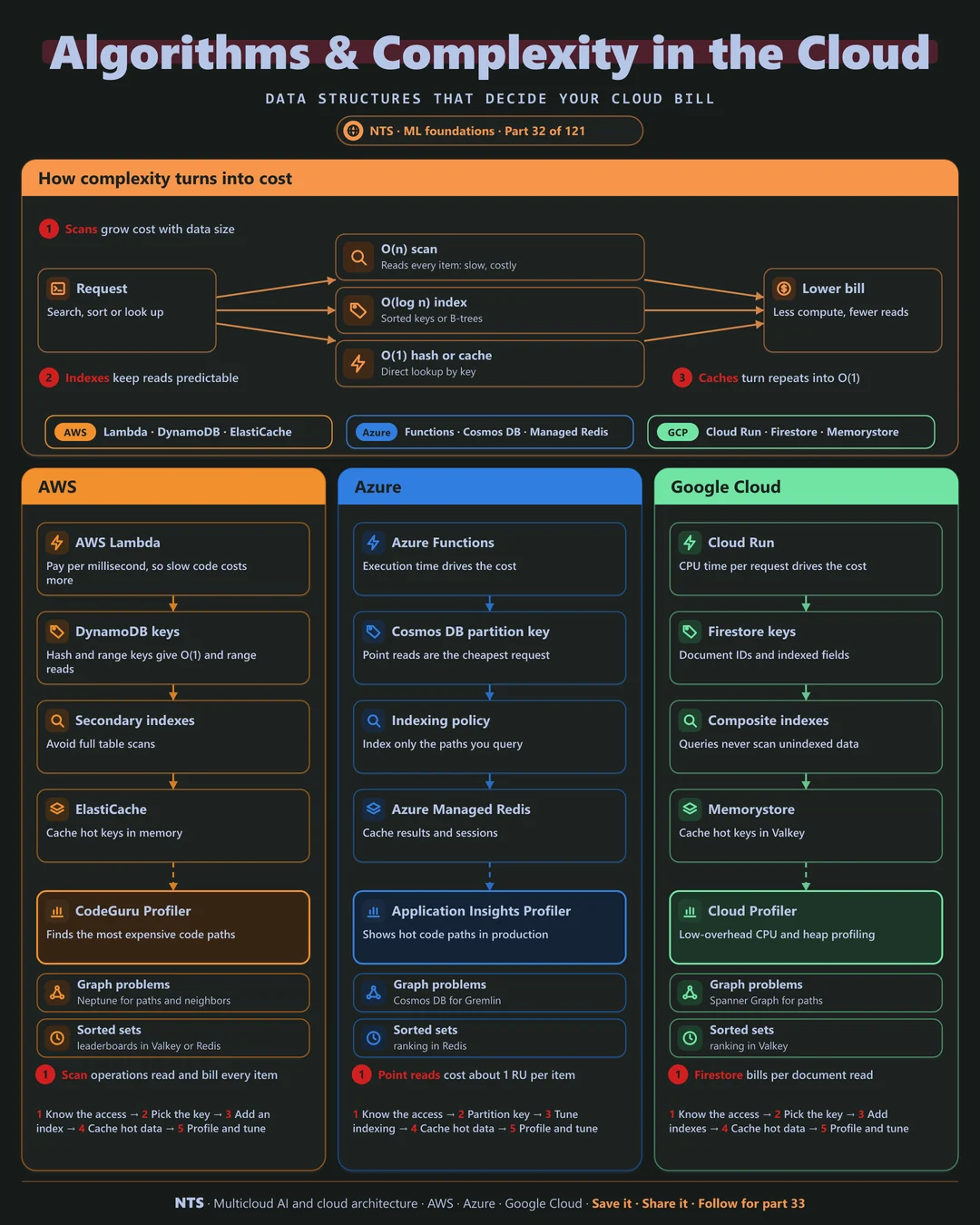
An O(n) scan reads every item, so cost grows with data size. An O(log n) index keeps reads predictable as data grows. An O(1) lookup by key or from a cache costs the same at a thousand items or a billion. Choosing the right structure is often the cheapest optimization available.
Profile before you resize
Continuous profilers show which functions consume CPU and memory in production. Fixing one hot path often saves more than doubling instance size would.
AWS, Azure and Google Cloud compared
| AWS | Azure | Google Cloud | |
|---|---|---|---|
| Pay-per-use compute | AWS Lambda | Azure Functions | Cloud Run |
| Key-value lookups | DynamoDB keys | Cosmos DB point reads | Firestore document IDs |
| Indexes | Secondary indexes | Indexing policy | Composite indexes |
| In-memory cache | ElastiCache | Azure Managed Redis | Memorystore |
| Production profiler | CodeGuru Profiler | Application Insights Profiler | Cloud Profiler |
What makes each cloud different
AWS
On AWS, DynamoDB Scan operations read and bill every item, while key and index queries read only what they need. Lambda bills per millisecond, so efficient code is directly cheaper, and CodeGuru Profiler highlights the most expensive code paths.
Azure
In Cosmos DB a point read by id and partition key is the cheapest operation, about one request unit, and indexing policies let you index only the paths you query. Application Insights Profiler captures hot paths from live traffic.
Google Cloud
Firestore bills per document read and refuses queries without a supporting index, which forces efficient design. Cloud Run bills CPU time per request, and Cloud Profiler adds low-overhead continuous profiling.
Design decisions that matter
- 01Design for the access pattern
Choose keys and indexes that answer each query directly.
- 02Cache repeated reads
Hot keys belong in memory.
- 03Profile in production
Optimize what real traffic exercises.
- 04Budget per request
Track cost per transaction, not just total spend.
Common mistakes we see
- Scans in hot paths. Costs climb with every new customer.
- Scaling up to hide slow code. Bigger instances multiply the waste.
- N+1 queries. One page triggers hundreds of database calls.
A practical 30-day plan
- Week 1
Turn on profiling for the top services.
- Week 2
Find the costliest queries and code paths.
- Week 3
Add indexes, caches and batching.
- Week 4
Measure cost per request before and after.
How NTS helps
NTS performance engineers profile cloud applications, fix the hot paths and redesign data access, typically cutting both latency and cost per request on AWS, Azure and Google Cloud.
What you get
- Profiling of slow and costly code paths
- Algorithm and data structure improvements
- Before-and-after cost and latency benchmarks
- Engineering guidelines for efficient code
Typical outcomes
- Faster applications
- Lower compute bills from efficient code
- Engineers who design with cost in mind
How we work with you
- 1Assess
A focused review of your performance and algorithm efficiency across AWS, Azure and Google Cloud. We look for the gaps we find most often: scans in hot paths, scaling up to hide slow code and n+1 queries.
- 2Design
A target architecture and roadmap built on the decisions that matter most: design for the access pattern, cache repeated reads, profile in production and budget per request.
- 3Build
Hands-on delivery alongside your team. We turn on profiling for the top services, find the costliest queries and code paths, add indexes, caches and batching, and finally measure cost per request before and after.
- 4Run and improve
We add performance checks to CI so regressions are caught before they reach production.
Why teams choose NTS for performance and algorithm efficiency
- Code is a cost driver
We show how inefficient code turns directly into cloud spend.
- Evidence-based tuning
Every change is measured with benchmarks.
- Lasting habits
We leave your team with tools and guidelines, not just fixes.
Book a free 30-minute review
Talk to an NTS architect about your performance and algorithm efficiency on AWS, Azure and Google Cloud.