
Multicloud AI & ERP / Cloud AI: Machine Learning & Generative AI
Why it matters
Churn, credit risk, demand, pricing and fraud scoring are tabular problems. Classical models train fast, run cheaply, explain their decisions and often outperform complex alternatives, which makes them the right starting point for most business ML.
How it works
How a classical model is built
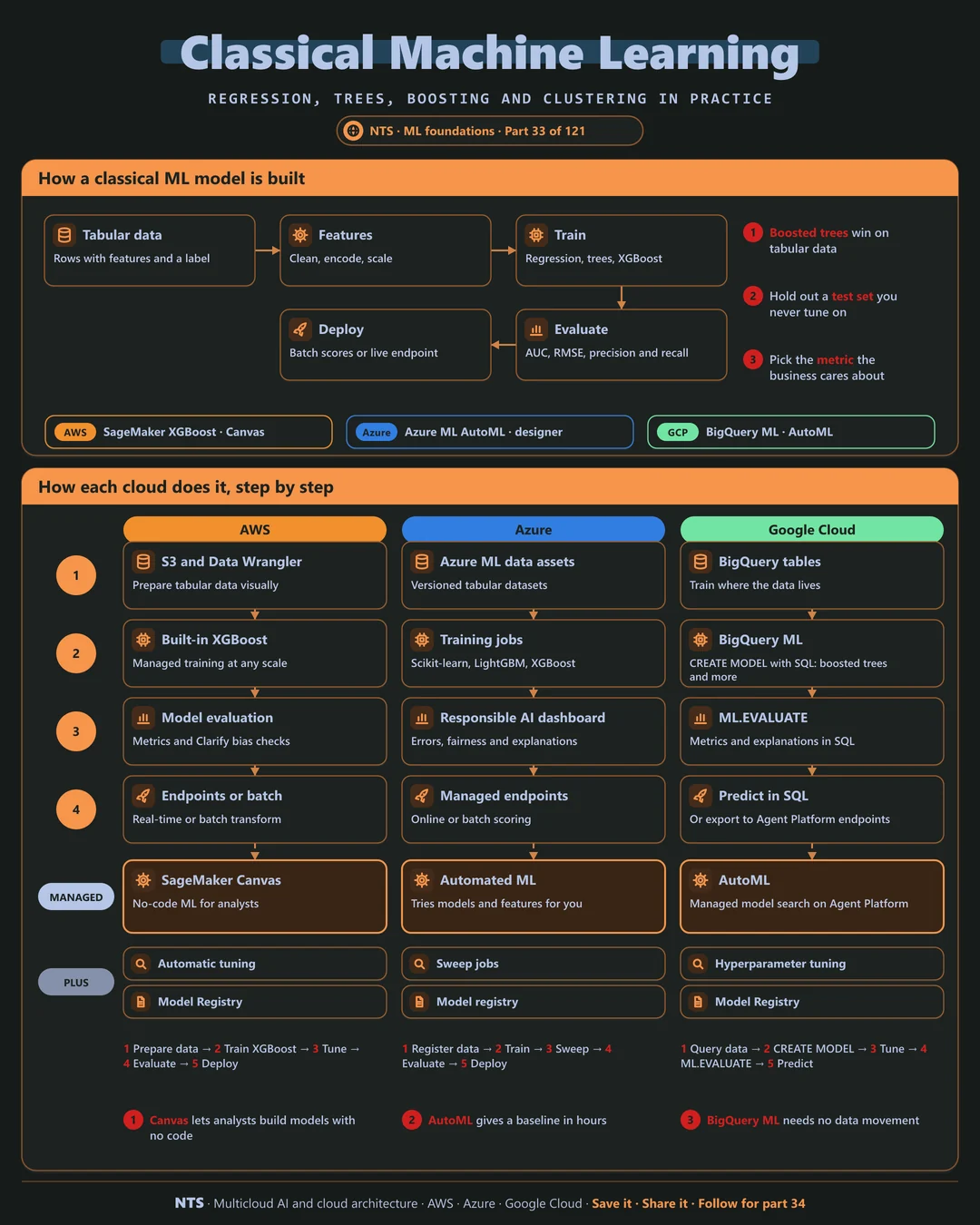
Start with tabular data: rows with features and a known outcome. Engineer features by cleaning, encoding and combining columns. Train regression, decision trees or boosted trees such as XGBoost and LightGBM, then evaluate on held-out data with metrics that match the business goal.
Pick the right metric
Accuracy misleads on imbalanced problems such as fraud. Precision, recall, AUC or error in currency terms usually tell the real story. Agree the metric with the business before training.
AWS, Azure and Google Cloud compared
| AWS | Azure | Google Cloud | |
|---|---|---|---|
| ML platform | SageMaker AI | Azure Machine Learning | Agent Platform (formerly Vertex AI) |
| Built-in boosting | SageMaker XGBoost | LightGBM and XGBoost in Azure ML | BigQuery ML boosted trees |
| No-code option | SageMaker Canvas | Azure ML designer, AutoML | AutoML |
| In-database ML | Redshift ML | Fabric data science | BigQuery ML |
| Tuning | Automatic model tuning | Sweep jobs | Hyperparameter tuning |
What makes each cloud different
AWS
SageMaker provides built-in XGBoost at any scale, automatic model tuning and Clarify for bias checks. SageMaker Canvas lets analysts build models without code and hand them to data scientists.
Azure
Azure Machine Learning runs scikit-learn, LightGBM and XGBoost jobs with MLflow tracking, and its Responsible AI dashboard adds error analysis, fairness and explanations in one place.
Google Cloud
BigQuery ML trains boosted trees, regression and clustering with SQL where the data already lives, with no data movement. Agent Platform, formerly Vertex AI, handles custom training and deployment.
Design decisions that matter
- 01Start with a strong simple baseline
Boosted trees before deep learning for tabular data.
- 02Agree the metric first
Tie it to business value.
- 03Hold out a test set
Never tune on the data you report results on.
- 04Train where the data lives
In-database ML avoids copies and pipelines.
Common mistakes we see
- Deep learning for small tabular data. More cost, less accuracy, no explanation.
- Data leakage. Features that secretly contain the answer inflate results.
- Accuracy on imbalanced data. Ninety-nine percent accuracy can mean zero fraud caught.
A practical 30-day plan
- Week 1
Define the prediction, the metric and the data.
- Week 2
Build features and a baseline model.
- Week 3
Tune boosted trees and check for leakage and bias.
- Week 4
Deploy for batch or real-time scoring and monitor.
How NTS helps
NTS data scientists build and deploy classical ML on AWS, Azure and Google Cloud, from churn and credit models to demand forecasts, with explainability and monitoring built in.
What you get
- Use-case selection based on business value
- Baseline models with clear metrics
- Feature pipelines and model training on your cloud
- Deployment and monitoring for production
Typical outcomes
- ML models delivering measurable value
- Explainable predictions business users trust
- A repeatable path from idea to production
How we work with you
- 1Assess
A focused review of your classical machine learning across AWS, Azure and Google Cloud. We look for the gaps we find most often: deep learning for small tabular data, data leakage and accuracy on imbalanced data.
- 2Design
A target architecture and roadmap built on the decisions that matter most: start with a strong simple baseline, agree the metric first, hold out a test set and train where the data lives.
- 3Build
Hands-on delivery alongside your team. We define the prediction, the metric and the data, build features and a baseline model, tune boosted trees and check for leakage and bias, and finally deploy for batch or real-time scoring and monitor.
- 4Run and improve
We monitor model performance, retrain on fresh data and expand to new use cases.
Why teams choose NTS for classical machine learning
- Simple models first
We start with proven, explainable methods before reaching for deep learning.
- Business metrics, not just accuracy
We measure the impact on revenue, cost or risk.
- Production-ready
Models ship with pipelines, monitoring and retraining.
Book a free 30-minute review
Talk to an NTS architect about your classical machine learning on AWS, Azure and Google Cloud.