
Multicloud AI & ERP / Cloud AI: Machine Learning & Generative AI
Why it matters
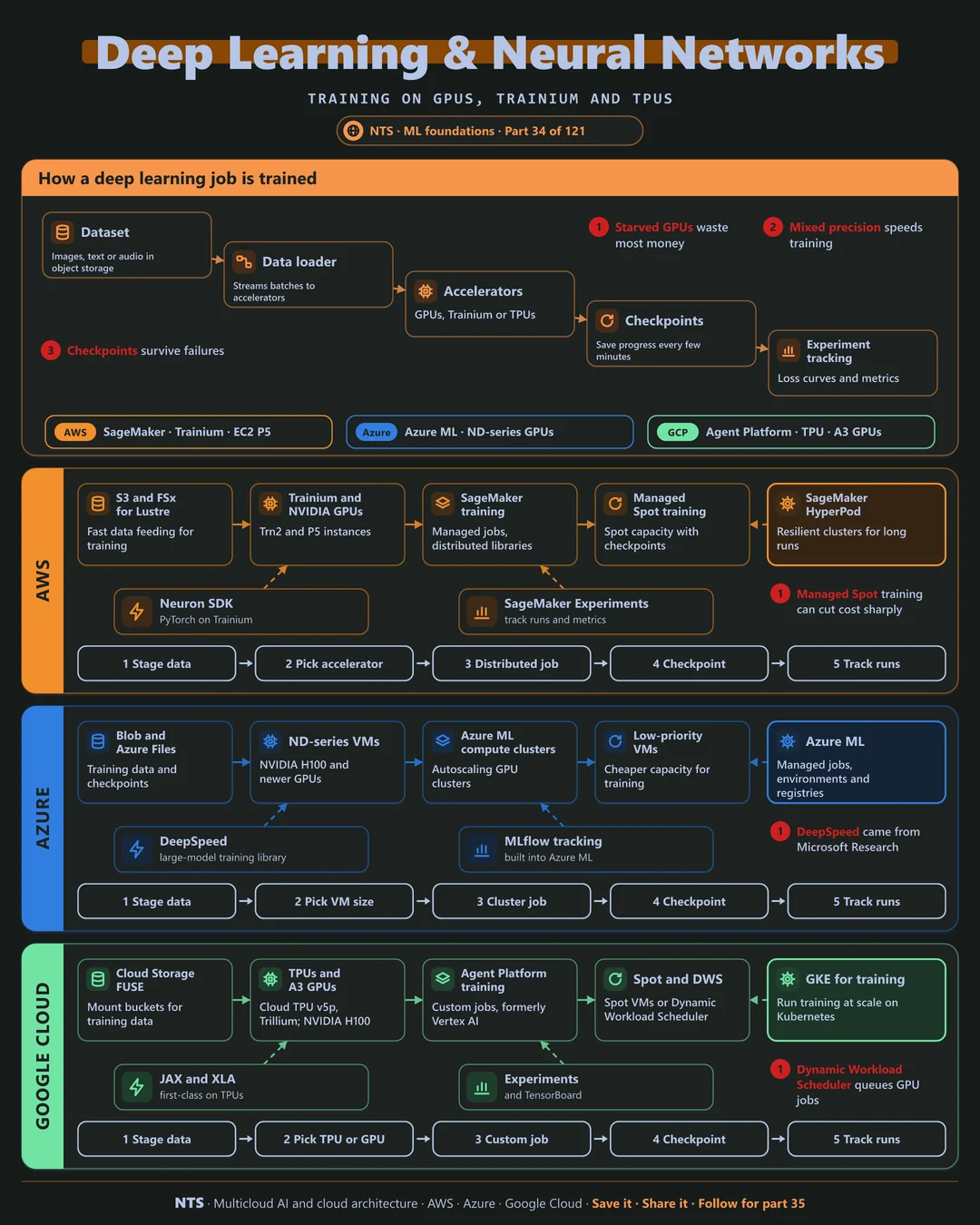
Training runs can consume thousands of accelerator hours. Idle GPUs waiting for data, the wrong chip for the framework or a crash without checkpoints can double the cost of a project.
How it works
Keeping accelerators busy
Data streams from object storage or a fast file system to the accelerators, which compute in parallel. The bottleneck is often the data loader, not the chip. Mixed precision, efficient formats and caching keep utilization high.
Resilience and tracking
Long runs fail. Checkpoints every few minutes mean a node failure costs minutes, not days. Experiment tracking records hyperparameters and loss curves so results can be compared and reproduced.
AWS, Azure and Google Cloud compared
| AWS | Azure | Google Cloud | |
|---|---|---|---|
| Managed training | SageMaker training jobs | Azure ML compute clusters | Agent Platform custom training |
| NVIDIA GPUs | P5 and P6 instances | ND-series VMs | A3 and A4 VMs |
| Custom accelerators | Trainium | Maia (in-house) | Cloud TPU |
| Fast training storage | FSx for Lustre | Azure Managed Lustre | Parallelstore, Managed Lustre |
| Cheaper capacity | Managed Spot training | Low-priority VMs | Spot VMs, Dynamic Workload Scheduler |
| Large-scale clusters | SageMaker HyperPod | Azure ML, CycleCloud | GKE, Cluster Director |
What makes each cloud different
AWS
AWS pairs NVIDIA GPUs with its own Trainium chips through the Neuron SDK, and SageMaker managed Spot training with checkpointing can sharply cut training cost. HyperPod adds resilient clusters for long runs.
Azure
Azure's ND-series VMs with InfiniBand networking power some of the largest training runs in the industry. Azure ML manages clusters and environments, and Microsoft's DeepSpeed library enables memory-efficient large-model training.
Google Cloud
Google offers Cloud TPUs alongside NVIDIA GPUs, with JAX and XLA as first-class frameworks and PyTorch support. Dynamic Workload Scheduler queues jobs until accelerators are available, often at lower cost.
Design decisions that matter
- 01Benchmark the accelerator for your model
Price per result, not price per hour.
- 02Feed the chips
Fast storage and an efficient data loader.
- 03Checkpoint frequently
Plan for failures in every long run.
- 04Use Spot or queued capacity for training
With checkpoints, interruptions are cheap.
Common mistakes we see
- Low GPU utilization. Paying for chips that wait on data.
- No checkpoints. A failure on day six restarts from day one.
- Training from scratch by default. Fine-tuning a foundation model is often enough.
A practical 30-day plan
- Week 1
Profile current training jobs for utilization and cost.
- Week 2
Fix the data pipeline and enable mixed precision.
- Week 3
Add checkpointing and move to Spot or queued capacity.
- Week 4
Benchmark an alternative accelerator.
How NTS helps
NTS optimizes deep learning training on AWS, Azure and Google Cloud: accelerator selection and benchmarking, data pipelines, distributed training and cost reduction with Spot and queued capacity.
What you get
- Model architecture choice for your data
- GPU training setups with cost controls
- Transfer learning from pretrained models
- Deployment with optimized inference
Typical outcomes
- Accurate models on images, text or signals
- Lower training costs
- Fast, efficient inference in production
How we work with you
- 1Assess
A focused review of your deep learning across AWS, Azure and Google Cloud. We look for the gaps we find most often: low GPU utilization, no checkpoints and training from scratch by default.
- 2Design
A target architecture and roadmap built on the decisions that matter most: benchmark the accelerator for your model, feed the chips, checkpoint frequently and use Spot or queued capacity for training.
- 3Build
Hands-on delivery alongside your team. We profile current training jobs for utilization and cost, fix the data pipeline and enable mixed precision, add checkpointing and move to Spot or queued capacity, and finally benchmark an alternative accelerator.
- 4Run and improve
We monitor drift, retrain models and optimize inference costs over time.
Why teams choose NTS for deep learning
- Pretrained first
We adapt existing models before training from scratch, saving time and money.
- GPU cost discipline
We right-size and schedule GPU use carefully.
- End-to-end delivery
From data to deployed endpoint, not just notebooks.
Book a free 30-minute review
Talk to an NTS architect about your deep learning on AWS, Azure and Google Cloud.