
Multicloud AI & ERP / Cloud AI: Machine Learning & Generative AI
Why it matters
Better forecasts mean less stock tied up, fewer shortages and right-sized capacity. Anomaly detection catches fraud, faults and runaway cloud costs within minutes instead of at month end.
How it works
Forecasting
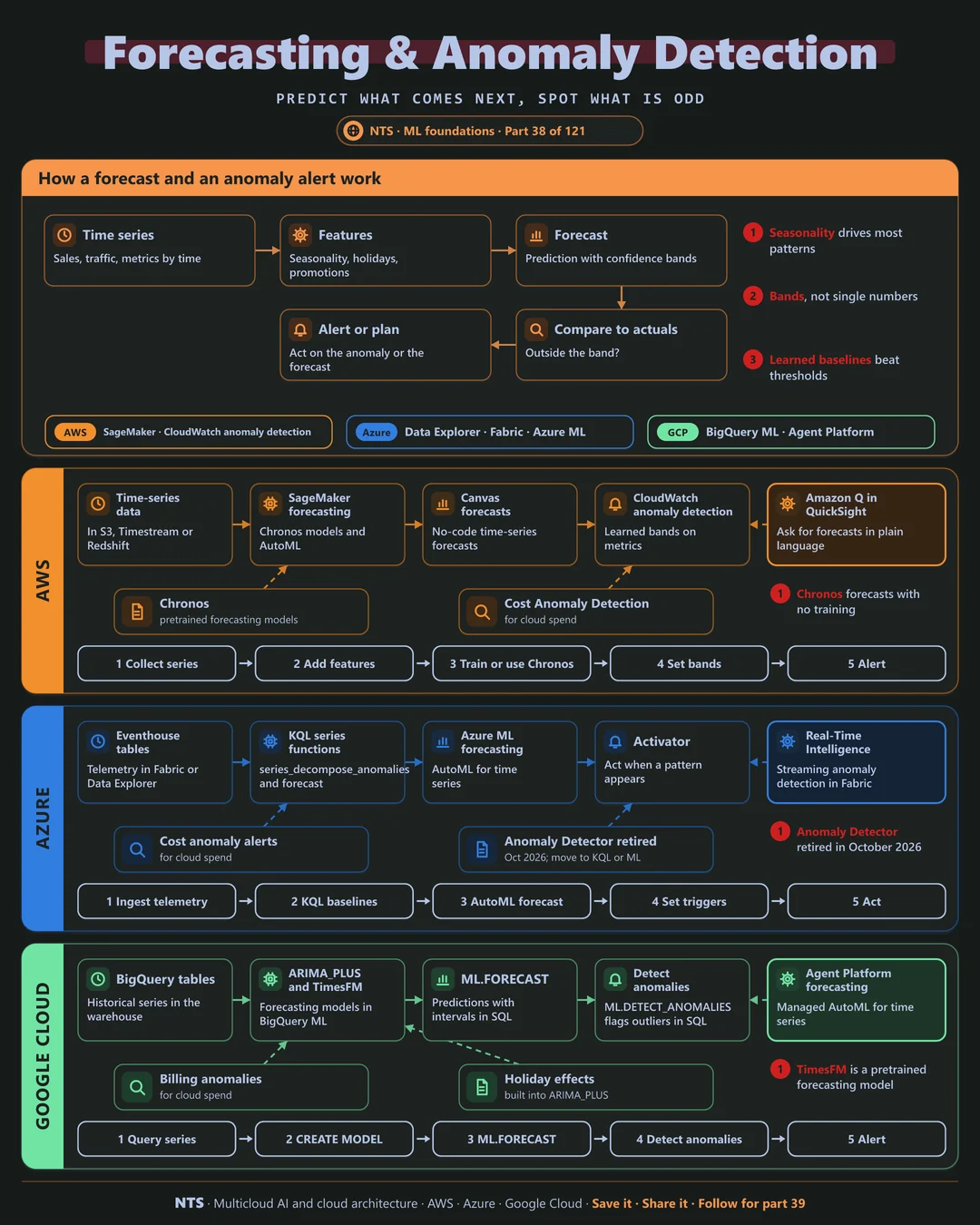
Historical time series plus known drivers such as holidays and promotions feed a model that predicts future values with confidence bands. Pretrained foundation models for time series now produce useful forecasts with no training at all.
Anomaly detection
Instead of fixed thresholds, a model learns the normal pattern including seasonality and alerts when actuals leave the expected band, reducing false alarms while catching real problems.
AWS, Azure and Google Cloud compared
| AWS | Azure | Google Cloud | |
|---|---|---|---|
| Pretrained forecasting | Chronos (SageMaker, Bedrock) | AutoML forecasting | TimesFM in BigQuery ML |
| SQL forecasting | Redshift ML | KQL series functions | ARIMA_PLUS, ML.FORECAST |
| Metric anomalies | CloudWatch anomaly detection | Azure Monitor dynamic thresholds | Cloud Monitoring alerting |
| Data anomalies | SageMaker models | KQL anomaly functions, Fabric | ML.DETECT_ANOMALIES |
| Spend anomalies | Cost Anomaly Detection | Cost Management anomaly alerts | Billing anomaly detection |
What makes each cloud different
AWS
AWS offers Chronos, a family of pretrained forecasting models, alongside SageMaker AutoML and no-code forecasting in SageMaker Canvas. CloudWatch anomaly detection learns bands on metrics automatically.
Azure
Azure AI Anomaly Detector was retired in October 2026. Its replacements are KQL time-series functions in Azure Data Explorer and Fabric, Fabric Real-Time Intelligence for streaming detection and Azure ML AutoML for forecasting.
Google Cloud
BigQuery ML forecasts with ARIMA_PLUS, including holiday effects, and TimesFM, Google's pretrained forecasting model, both from SQL. ML.DETECT_ANOMALIES flags outliers in the warehouse.
Design decisions that matter
- 01Bands, not single numbers
Plan with ranges and probabilities.
- 02Include known events
Holidays and promotions drive most errors.
- 03Learned baselines over fixed thresholds
Fewer false alarms.
- 04Migrate off Anomaly Detector
Plan the move to supported services.
Common mistakes we see
- Single-point forecasts. Planners cannot see risk.
- Fixed alert thresholds. Alerts fire every Monday morning.
- Retired APIs in production. Workloads stop when the service ends.
A practical 30-day plan
- Week 1
Pick one forecast and one anomaly use case.
- Week 2
Test a pretrained model against your current method.
- Week 3
Add known events and confidence bands.
- Week 4
Replace fixed thresholds with learned baselines.
How NTS helps
NTS builds forecasting and anomaly detection on AWS, Azure and Google Cloud, including migrations off Azure Anomaly Detector, using pretrained time-series models and in-warehouse ML.
What you get
- Forecast models for demand, capacity or revenue
- Anomaly detection on business and operational metrics
- Alerts that reach the right owners
- Accuracy tracking against actuals
Typical outcomes
- Better planning for inventory and capacity
- Problems spotted before customers notice
- Measured forecast accuracy
How we work with you
- 1Assess
A focused review of your forecasting and anomaly detection across AWS, Azure and Google Cloud. We look for the gaps we find most often: single-point forecasts, fixed alert thresholds and retired APIs in production.
- 2Design
A target architecture and roadmap built on the decisions that matter most: bands, not single numbers, include known events, learned baselines over fixed thresholds and migrate off Anomaly Detector.
- 3Build
Hands-on delivery alongside your team. We pick one forecast and one anomaly use case, test a pretrained model against your current method, add known events and confidence bands, and finally replace fixed thresholds with learned baselines.
- 4Run and improve
We monitor accuracy, retrain models and adjust thresholds as patterns change.
Why teams choose NTS for forecasting and anomaly detection
- Forecasts people plan with
We provide ranges and accuracy, not just single numbers.
- Fewer false alarms
We tune anomaly detection to what really matters.
- Built on your data platform
Models run where your data already lives.
Book a free 30-minute review
Talk to an NTS architect about your forecasting and anomaly detection on AWS, Azure and Google Cloud.