
Multicloud AI & ERP / Cloud AI: Machine Learning & Generative AI
Why it matters
Prompting and fine-tuning get a model most of the way. Feedback-based tuning closes the gap for tasks where quality is hard to define with examples alone, such as tone, safety, multi-step reasoning and tool use.
How it works
The feedback loop
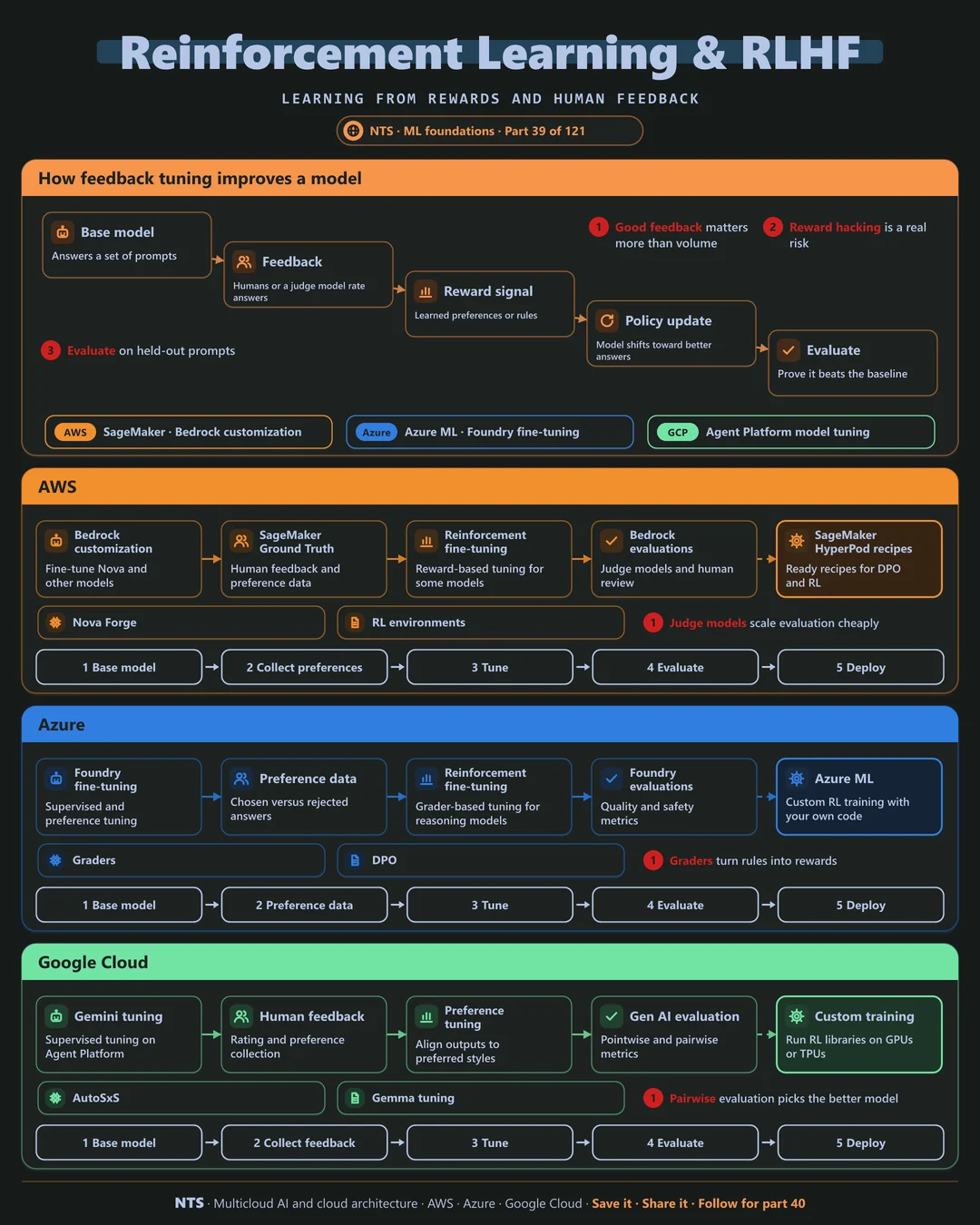
A base model answers a set of prompts. Humans or a judge model rate or compare the answers. Those preferences become a reward signal, and the model is updated to produce higher-reward answers. Evaluation on held-out prompts proves the gain.
Simpler variants
Direct preference optimization skips a separate reward model, and grader-based reinforcement fine-tuning turns rules or checks into rewards. Both are now available as managed services.
AWS, Azure and Google Cloud compared
| AWS | Azure | Google Cloud | |
|---|---|---|---|
| Managed tuning | Bedrock model customization | Foundry fine-tuning | Agent Platform tuning |
| Preference or RL tuning | Reinforcement fine-tuning (selected models) | Preference and reinforcement fine-tuning | Preference tuning |
| Feedback collection | SageMaker Ground Truth | Labeling in Azure ML | Human rating tools |
| Evaluation | Bedrock evaluations | Foundry evaluations | Gen AI evaluation service |
| Custom RL | SageMaker, HyperPod recipes | Azure ML | Custom training on GPUs or TPUs |
What makes each cloud different
AWS
AWS supports customization of Nova and other models in Bedrock, including reinforcement fine-tuning for selected models, Nova Forge for building custom Nova models, and HyperPod recipes for advanced techniques such as DPO.
Azure
Microsoft Foundry offers supervised, preference and reinforcement fine-tuning with graders that score answers automatically, plus evaluations for quality and safety before deployment.
Google Cloud
Agent Platform supports supervised and preference tuning for Gemini and Gemma, with pairwise evaluation to compare tuned and base models side by side.
Design decisions that matter
- 01Supervised tuning before RL
Simpler, cheaper, often enough.
- 02Quality feedback over quantity
A few hundred careful ratings beat thousands of noisy ones.
- 03Guard against reward hacking
Check that higher scores mean better answers.
- 04Evaluate on held-out prompts
Prove the gain before deploying.
Common mistakes we see
- Tuning before prompting well. Expensive fixes for prompt problems.
- Rewarding the wrong thing. Models learn to please the grader, not users.
- No regression checks. Gains on one task, losses on others.
A practical 30-day plan
- Week 1
Define the behavior to improve and the evaluation set.
- Week 2
Collect preferences or write graders.
- Week 3
Run supervised and preference tuning experiments.
- Week 4
Evaluate, check for regressions and deploy the winner.
How NTS helps
NTS helps teams customize models on Bedrock, Microsoft Foundry and Agent Platform, from feedback data design and graders to tuning runs and evaluation, with clear before-and-after evidence.
What you get
- A fit assessment for reinforcement learning use cases
- Simulation and reward design
- Preference tuning for language models
- Safety and evaluation checks
Typical outcomes
- Optimization of complex decisions
- Models aligned with your preferences and policies
- Safe, evaluated releases
How we work with you
- 1Assess
A focused review of your reinforcement learning and model alignment across AWS, Azure and Google Cloud. We look for the gaps we find most often: tuning before prompting well, rewarding the wrong thing and no regression checks.
- 2Design
A target architecture and roadmap built on the decisions that matter most: supervised tuning before RL, quality feedback over quantity, guard against reward hacking and evaluate on held-out prompts.
- 3Build
Hands-on delivery alongside your team. We define the behavior to improve and the evaluation set, collect preferences or write graders, run supervised and preference tuning experiments, and finally evaluate, check for regressions and deploy the winner.
- 4Run and improve
We monitor behavior in production and refine rewards and preferences over time.
Why teams choose NTS for reinforcement learning and model alignment
- Honest fit assessment
We tell you when simpler methods will do the job.
- Reward design experience
We avoid rewards that teach models the wrong behavior.
- Safety first
Every tuned model is evaluated before release.
Book a free 30-minute review
Talk to an NTS architect about your reinforcement learning and model alignment on AWS, Azure and Google Cloud.