
Multicloud AI & ERP / Cloud AI: Machine Learning & Generative AI
Why it matters
Regulators, customers and employees expect AI decisions to be fair and explainable, especially in lending, hiring, insurance and healthcare. Bias found after launch damages trust and can bring legal exposure.
How it works
Checks on every version
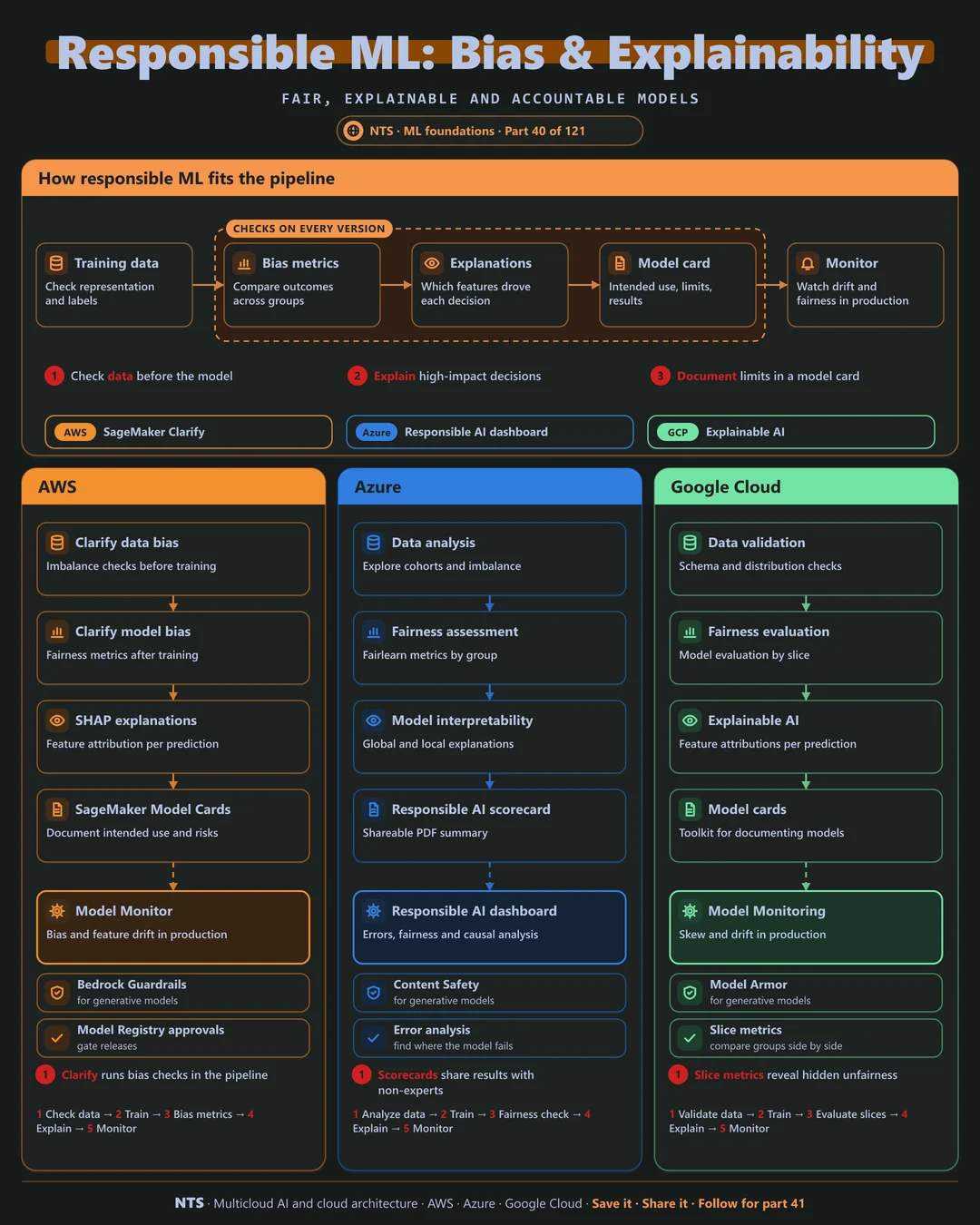
Check training data for representation and label quality. Measure bias metrics that compare outcomes across groups. Generate explanations that show which features drove each decision. Document intended use, limits and results in a model card, and monitor fairness and drift in production.
AWS, Azure and Google Cloud compared
| AWS | Azure | Google Cloud | |
|---|---|---|---|
| Bias detection | SageMaker Clarify | Fairness assessment (Fairlearn) | Model evaluation by slice |
| Explanations | Clarify SHAP values | Model interpretability | Explainable AI |
| Documentation | SageMaker Model Cards | Responsible AI scorecard | Model cards |
| Production monitoring | Model Monitor | Model monitoring | Model Monitoring |
| All-in-one view | Clarify reports | Responsible AI dashboard | Evaluation and monitoring |
What makes each cloud different
AWS
SageMaker Clarify detects bias in data before training and in models after training, and explains predictions with SHAP values. Model Cards document intended use and risks, and Model Monitor tracks bias drift in production.
Azure
Azure ML's Responsible AI dashboard combines error analysis, fairness, interpretability and causal analysis, and produces a shareable scorecard for non-technical stakeholders.
Google Cloud
Google Cloud's Explainable AI provides feature attributions per prediction, model evaluation supports slice metrics to compare groups, and Model Monitoring watches for skew and drift.
Design decisions that matter
- 01Bias checks in the pipeline
Every model version, automatically.
- 02Define protected groups and metrics upfront
With legal and business owners.
- 03Explain high-impact decisions
Per prediction, in plain language.
- 04Keep the evidence
Reports and model cards for audits.
Common mistakes we see
- A one-time review. Data and models drift after launch.
- Removing sensitive columns and assuming fairness. Proxies such as postcode carry the same signal.
- Explanations nobody can read. Technical charts do not satisfy customers or regulators.
A practical 30-day plan
- Week 1
Agree fairness metrics and groups for the top models.
- Week 2
Add bias checks and explanations to the pipeline.
- Week 3
Write model cards for production models.
- Week 4
Turn on fairness and drift monitoring.
How NTS helps
NTS builds responsible AI practices on AWS, Azure and Google Cloud: bias testing, explainability, model documentation and monitoring, aligned with regulations such as the EU AI Act.
What you get
- Bias testing across key groups
- Explainability reports for models
- Model cards and documentation
- A responsible AI review process
Typical outcomes
- Fairer, more explainable models
- Documentation ready for regulators
- Stakeholders who trust AI decisions
How we work with you
- 1Assess
A focused review of your responsible AI across AWS, Azure and Google Cloud. We look for the gaps we find most often: a one-time review, removing sensitive columns and assuming fairness and explanations nobody can read.
- 2Design
A target architecture and roadmap built on the decisions that matter most: bias checks in the pipeline, define protected groups and metrics upfront, explain high-impact decisions and keep the evidence.
- 3Build
Hands-on delivery alongside your team. We agree fairness metrics and groups for the top models, add bias checks and explanations to the pipeline, write model cards for production models, and finally turn on fairness and drift monitoring.
- 4Run and improve
We re-test models for bias and drift, and update documentation as models change.
Why teams choose NTS for responsible AI
- Trust is a requirement
We make fairness and explainability part of every AI project.
- Regulation-ready
We prepare documentation for the EU AI Act and industry rules.
- Practical tooling
We use built-in cloud tools so checks run automatically.
Book a free 30-minute review
Talk to an NTS architect about your responsible AI on AWS, Azure and Google Cloud.