
Multicloud AI & ERP / Cloud AI: Machine Learning & Generative AI
Why it matters
Contact centers and voice assistants are moving from rigid menus to natural conversations. Latency is the whole experience: a pause of two seconds feels broken, and callers expect to interrupt like they would with a person.
How it works
How a voice agent answers
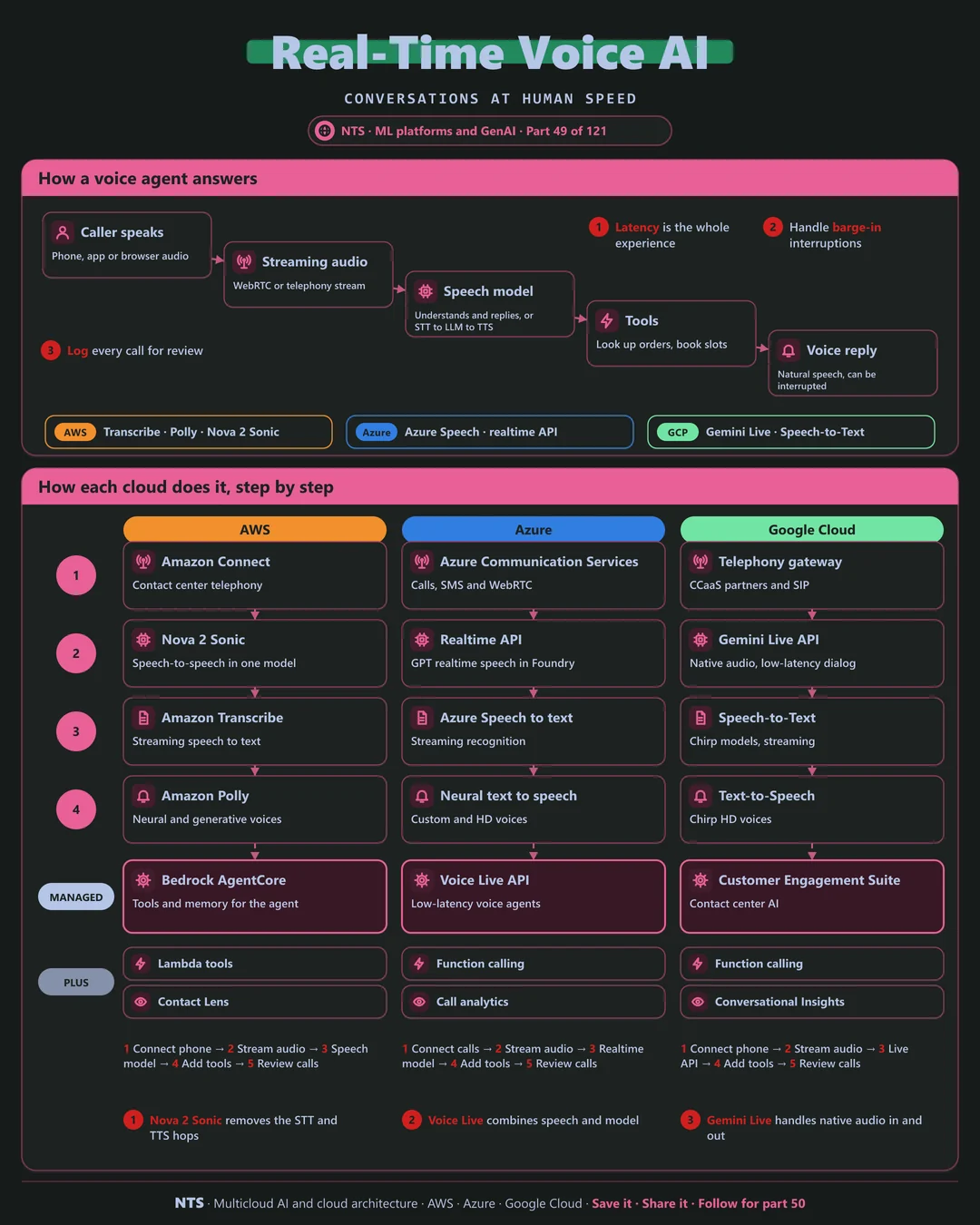
Audio streams in over telephony or WebRTC. A speech model understands and replies, either natively speech-to-speech or through speech-to-text, a language model and text-to-speech. Tools look up orders or book slots mid-call, and the agent responds in natural speech that can be interrupted.
AWS, Azure and Google Cloud compared
| AWS | Azure | Google Cloud | |
|---|---|---|---|
| Speech-to-speech model | Amazon Nova 2 Sonic | GPT realtime models in Foundry | Gemini Live API |
| Speech to text | Amazon Transcribe | Azure Speech to text | Speech-to-Text (Chirp) |
| Text to speech | Amazon Polly | Neural text to speech | Text-to-Speech (Chirp HD) |
| Contact center | Amazon Connect | Dynamics 365 Contact Center | Customer Engagement Suite |
| Call analytics | Contact Lens | Call analytics | Conversational Insights |
What makes each cloud different
AWS
Amazon Nova 2 Sonic handles speech-to-speech in a single model, Amazon Connect provides the contact center, and Contact Lens analyzes every call for sentiment and quality.
Azure
Azure offers realtime speech models in Microsoft Foundry and the Voice Live API for low-latency voice agents, with Azure Communication Services for calls and custom neural voices.
Google Cloud
The Gemini Live API handles native audio in and out with low-latency dialog, Chirp models power speech recognition and synthesis, and the Customer Engagement Suite runs contact center AI.
Design decisions that matter
- 01Measure end-to-end latency per turn
From end of speech to first audio.
- 02Design for interruptions
Barge-in must stop the agent instantly.
- 03Tools for real actions
Voice agents should resolve, not just talk.
- 04Review calls continuously
Analytics on every conversation.
Common mistakes we see
- Chaining slow services. Each hop adds hundreds of milliseconds.
- No human handoff. Frustrated callers with nowhere to go.
- Ignoring accents and noise. Test with real callers, not studio audio.
A practical 30-day plan
- Week 1
Pick one call type with clear outcomes.
- Week 2
Prototype with a speech-to-speech model.
- Week 3
Connect tools and human handoff.
- Week 4
Pilot with live calls and review analytics.
How NTS helps
NTS builds voice AI agents on Amazon Connect, Azure and Google's Customer Engagement Suite, from latency engineering and tool integration to handoff and call analytics.
What you get
- Real-time voice agents for calls or apps
- Speech recognition tuned to your vocabulary
- Low-latency architecture end to end
- Handoff to human agents with context
Typical outcomes
- Shorter wait times for callers
- More calls resolved automatically
- Agents freed for complex cases
How we work with you
- 1Assess
A focused review of your voice AI across AWS, Azure and Google Cloud. We look for the gaps we find most often: chaining slow services, no human handoff and ignoring accents and noise.
- 2Design
A target architecture and roadmap built on the decisions that matter most: measure end-to-end latency per turn, design for interruptions, tools for real actions and review calls continuously.
- 3Build
Hands-on delivery alongside your team. We pick one call type with clear outcomes, prototype with a speech-to-speech model, connect tools and human handoff, and finally pilot with live calls and review analytics.
- 4Run and improve
We review call quality, tune voice flows and add new intents over time.
Why teams choose NTS for voice AI
- Natural conversations
We design for low latency and interruptions, so calls feel human.
- Contact center experience
We integrate with your telephony and CRM systems.
- Safe by design
Guardrails and handoffs protect customers.
Book a free 30-minute review
Talk to an NTS architect about your voice AI on AWS, Azure and Google Cloud.