
Multicloud AI & ERP / Cloud AI: Machine Learning & Generative AI
Why it matters
Generative AI can produce harmful or off-brand content, be manipulated by crafted prompts and leak personal data. Guardrails reduce those risks consistently, across every model and application, and are increasingly expected by regulators.
How it works
Two checkpoints per call
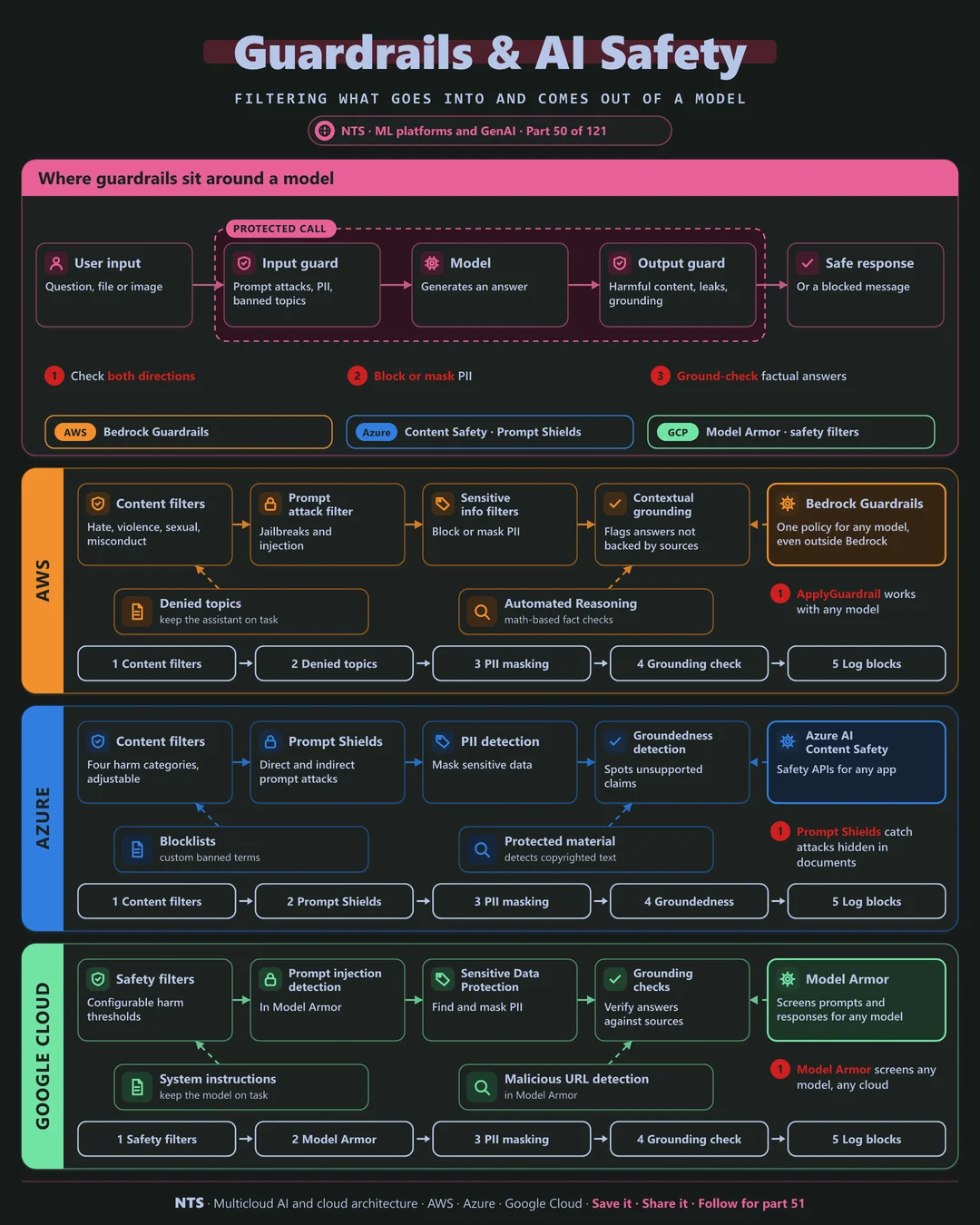
An input guard screens the user's prompt and any documents for attacks, personal data and banned topics. The model answers. An output guard checks for harmful content, leaks and claims not supported by sources, then returns a safe response or a polite refusal.
AWS, Azure and Google Cloud compared
| AWS | Azure | Google Cloud | |
|---|---|---|---|
| Guardrail service | Bedrock Guardrails | Azure AI Content Safety | Model Armor |
| Prompt attack detection | Prompt attack filter | Prompt Shields | Prompt injection detection |
| PII handling | Sensitive information filters | PII detection | Sensitive Data Protection |
| Grounding checks | Contextual grounding checks | Groundedness detection | Grounding checks |
| Works with other models | ApplyGuardrail API | Content Safety APIs | Model Armor for any model |
What makes each cloud different
AWS
Bedrock Guardrails combine content filters, denied topics, PII masking, contextual grounding and Automated Reasoning checks, and the ApplyGuardrail API protects models outside Bedrock too.
Azure
Azure AI Content Safety provides adjustable harm filters, Prompt Shields for direct and indirect attacks hidden in documents, groundedness detection and protected material detection.
Google Cloud
Model Armor screens prompts and responses for any model on any cloud, detecting injection, jailbreaks, sensitive data and malicious URLs, alongside Gemini's configurable safety filters.
Design decisions that matter
- 01Guard input and output
On every model, every call.
- 02Mask PII by default
Unmask only where justified.
- 03Check grounding for factual answers
Flag claims without sources.
- 04Log blocks
Tune filters from real data.
Common mistakes we see
- Guarding only the input. Harmful or leaked output still reaches users.
- Filters too strict. Users abandon an assistant that refuses everything.
- Different rules per app. Inconsistent protection across the estate.
A practical 30-day plan
- Week 1
Define content, topic and PII policies with legal and brand teams.
- Week 2
Apply guardrails to all model calls through a shared layer.
- Week 3
Add grounding checks for knowledge assistants.
- Week 4
Review blocked logs and tune thresholds.
How NTS helps
NTS implements AI guardrails across Bedrock, Microsoft Foundry and Agent Platform, with central policy, PII protection, grounding checks and tuning from real usage.
What you get
- Input and output guardrails for every AI application
- PII detection and redaction
- Topic and content policies
- Monitoring of blocked and flagged requests
Typical outcomes
- AI applications that stay on topic and on policy
- Sensitive data protected
- Confidence to launch AI publicly
How we work with you
- 1Assess
A focused review of your AI guardrails and safety across AWS, Azure and Google Cloud. We look for the gaps we find most often: guarding only the input, filters too strict and different rules per app.
- 2Design
A target architecture and roadmap built on the decisions that matter most: guard input and output, mask PII by default, check grounding for factual answers and log blocks.
- 3Build
Hands-on delivery alongside your team. We define content, topic and PII policies with legal and brand teams, apply guardrails to all model calls through a shared layer, add grounding checks for knowledge assistants, and finally review blocked logs and tune thresholds.
- 4Run and improve
We review flagged traffic, update policies and test guardrails against new attack patterns.
Why teams choose NTS for AI guardrails and safety
- Safety without blocking value
We tune guardrails so useful requests still pass.
- Layered protection
We combine cloud guardrails with application-level checks.
- Audit-ready
Every blocked request is logged and reviewable.
Book a free 30-minute review
Talk to an NTS architect about your AI guardrails and safety on AWS, Azure and Google Cloud.