
Multicloud AI & ERP / Cloud AI: Machine Learning & Generative AI
Why it matters
AI behavior changes with every prompt edit, model upgrade and data refresh. Without evaluation, teams ship regressions they cannot see and argue about quality without evidence.
How it works
How an evaluation run works
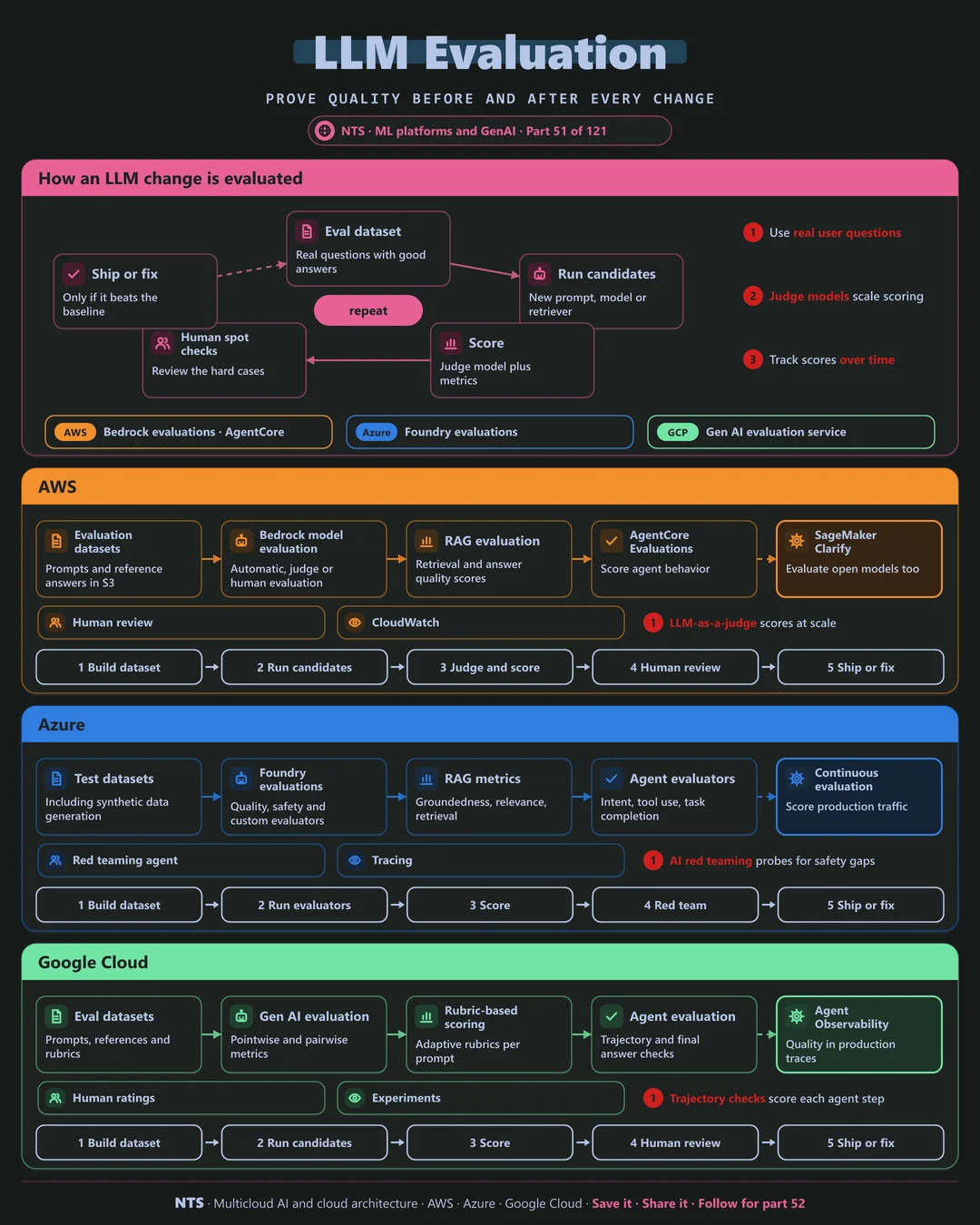
Keep an evaluation dataset of real questions with good answers. Run each candidate (a new prompt, model or retriever) against it. Score with metrics and a judge model, have humans check the hard cases, and ship only if it beats the baseline.
Agents need step-level checks
For agents, evaluate the trajectory as well as the final answer: did it call the right tools, in the right order, with the right inputs?
AWS, Azure and Google Cloud compared
| AWS | Azure | Google Cloud | |
|---|---|---|---|
| Evaluation service | Bedrock evaluations | Foundry evaluations | Gen AI evaluation service |
| Judge models | LLM-as-a-judge | AI-assisted evaluators | Pointwise and pairwise metrics |
| RAG metrics | Retrieval and answer quality | Groundedness, relevance | Grounding and quality metrics |
| Agent evaluation | AgentCore Evaluations | Agent evaluators | Trajectory evaluation |
| Safety testing | Guardrail testing | AI red teaming agent | Red teaming with Model Armor |
What makes each cloud different
AWS
Bedrock evaluations support automatic metrics, LLM-as-a-judge and human review, plus RAG evaluation for knowledge bases. AgentCore Evaluations score agent behavior.
Azure
Foundry provides quality, safety and custom evaluators, continuous evaluation of production traffic and an AI red teaming agent that probes applications for safety gaps.
Google Cloud
Google's Gen AI evaluation service offers pointwise and pairwise metrics with adaptive rubrics and trajectory evaluation that scores each step an agent takes.
Design decisions that matter
- 01Real questions in the eval set
Sampled from users, refreshed regularly.
- 02Gate releases on scores
Like unit tests for AI.
- 03Judges plus humans
Scale with judges, calibrate with people.
- 04Track scores over time
Spot drift between releases.
Common mistakes we see
- Vibes-based testing. A few manual chats before release.
- Synthetic-only data. Misses what real users actually ask.
- Uncalibrated judge models. Scores that do not match human opinion.
A practical 30-day plan
- Week 1
Collect 100 real questions with reference answers.
- Week 2
Set up automated scoring with a judge model.
- Week 3
Calibrate the judge against human ratings.
- Week 4
Make evaluation a release gate in CI/CD.
How NTS helps
NTS builds LLM evaluation pipelines on Bedrock, Microsoft Foundry and Agent Platform, covering datasets, judge calibration, agent trajectory checks and release gates, so quality is measured, not guessed.
What you get
- Evaluation datasets built from real use cases
- Automated quality, safety and faithfulness scoring
- Evaluation gates in your CI/CD pipeline
- Dashboards comparing models and prompts
Typical outcomes
- Fewer AI quality regressions
- Faster, safer model and prompt updates
- Proof of quality for stakeholders
How we work with you
- 1Assess
A focused review of your LLM evaluation across AWS, Azure and Google Cloud. We look for the gaps we find most often: vibes-based testing, synthetic-only data and uncalibrated judge models.
- 2Design
A target architecture and roadmap built on the decisions that matter most: real questions in the eval set, gate releases on scores, judges plus humans and track scores over time.
- 3Build
Hands-on delivery alongside your team. We collect 100 real questions with reference answers, set up automated scoring with a judge model, calibrate the judge against human ratings, and finally make evaluation a release gate in CI/CD.
- 4Run and improve
We grow test sets from production feedback and run evaluations on every change.
Why teams choose NTS for LLM evaluation
- Quality you can measure
We replace gut feel with repeatable scores.
- Release with confidence
Every change is tested before it reaches users.
- Model changes made easy
Evaluations make switching models a data-driven decision.
Book a free 30-minute review
Talk to an NTS architect about your LLM evaluation on AWS, Azure and Google Cloud.