
Multicloud AI & ERP / Agentic AI & Cloud AI Infrastructure
Why it matters
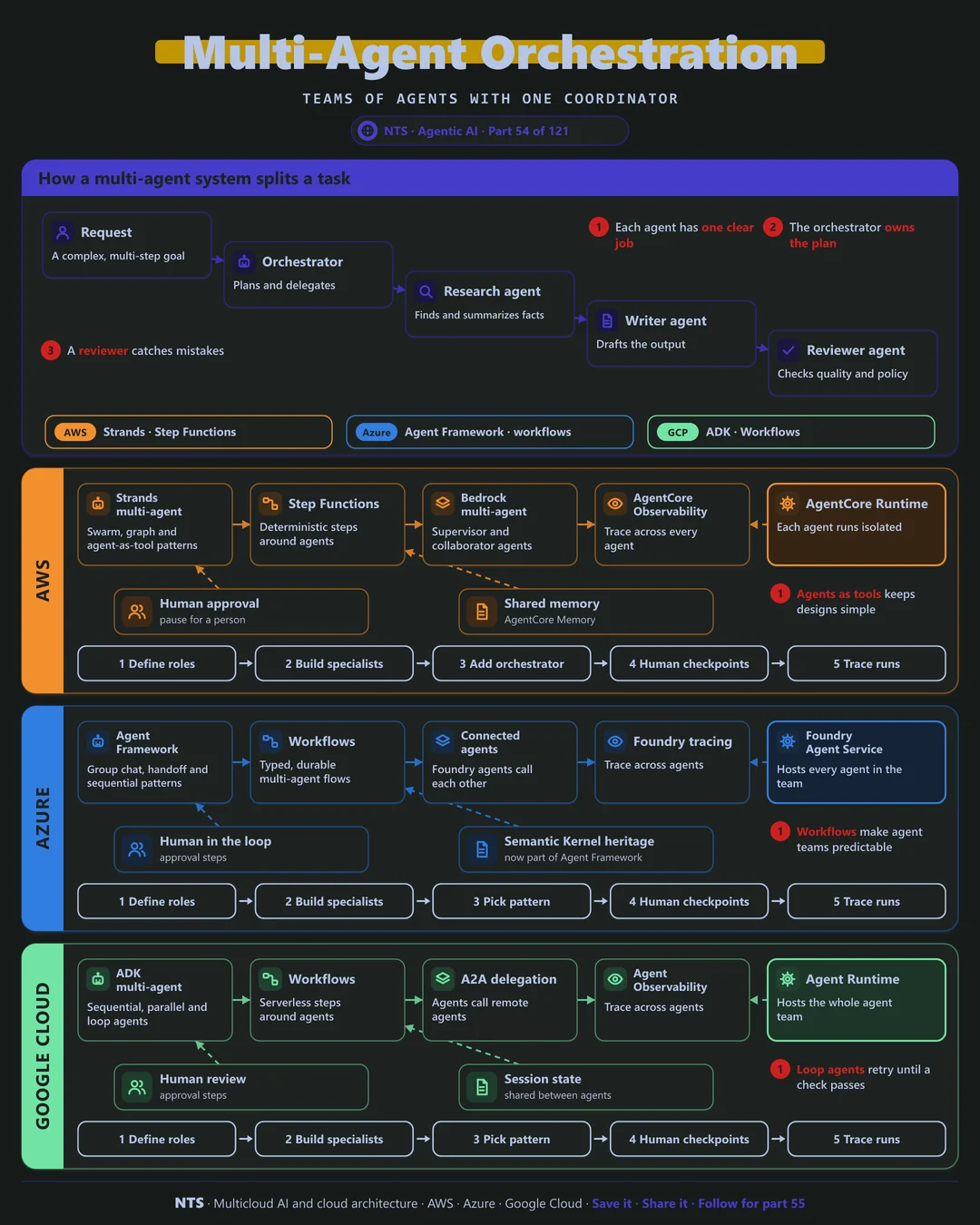
Complex work such as research reports, claims handling or software changes has distinct steps. Splitting them across specialist agents improves accuracy, makes failures easier to locate and lets each agent be tested on its own.
How it works
Orchestrator and specialists
An orchestrator plans the work and delegates. A research agent gathers facts, a writer agent drafts and a reviewer agent checks quality and policy. Clear handoffs and shared state keep the team aligned, and humans approve at key checkpoints.
Patterns
Common patterns include sequential pipelines, parallel fan-out, hierarchical delegation, group chat and loop-until-pass with a reviewer. Deterministic workflow steps around agents add predictability where it matters.
AWS, Azure and Google Cloud compared
| AWS | Azure | Google Cloud | |
|---|---|---|---|
| Multi-agent SDK | Strands (swarm, graph, agent-as-tool) | Agent Framework (group chat, handoff) | ADK (sequential, parallel, loop) |
| Deterministic workflows | Step Functions | Agent Framework workflows, Logic Apps | Workflows |
| Managed hosting | AgentCore Runtime | Foundry Agent Service | Agent Runtime |
| Cross-agent tracing | AgentCore Observability | Foundry tracing | Agent Observability |
| Remote delegation | A2A | A2A, connected agents | A2A |
What makes each cloud different
AWS
Strands Agents supports swarm, graph and agent-as-tool patterns, Step Functions wraps agents in deterministic steps, and AgentCore isolates and traces each agent in the team.
Azure
The Microsoft Agent Framework offers group chat, handoff and sequential orchestration plus typed, durable workflows, bringing Semantic Kernel and AutoGen ideas together.
Google Cloud
ADK provides sequential, parallel and loop agents out of the box, with loop agents retrying until a check passes, and A2A lets agents call remote specialists.
Design decisions that matter
- 01One clear job per agent
Narrow scope, fewer tools.
- 02The orchestrator owns the plan
Specialists do not freelance.
- 03A reviewer agent before output
Catches errors and policy breaks.
- 04Deterministic steps where possible
Use agents only where judgment is needed.
Common mistakes we see
- Agents talking without structure. Endless loops and runaway costs.
- No shared state. Agents repeat or contradict each other.
- Testing only end to end. Failures cannot be traced to an agent.
A practical 30-day plan
- Week 1
Break the process into roles and handoffs.
- Week 2
Build and test each specialist alone.
- Week 3
Add the orchestrator and reviewer.
- Week 4
Add human checkpoints and trace the full run.
How NTS helps
NTS architects multi-agent systems on AWS, Azure and Google Cloud, choosing patterns, building specialist agents and adding the controls, tracing and human checkpoints that make them dependable.
What you get
- Architecture for supervisor and specialist agents
- Workflow design with clear handoffs
- Cost and loop limits
- Tracing across every agent step
Typical outcomes
- Complex workflows automated reliably
- Controlled agent costs
- Easy debugging of agent behavior
How we work with you
- 1Assess
A focused review of your multi-agent systems across AWS, Azure and Google Cloud. We look for the gaps we find most often: agents talking without structure, no shared state and testing only end to end.
- 2Design
A target architecture and roadmap built on the decisions that matter most: one clear job per agent, the orchestrator owns the plan, a reviewer agent before output and deterministic steps where possible.
- 3Build
Hands-on delivery alongside your team. We break the process into roles and handoffs, build and test each specialist alone, add the orchestrator and reviewer, and finally add human checkpoints and trace the full run.
- 4Run and improve
We monitor traces, tune agent roles and improve workflows as needs grow.
Why teams choose NTS for multi-agent systems
- Only as complex as needed
We use multiple agents only when one is not enough.
- Predictable behavior
Clear roles and limits prevent endless loops and runaway costs.
- Full visibility
Tracing shows exactly what each agent did and why.
Book a free 30-minute review
Talk to an NTS architect about your multi-agent systems on AWS, Azure and Google Cloud.