
Multicloud AI & ERP / Cloud AI Applications & Industry AI Solutions
Why it matters
Most AI prototypes never reach production because the surrounding engineering is missing. Rate limits, model outages, cost spikes and security reviews all hit at once when real users arrive.
How it works
The production path
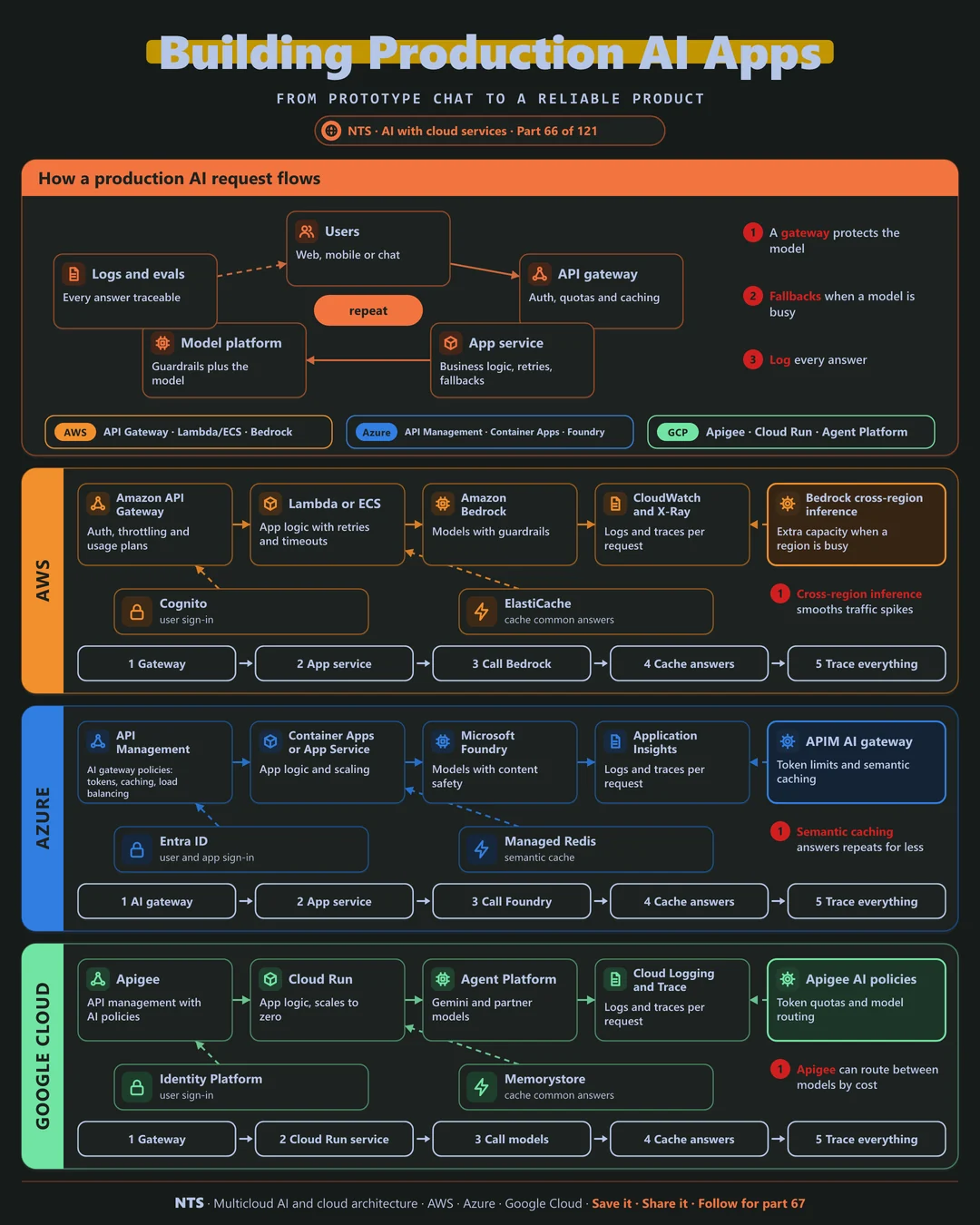
Users reach an API gateway that handles authentication, quotas and caching. An app service holds business logic with retries, timeouts and fallbacks to another model or region. The model platform applies guardrails, and logs and evaluations make every answer traceable.
AWS, Azure and Google Cloud compared
| AWS | Azure | Google Cloud | |
|---|---|---|---|
| API gateway | Amazon API Gateway | Azure API Management (AI gateway) | Apigee |
| App hosting | Lambda, ECS, App Runner | Container Apps, App Service | Cloud Run |
| Model platform | Amazon Bedrock | Microsoft Foundry | Agent Platform |
| Semantic cache | ElastiCache | APIM semantic caching, Managed Redis | Memorystore |
| Capacity resilience | Cross-region inference | Load balancing across deployments | Global endpoint |
What makes each cloud different
AWS
On AWS, API Gateway fronts Lambda or ECS services that call Bedrock, and cross-region inference spreads requests across regions automatically when one is busy.
Azure
Azure API Management works as an AI gateway with token limits, semantic caching and load balancing across Foundry deployments, in front of Container Apps or App Service.
Google Cloud
On Google Cloud, Apigee applies AI policies such as token quotas and model routing, Cloud Run hosts the app and the Gemini global endpoint routes to available capacity.
Design decisions that matter
- 01Gateway in front of every model call
Auth, quotas, caching and logs.
- 02Fallbacks for capacity
Another region or model when the first is busy.
- 03Timeouts and retries with backoff
Never let one slow call hang the app.
- 04Feature flags for AI
Turn features off without a deploy.
Common mistakes we see
- Calling models directly from the frontend. Keys exposed and no control.
- No fallback. A provider incident becomes your outage.
- No cost limits. One loop can burn a monthly budget.
A practical 30-day plan
- Week 1
Put a gateway in front of model calls.
- Week 2
Add retries, timeouts and fallbacks.
- Week 3
Add caching and quotas per client.
- Week 4
Add tracing, evaluations and feature flags.
How NTS helps
NTS takes AI prototypes to production on AWS, Azure and Google Cloud, adding gateways, resilience patterns, cost controls, security and observability, so launches go smoothly.
What you get
- A reference architecture for your AI application
- Security, guardrails and evaluation built in
- Scalable, observable deployment
- A launch readiness review
Typical outcomes
- AI applications that launch on time
- Reliable performance under real load
- Users who trust the results
How we work with you
- 1Assess
A focused review of your production AI applications across AWS, Azure and Google Cloud. We look for the gaps we find most often: calling models directly from the frontend, no fallback and no cost limits.
- 2Design
A target architecture and roadmap built on the decisions that matter most: gateway in front of every model call, fallbacks for capacity, timeouts and retries with backoff and feature flags for AI.
- 3Build
Hands-on delivery alongside your team. We put a gateway in front of model calls, add retries, timeouts and fallbacks, add caching and quotas per client, and finally add tracing, evaluations and feature flags.
- 4Run and improve
We support the application after launch, improving quality, cost and features.
Why teams choose NTS for production AI applications
- From prototype to production
We close the gap that stops most AI pilots from launching.
- Complete engineering
Security, testing, monitoring and cost are all covered.
- Proven patterns
We reuse designs that have worked in production.
Book a free 30-minute review
Talk to an NTS architect about your production AI applications on AWS, Azure and Google Cloud.