
Multicloud AI & ERP / Cloud AI Applications & Industry AI Solutions
Why it matters
A fraud decision after settlement is too late; a recommendation after the visitor leaves is wasted. Scoring events in real time turns AI from reporting into action.
How it works
Scoring in real time
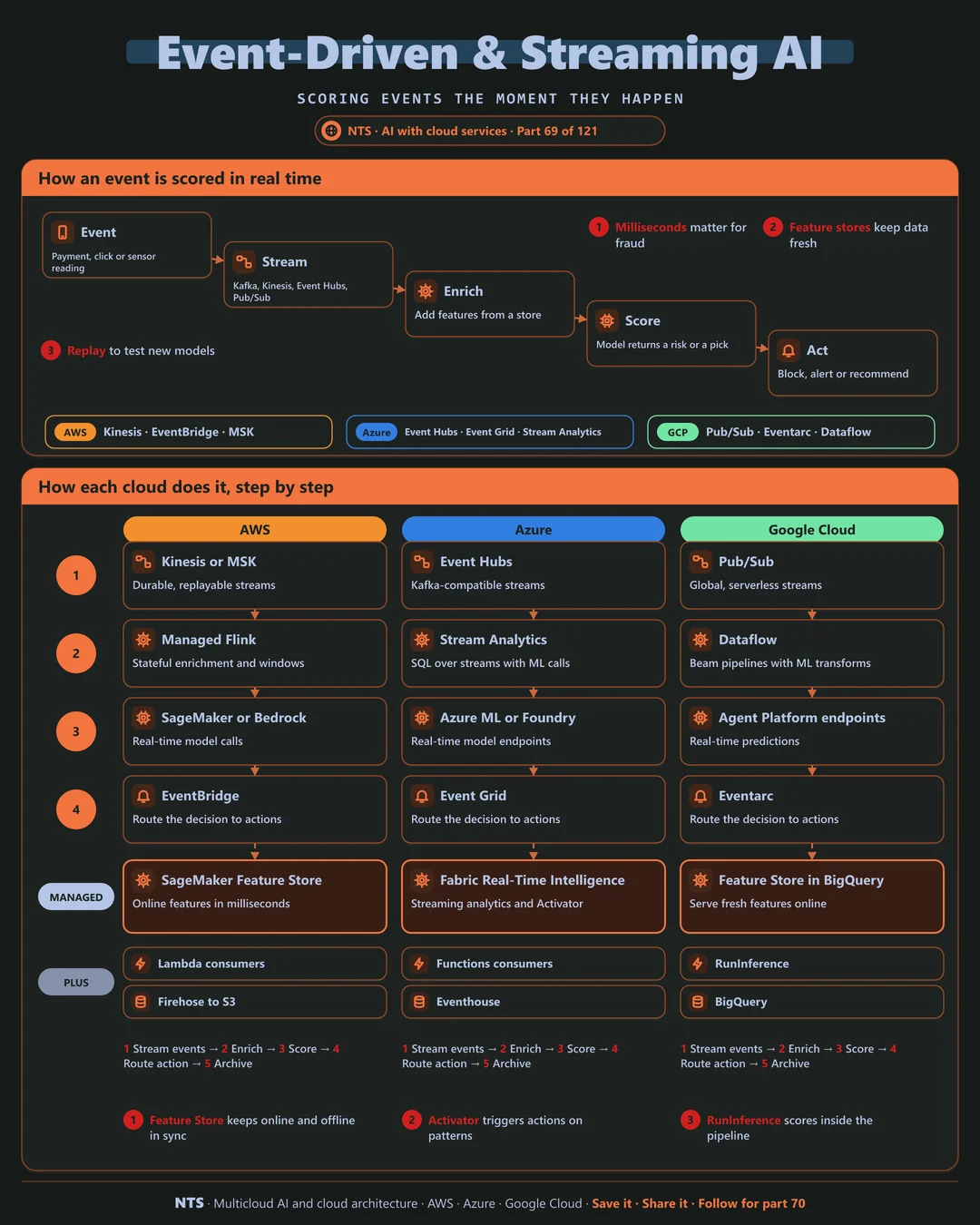
An event such as a payment or click enters a stream. A processor enriches it with features from a store, a model scores it and the result triggers an action: block, alert or recommend. Events are archived for retraining and replay.
AWS, Azure and Google Cloud compared
| AWS | Azure | Google Cloud | |
|---|---|---|---|
| Event streams | Kinesis, MSK | Event Hubs | Pub/Sub, Managed Kafka |
| Stream processing | Managed Flink | Stream Analytics, Fabric | Dataflow |
| Online features | SageMaker Feature Store | Azure ML feature store | Feature Store in BigQuery |
| Real-time scoring | SageMaker, Bedrock | Azure ML, Foundry | Agent Platform endpoints, RunInference |
| Event routing | EventBridge | Event Grid | Eventarc |
What makes each cloud different
AWS
AWS pairs Kinesis or MSK with Managed Flink, SageMaker Feature Store for millisecond online features and EventBridge to route decisions to downstream systems.
Azure
Azure uses Event Hubs and Stream Analytics or Fabric Real-Time Intelligence, where Activator triggers actions when patterns appear, with Azure ML endpoints for scoring.
Google Cloud
Google runs Pub/Sub into Dataflow, where RunInference scores events inside the pipeline itself, with features served from BigQuery-based Feature Store.
Design decisions that matter
- 01Score as events arrive
Batch only what can wait.
- 02Same features online and offline
Avoid training-serving skew.
- 03Archive every event
For retraining and replay testing.
- 04Set latency budgets
End-to-end, per use case.
Common mistakes we see
- Features computed differently in training and serving. Models behave unpredictably.
- No replay capability. New models cannot be tested on history.
- Synchronous calls in the stream. One slow service stalls the pipeline.
A practical 30-day plan
- Week 1
Pick the real-time decision and its latency budget.
- Week 2
Build the stream and feature pipeline.
- Week 3
Deploy the model and the action path.
- Week 4
Archive events and test replay.
How NTS helps
NTS builds streaming AI on AWS, Azure and Google Cloud, covering event pipelines, feature stores, real-time scoring and automated actions for fraud, personalization and operations.
What you get
- Real-time pipelines that score events with AI
- Feature freshness for live decisions
- Back-pressure and failure handling
- Latency monitoring end to end
Typical outcomes
- Instant decisions on live events
- Fraud and issues caught as they happen
- Reliable real-time AI at scale
How we work with you
- 1Assess
A focused review of your event-driven and streaming AI across AWS, Azure and Google Cloud. We look for the gaps we find most often: features computed differently in training and serving, no replay capability and synchronous calls in the stream.
- 2Design
A target architecture and roadmap built on the decisions that matter most: score as events arrive, same features online and offline, archive every event and set latency budgets.
- 3Build
Hands-on delivery alongside your team. We pick the real-time decision and its latency budget, build the stream and feature pipeline, deploy the model and the action path, and finally archive events and test replay.
- 4Run and improve
We tune throughput, latency and costs, and update models in the stream safely.
Why teams choose NTS for event-driven and streaming AI
- Real-time expertise
We combine streaming and AI without breaking either.
- Decisions in milliseconds
We design for low latency from the start.
- Resilient flows
Pipelines keep running when models slow down.
Book a free 30-minute review
Talk to an NTS architect about your event-driven and streaming AI on AWS, Azure and Google Cloud.