
Multicloud AI & ERP / Cloud & AI Security, Governance & Compliance
Why it matters
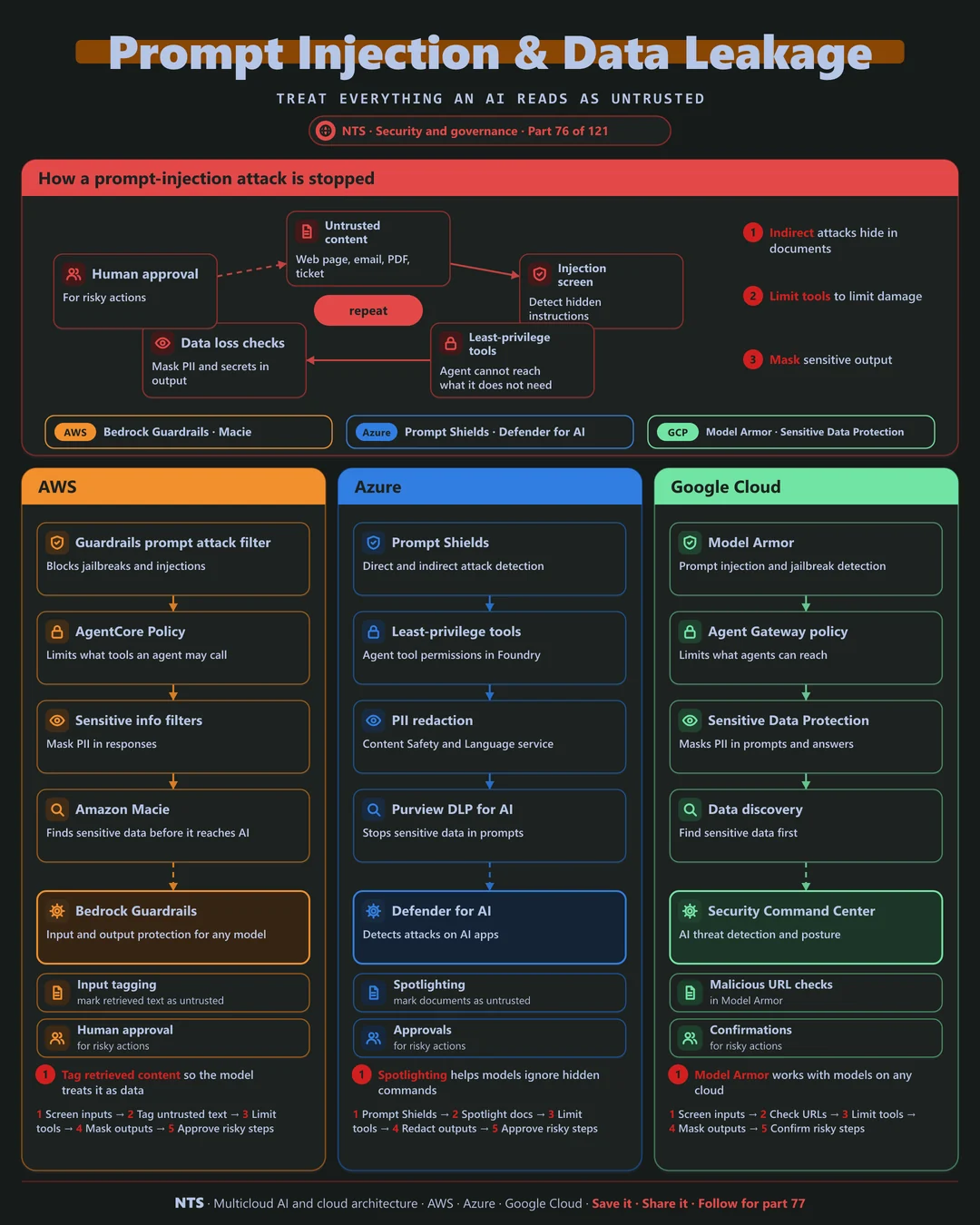
Prompt injection is the top security risk for AI applications. Any content an AI reads, such as emails, PDFs, tickets or websites, can carry instructions an attacker planted, and agents with tools can act on them.
How it works
Layered defense
Screen untrusted content for hidden instructions. Mark retrieved text as data, not commands. Give agents least-privilege tools so a hijacked agent can do little harm. Mask personal data and secrets in output, and require human approval for risky actions.
AWS, Azure and Google Cloud compared
| AWS | Azure | Google Cloud | |
|---|---|---|---|
| Injection detection | Guardrails prompt attack filter | Prompt Shields | Model Armor |
| Tool limits | AgentCore Policy | Foundry tool permissions | Agent Gateway policy |
| PII protection | Guardrails sensitive info filters, Macie | Purview DLP, PII redaction | Sensitive Data Protection |
| Threat detection for AI | GuardDuty and Security Hub | Defender for AI | Security Command Center |
| Untrusted content handling | Input tagging | Spotlighting | URL and content screening |
What makes each cloud different
AWS
Bedrock Guardrails detect jailbreaks and injected instructions and mask sensitive information, AgentCore Policy limits agent tools and Amazon Macie finds sensitive data before it reaches AI.
Azure
Azure's Prompt Shields detect both direct attacks and indirect ones hidden in documents, spotlighting marks untrusted content, and Defender for AI raises alerts on attacks against AI apps.
Google Cloud
Model Armor screens prompts and responses for injection, jailbreaks, sensitive data and malicious URLs on any model, with Security Command Center tracking AI threats.
Design decisions that matter
- 01Treat all retrieved content as untrusted
Documents, email and web pages.
- 02Least-privilege tools
Limit the blast radius.
- 03Screen inputs and outputs
On every call.
- 04Human approval for risky actions
Payments, deletes, external messages.
Common mistakes we see
- Trusting internal documents. Attackers can plant text anywhere users can write.
- Agents with broad tools. Injection turns into real damage.
- No red teaming. Defenses never tested.
A practical 30-day plan
- Week 1
Map AI apps, content sources and tools.
- Week 2
Add injection screening and content tagging.
- Week 3
Reduce agent tool permissions.
- Week 4
Red team the top applications.
How NTS helps
NTS secures AI applications against prompt injection and data leakage on AWS, Azure and Google Cloud, covering threat modeling, guardrails, tool permissions, data protection and red teaming.
What you get
- Threat modeling for your AI applications
- Prompt injection defenses and testing
- Output filtering and data loss controls
- Red-team exercises against your AI
Typical outcomes
- AI applications resistant to injection attacks
- Sensitive data kept out of AI outputs
- Confidence to connect AI to real systems
How we work with you
- 1Assess
A focused review of your prompt injection and AI data leakage defense across AWS, Azure and Google Cloud. We look for the gaps we find most often: trusting internal documents, agents with broad tools and no red teaming.
- 2Design
A target architecture and roadmap built on the decisions that matter most: treat all retrieved content as untrusted, least-privilege tools, screen inputs and outputs and human approval for risky actions.
- 3Build
Hands-on delivery alongside your team. We map AI apps, content sources and tools, add injection screening and content tagging, reduce agent tool permissions, and finally red team the top applications.
- 4Run and improve
We re-test regularly against new attack techniques and update defenses.
Why teams choose NTS for prompt injection and AI data leakage defense
- AI security specialists
We understand attacks unique to AI systems.
- Tested defenses
We attack your AI before real attackers do.
- Layered protection
No single control is trusted alone.
Book a free 30-minute review
Talk to an NTS architect about your prompt injection and AI data leakage defense on AWS, Azure and Google Cloud.