
Multicloud AI & ERP / Cloud Migration, Integration & AI Operations
Why it matters
Mergers, regulation, pricing and best-of-breed AI services push organizations onto more than one cloud. Without a portability strategy, each cloud becomes a silo and switching costs grow every year.
How it works
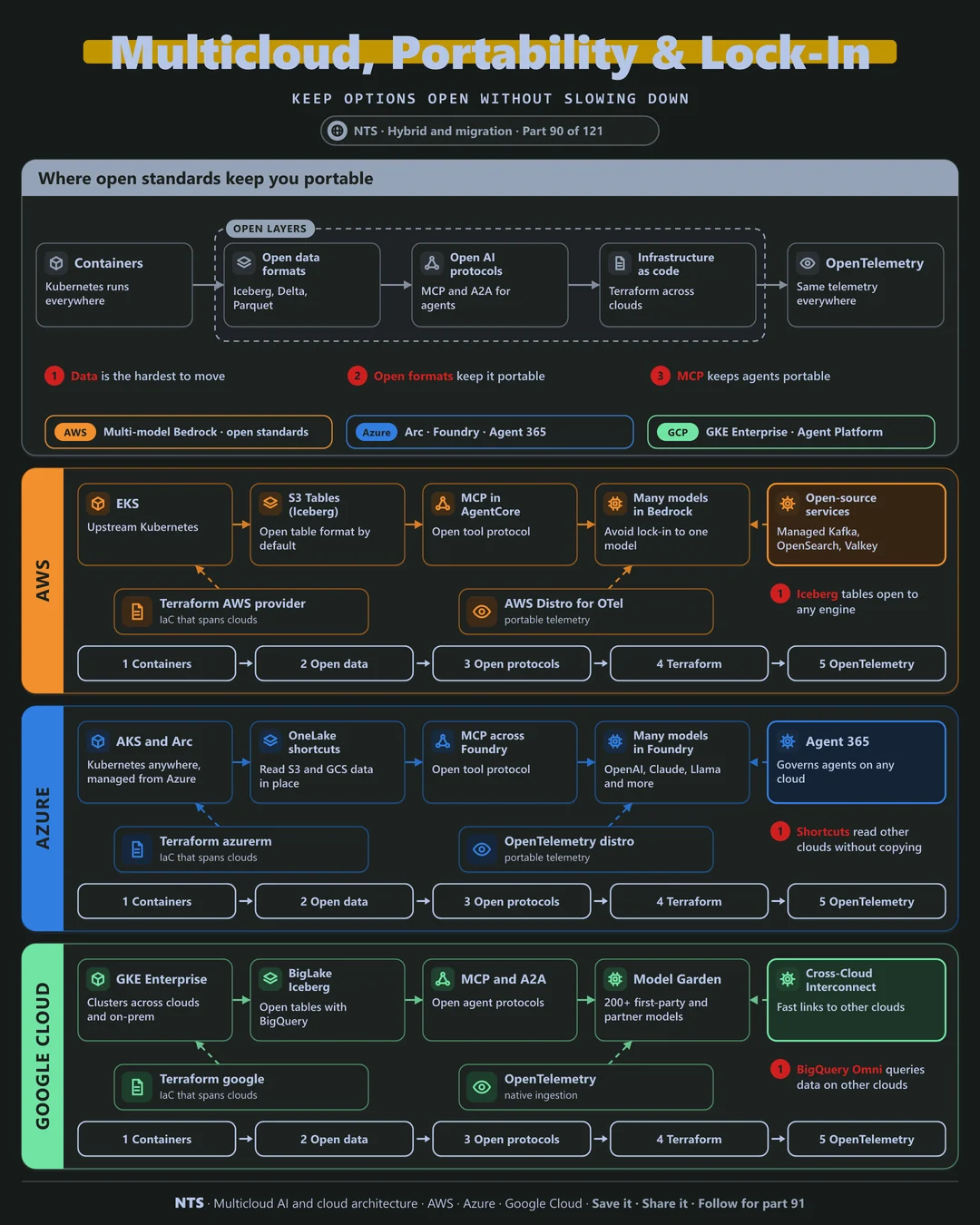
Where open standards pay off
Containers and Kubernetes run the same everywhere. Open data formats such as Iceberg and Delta keep data readable by any engine. Open AI protocols such as MCP and A2A keep agents and tools portable. Infrastructure as code with Terraform and OpenTelemetry for monitoring complete the portable layer.
Use managed services everywhere else
Portability has a cost. Use each cloud's best managed services for everything that does not need to move, and keep the expensive-to-move layers (data and integrations) open.
AWS, Azure and Google Cloud compared
| AWS | Azure | Google Cloud | |
|---|---|---|---|
| Kubernetes | Amazon EKS | AKS and Azure Arc | GKE Enterprise |
| Open table formats | S3 Tables (Iceberg) | OneLake (Delta, Iceberg) | BigLake (Iceberg) |
| Cross-cloud data access | Iceberg REST catalog | OneLake shortcuts | BigQuery Omni |
| Multi-model AI | Bedrock (many providers) | Foundry (many providers) | Model Garden (many providers) |
| Agent protocols | MCP, A2A | MCP, A2A | MCP, A2A |
What makes each cloud different
AWS
AWS supports portability through EKS, Iceberg-native S3 Tables, managed open-source services such as Kafka, OpenSearch and Valkey, and Bedrock's many model providers behind one API.
Azure
Azure leans on Arc to manage resources on any cloud, OneLake shortcuts to read S3 and Google Cloud Storage data in place and Agent 365 to govern agents across clouds.
Google Cloud
Google offers GKE Enterprise across clouds, BigQuery Omni to query data on other clouds and Cross-Cloud Interconnect for fast private links between providers.
Design decisions that matter
- 01Open formats for data
The most expensive layer to move.
- 02Containers for applications
Portable by default.
- 03MCP for agent integrations
Tools reusable across platforms.
- 04Managed services elsewhere
Do not pay for portability you will not use.
Common mistakes we see
- Lowest common denominator. Avoiding every managed service wastes the cloud.
- Proprietary data formats. Lock-in where it hurts most.
- No exit plan. Negotiating power disappears.
A practical 30-day plan
- Week 1
Identify the layers that must stay portable.
- Week 2
Standardize on open data and container formats.
- Week 3
Adopt Terraform and OpenTelemetry across clouds.
- Week 4
Document an exit plan for critical workloads.
How NTS helps
NTS designs multicloud strategies across AWS, Azure and Google Cloud, covering portability layers, open data architectures, cross-cloud networking and governance, so you keep options open without slowing down.
What you get
- A multicloud strategy with clear workload placement
- Portable platforms with Kubernetes and open formats
- Exit plans for critical workloads
- Unified governance across clouds
Typical outcomes
- Freedom to choose the best cloud for each workload
- Stronger negotiating position with providers
- Documented exit options
How we work with you
- 1Assess
A focused review of your multicloud and portability strategy across AWS, Azure and Google Cloud. We look for the gaps we find most often: lowest common denominator, proprietary data formats and no exit plan.
- 2Design
A target architecture and roadmap built on the decisions that matter most: open formats for data, containers for applications, MCP for agent integrations and managed services elsewhere.
- 3Build
Hands-on delivery alongside your team. We identify the layers that must stay portable, standardize on open data and container formats, adopt Terraform and OpenTelemetry across clouds, and finally document an exit plan for critical workloads.
- 4Run and improve
We review placement and portability as services and prices change.
Why teams choose NTS for multicloud and portability strategy
- Truly vendor-neutral
We work across AWS, Azure and Google Cloud without favorites.
- Portability where it pays
We avoid over-engineering for portability you will never use.
- Lock-in managed, not feared
We make lock-in a conscious, documented choice.
Book a free 30-minute review
Talk to an NTS architect about your multicloud and portability strategy on AWS, Azure and Google Cloud.