
Multicloud AI & ERP / Cloud Migration, Integration & AI Operations
Why it matters
Cloud choice shapes costs, skills and capabilities for a decade. Decisions driven by a single feature, a sales relationship or habit often lead to expensive regrets.
How it works
Five steps to a decision
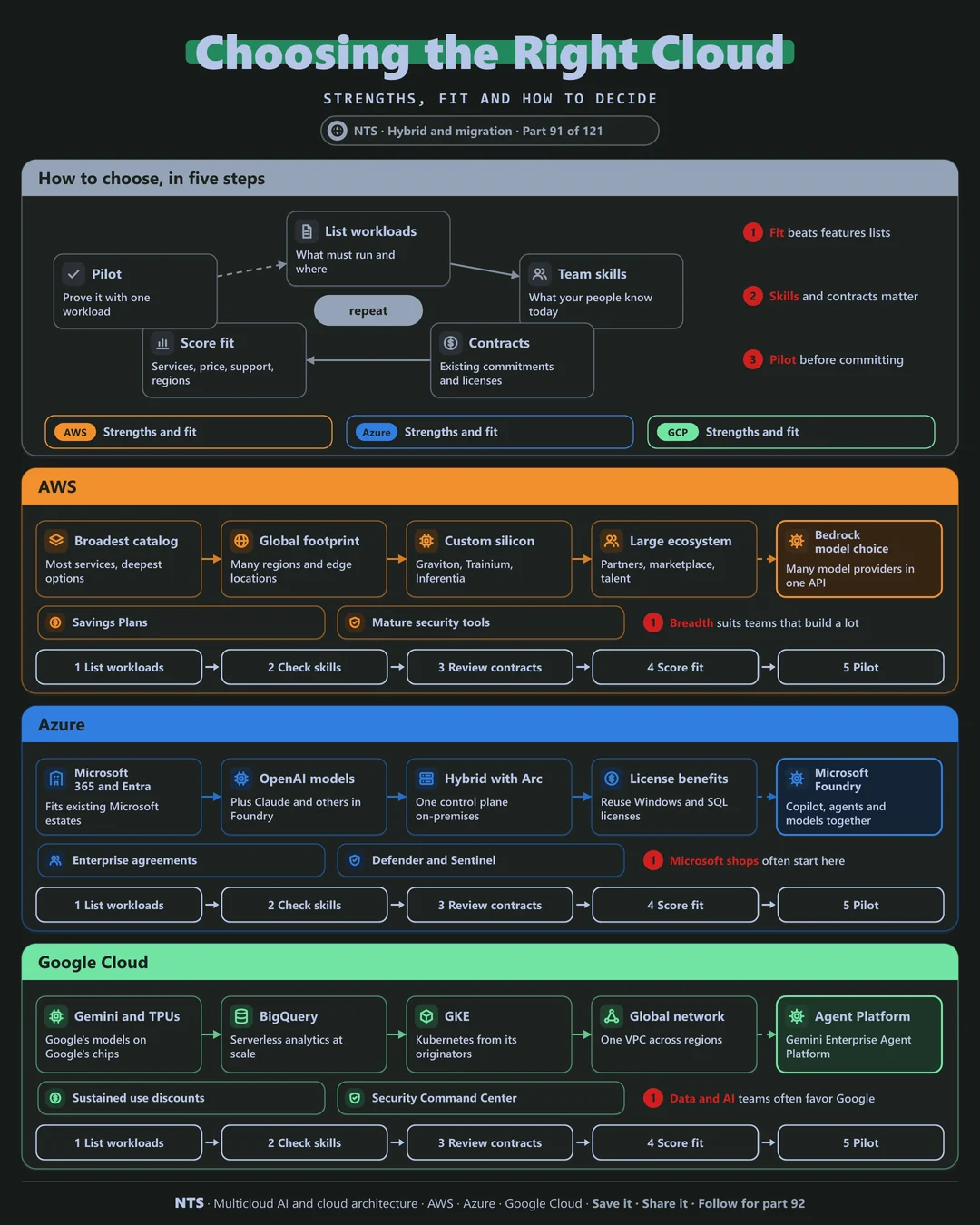
List the workloads and where they must run. Assess team skills. Review contracts and licenses already in place. Score fit on services, price, support and regions. Then pilot one real workload before committing.
AWS, Azure and Google Cloud compared
| AWS | Azure | Google Cloud | |
|---|---|---|---|
| Typical strength | Broadest service catalog | Microsoft 365 and Entra integration | Data, analytics and AI |
| AI platform | Bedrock, AgentCore | Microsoft Foundry, Copilot | Gemini, Agent Platform |
| Custom silicon | Graviton, Trainium, Inferentia | Cobalt, Maia | Axion, TPU |
| Hybrid approach | Outposts, EKS Hybrid Nodes | Arc, Azure Local | Distributed Cloud, GKE Enterprise |
| License advantage | Savings Plans flexibility | Azure Hybrid Benefit | Sustained use discounts |
What makes each cloud different
AWS
AWS offers the broadest catalog and deepest options in most service categories, a very large partner ecosystem and its own chips across general compute and AI. It suits teams that build a lot themselves.
Azure
Azure is often the natural fit for Microsoft-centric organizations: Entra ID, Microsoft 365, Windows and SQL Server licensing benefits, OpenAI models in Foundry and Arc for hybrid.
Google Cloud
Google Cloud stands out for data and AI: BigQuery, Gemini models, TPUs and Kubernetes heritage with GKE, plus a global network with VPCs that span regions.
Design decisions that matter
- 01Score against your own workloads
Not generic comparisons.
- 02Count skills and contracts
They often decide the total cost.
- 03Pilot before committing
One real workload, real numbers.
- 04Allow for a second cloud
For specific strengths, deliberately.
Common mistakes we see
- Choosing on one feature. It may matter less in two years.
- Ignoring exit costs. Data egress and re-skilling add up.
- Multicloud by accident. Every team picks a different cloud.
A practical 30-day plan
- Week 1
List workloads, constraints and current contracts.
- Week 2
Score each cloud with stakeholders.
- Week 3
Pilot the top choice with a real workload.
- Week 4
Decide, document and plan the landing zone.
How NTS helps
NTS runs vendor-neutral cloud selection with you across AWS, Azure and Google Cloud, covering workload analysis, scoring, total cost of ownership and pilots, so the decision is based on evidence.
What you get
- A scored comparison of AWS, Azure and Google Cloud for your needs
- Cost models for your actual workloads
- Proof-of-concept testing
- A clear recommendation with reasoning
Typical outcomes
- A confident, well-documented decision
- Better commercial terms
- No regrets after commitment
How we work with you
- 1Assess
A focused review of your cloud provider selection across AWS, Azure and Google Cloud. We look for the gaps we find most often: choosing on one feature, ignoring exit costs and multicloud by accident.
- 2Design
A target architecture and roadmap built on the decisions that matter most: score against your own workloads, count skills and contracts, pilot before committing and allow for a second cloud.
- 3Build
Hands-on delivery alongside your team. We list workloads, constraints and current contracts, score each cloud with stakeholders, pilot the top choice with a real workload, and finally decide, document and plan the landing zone.
- 4Run and improve
We revisit the choice as your needs evolve and help negotiate renewals.
Why teams choose NTS for cloud provider selection
- Independent advice
We have no reason to favor one provider.
- Evidence-based
We test with your workloads, not marketing claims.
- Business-aware
We weigh skills, contracts and strategy, not just features.
Book a free 30-minute review
Talk to an NTS architect about your cloud provider selection on AWS, Azure and Google Cloud.