
Multicloud AI & ERP / Cloud Migration, Integration & AI Operations
Why it matters
APIs are how partners, mobile apps and now AI agents reach your business. Unmanaged APIs leak data, buckle under traffic spikes and break clients when they change.
How it works
How a managed API call works
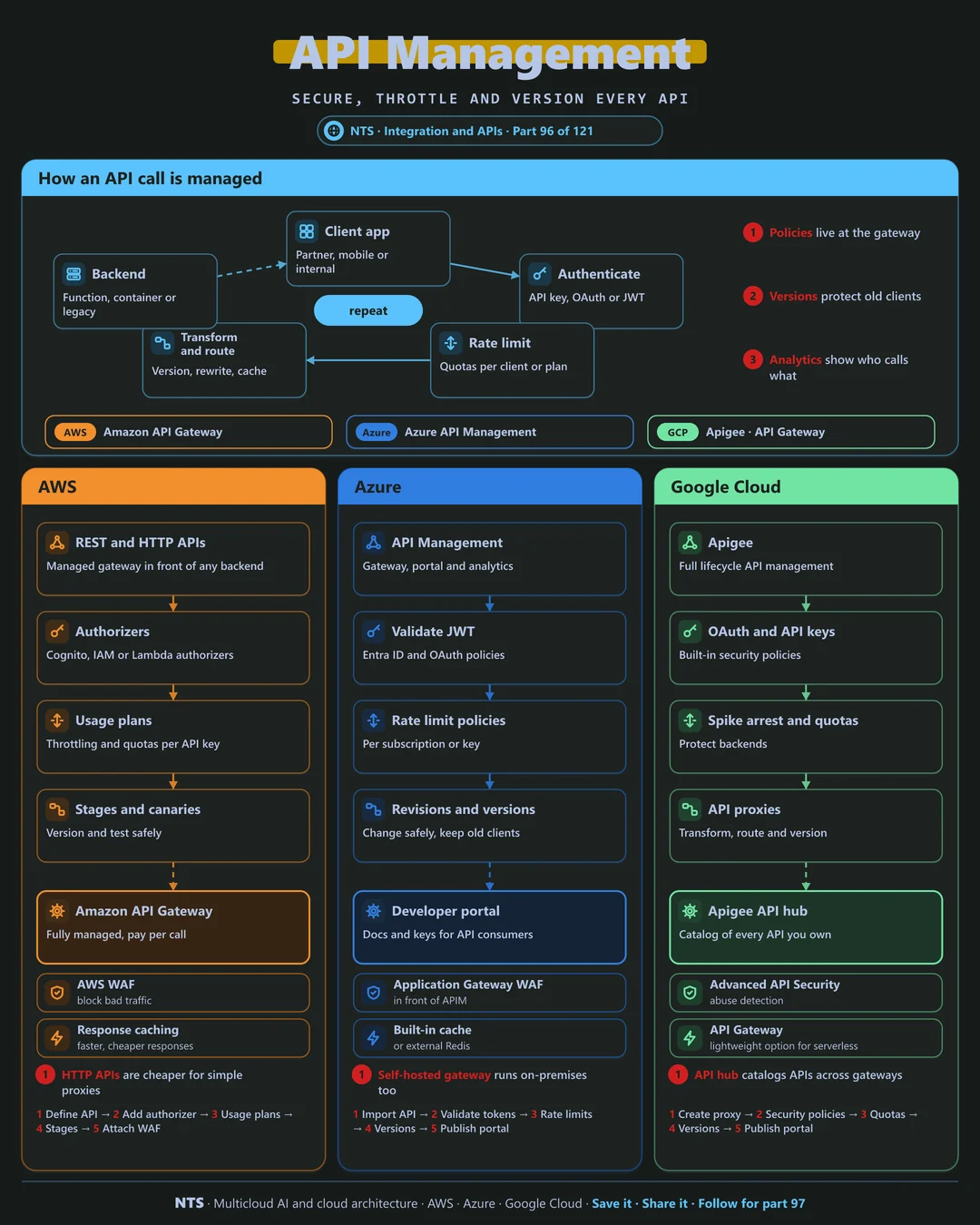
A client calls through the gateway, which authenticates it, applies rate limits and quotas, transforms and routes the request to the right version, and forwards it to the backend: a function, container or legacy system. Analytics record who called what.
AWS, Azure and Google Cloud compared
| AWS | Azure | Google Cloud | |
|---|---|---|---|
| API management | Amazon API Gateway | Azure API Management | Apigee |
| Lightweight gateway | HTTP APIs | Consumption tier | API Gateway |
| Authentication | Cognito, IAM, Lambda authorizers | Validate JWT, Entra ID | OAuth, API keys |
| Developer portal | API Gateway portal options | Developer portal | Integrated portal |
| AI and MCP | AgentCore Gateway | AI gateway, MCP servers | API hub, AI policies |
What makes each cloud different
AWS
Amazon API Gateway offers REST and lower-cost HTTP APIs with authorizers, usage plans and canary stages, fully managed and billed per call.
Azure
Azure API Management provides a gateway, developer portal and analytics, a self-hosted gateway for on-premises and an AI gateway with token limits and semantic caching for model APIs.
Google Cloud
Apigee is Google's full lifecycle API platform with advanced security and monetization, and API hub catalogs every API across gateways; API Gateway covers lightweight serverless needs.
Design decisions that matter
- 01Auth and throttling on every public API
Before go-live.
- 02Version from day one
Old clients keep working.
- 03A catalog of all APIs
You cannot secure what you cannot find.
- 04Treat agents as API clients
Same keys, quotas and logs.
Common mistakes we see
- Backends exposed directly. No control or visibility.
- Breaking changes without versions. Partners fail overnight.
- No rate limits. One client takes everyone down.
A practical 30-day plan
- Week 1
Inventory APIs and their consumers.
- Week 2
Put priority APIs behind the gateway.
- Week 3
Add authentication, quotas and versioning.
- Week 4
Publish a developer portal and catalog.
How NTS helps
NTS designs API platforms with API Gateway, Azure API Management and Apigee, covering security, versioning, developer portals and AI gateways for model and agent traffic.
What you get
- An API gateway with security and rate limits
- A developer portal with documentation
- API standards and versioning
- Analytics on API usage
Typical outcomes
- Faster partner and developer onboarding
- Protected backend systems
- Insight into how APIs are used
How we work with you
- 1Assess
A focused review of your API management across AWS, Azure and Google Cloud. We look for the gaps we find most often: backends exposed directly, breaking changes without versions and no rate limits.
- 2Design
A target architecture and roadmap built on the decisions that matter most: auth and throttling on every public API, version from day one, a catalog of all APIs and treat agents as API clients.
- 3Build
Hands-on delivery alongside your team. We inventory APIs and their consumers, put priority APIs behind the gateway, add authentication, quotas and versioning, and finally publish a developer portal and catalog.
- 4Run and improve
We manage API lifecycles, versions and policies as your API portfolio grows.
Why teams choose NTS for API management
- APIs as products
We help you design APIs partners and developers love.
- Secure by default
Authentication, limits and threat protection on every API.
- Ready for AI agents
APIs designed for both people and agents.
Book a free 30-minute review
Talk to an NTS architect about your API management on AWS, Azure and Google Cloud.