
Multicloud AI & ERP / Cloud Migration, Integration & AI Operations
Why it matters
Direct service-to-service calls spread failures: when one service slows, everything upstream stalls. Messaging absorbs spikes, isolates failures and makes systems recover gracefully.
How it works
Topics, queues and dead letters
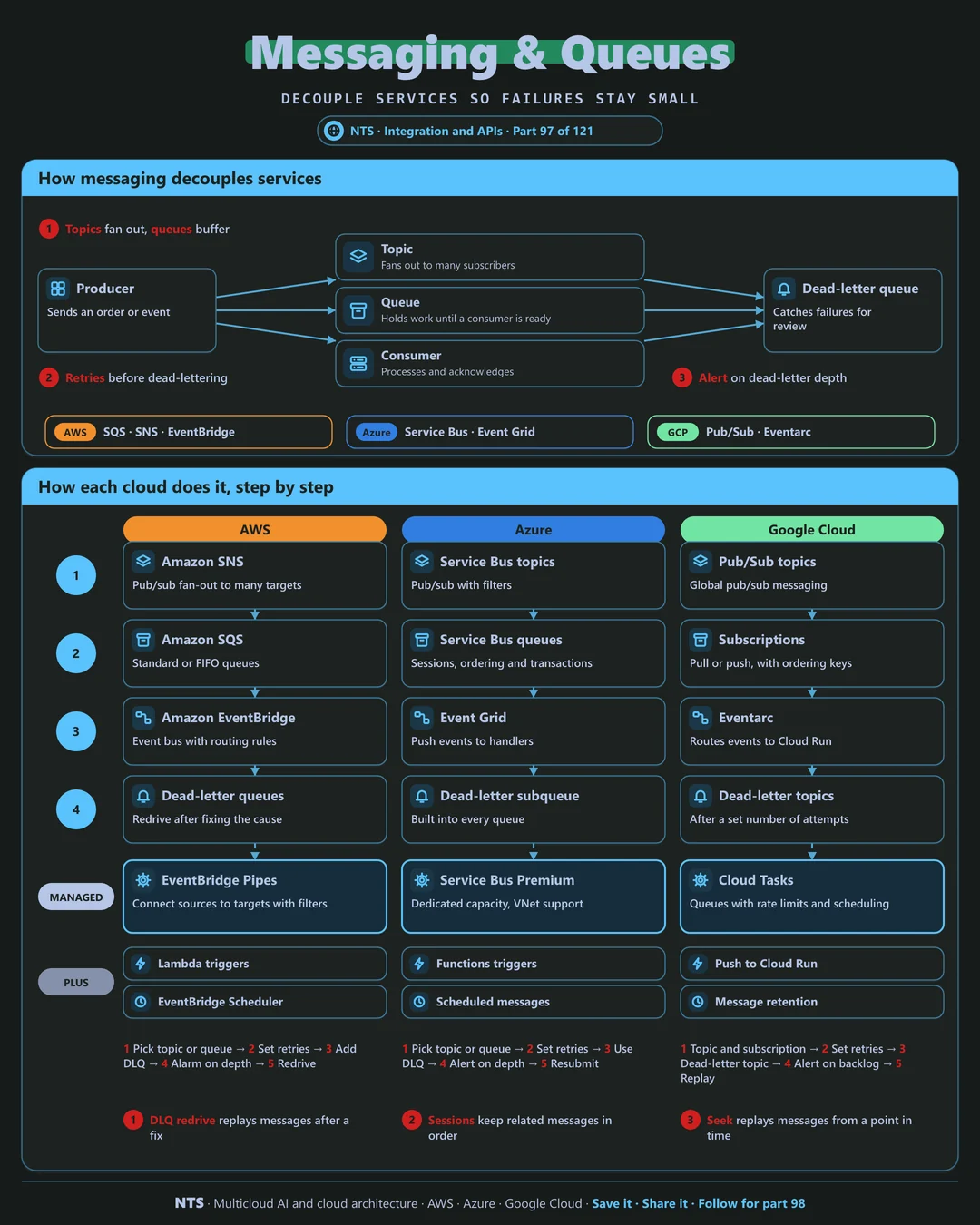
A producer publishes a message. A topic fans it out to every interested subscriber, and a queue holds work until a consumer is ready. Messages that keep failing go to a dead-letter queue for review, so nothing is silently lost.
AWS, Azure and Google Cloud compared
| AWS | Azure | Google Cloud | |
|---|---|---|---|
| Queues | Amazon SQS | Service Bus queues | Pub/Sub subscriptions, Cloud Tasks |
| Pub/sub topics | Amazon SNS | Service Bus topics | Pub/Sub topics |
| Event bus | Amazon EventBridge | Event Grid | Eventarc |
| Dead letters | SQS DLQ with redrive | Dead-letter subqueue | Dead-letter topics |
| Ordering | FIFO queues | Sessions | Ordering keys |
What makes each cloud different
AWS
AWS pairs SNS fan-out with SQS standard and FIFO queues, EventBridge for routing rules and DLQ redrive to replay messages once the cause is fixed.
Azure
Azure Service Bus offers queues and topics with sessions for ordered processing, transactions and a built-in dead-letter subqueue, with Event Grid for push-based events.
Google Cloud
Google Pub/Sub provides global topics and subscriptions with ordering keys, dead-letter topics and seek to replay messages from a point in time.
Design decisions that matter
- 01Queues between services
No direct synchronous chains.
- 02A dead-letter queue for every queue
With an alert on depth.
- 03Idempotent consumers
Safe when messages repeat.
- 04Retries with backoff
Before dead-lettering.
Common mistakes we see
- No dead-letter queue. Failed messages vanish.
- Ignoring duplicates. Orders processed twice.
- Unmonitored queue depth. Backlogs grow unnoticed.
A practical 30-day plan
- Week 1
Map synchronous calls between services.
- Week 2
Add queues to the most fragile paths.
- Week 3
Add dead-letter queues and alerts.
- Week 4
Make consumers idempotent and test replay.
How NTS helps
NTS designs event-driven and messaging architectures on AWS, Azure and Google Cloud, covering queues, topics, dead-letter handling and replay, to make systems resilient to failure and spikes.
What you get
- Queue and pub/sub designs for your workflows
- Retry and dead-letter handling
- Ordering and idempotency patterns
- Queue depth and age monitoring
Typical outcomes
- More resilient applications
- Traffic spikes handled gracefully
- Fewer failures between systems
How we work with you
- 1Assess
A focused review of your messaging and queues across AWS, Azure and Google Cloud. We look for the gaps we find most often: no dead-letter queue, ignoring duplicates and unmonitored queue depth.
- 2Design
A target architecture and roadmap built on the decisions that matter most: queues between services, a dead-letter queue for every queue, idempotent consumers and retries with backoff.
- 3Build
Hands-on delivery alongside your team. We map synchronous calls between services, add queues to the most fragile paths, add dead-letter queues and alerts, and finally make consumers idempotent and test replay.
- 4Run and improve
We monitor queues, tune consumers and handle dead-lettered messages.
Why teams choose NTS for messaging and queues
- Decoupled systems
We make services independent so one failure does not cascade.
- No lost messages
Retries and dead-letter queues protect every message.
- Scales smoothly
Queues absorb spikes without dropping work.
Book a free 30-minute review
Talk to an NTS architect about your messaging and queues on AWS, Azure and Google Cloud.