
Multicloud AI & ERP / Cloud AI Applications & Industry AI Solutions
Why it matters
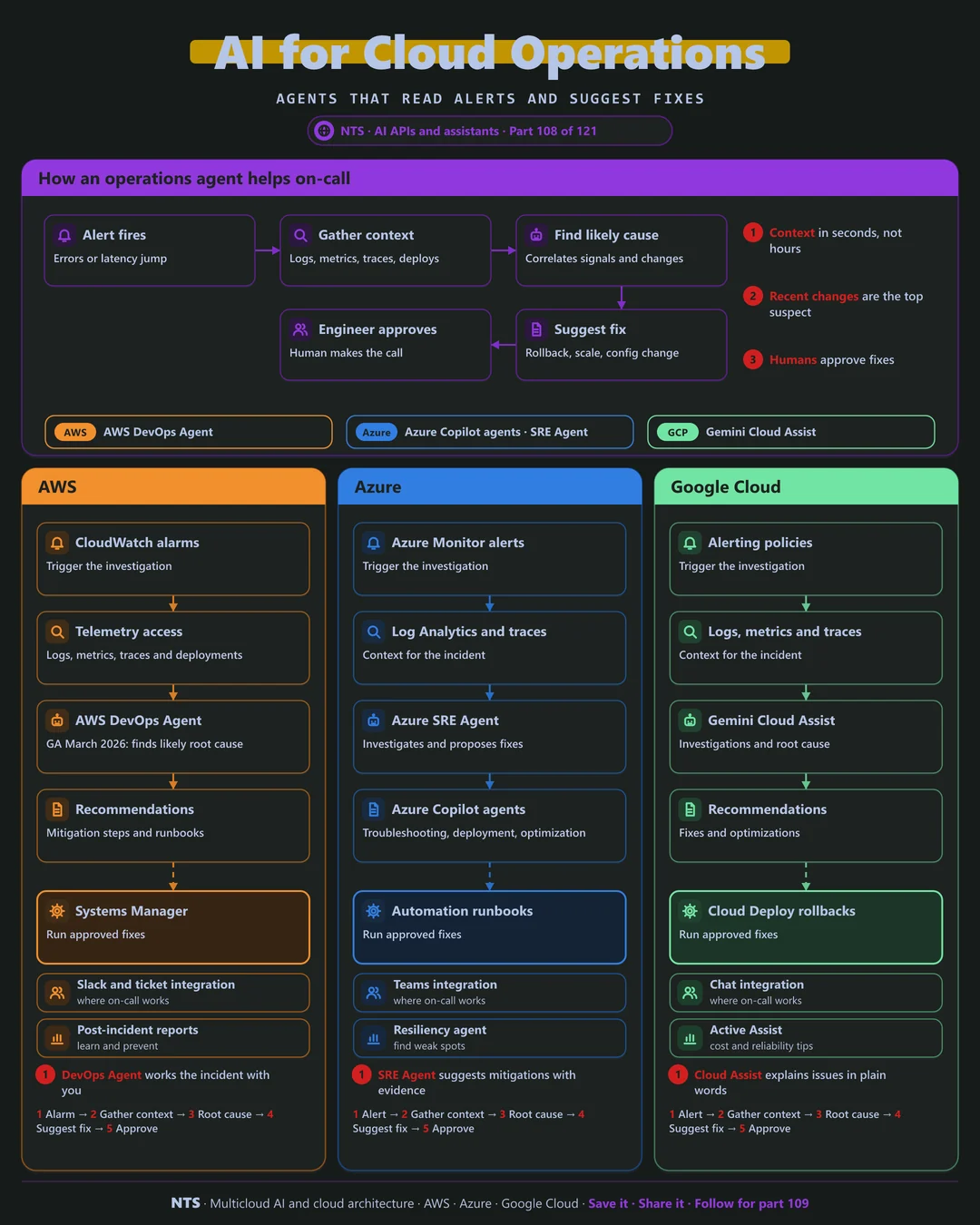
Incidents cost money every minute, and much of the time goes on gathering context. AI agents that pull logs, metrics, traces and deployment history together can cut diagnosis time sharply.
How it works
How an operations agent helps
An alert fires. The agent gathers context from logs, metrics, traces and recent deployments, identifies the likely cause by correlating signals with changes, and suggests a fix such as a rollback or scaling action. The engineer approves the decision.
AWS, Azure and Google Cloud compared
| AWS | Azure | Google Cloud | |
|---|---|---|---|
| Operations agent | AWS DevOps Agent (GA Mar 2026) | Azure SRE Agent | Gemini Cloud Assist |
| Assistant for cloud admins | Amazon Q in the console | Azure Copilot agents | Gemini Cloud Assist |
| Telemetry source | CloudWatch, X-Ray | Azure Monitor | Cloud Monitoring, Logging, Trace |
| Action runner | Systems Manager automation | Automation runbooks | Cloud Deploy, automation |
| Recommendations | Trusted Advisor, Compute Optimizer | Azure Advisor | Active Assist |
What makes each cloud different
AWS
The AWS DevOps Agent, generally available since March 31, 2026, investigates incidents across telemetry and deployments and recommends mitigations, working where on-call teams already collaborate.
Azure
The Azure SRE Agent investigates and proposes fixes with evidence, and Azure Copilot agents help with troubleshooting, deployment, optimization and resiliency.
Google Cloud
Gemini Cloud Assist explains issues in plain language, runs investigations and suggests fixes and optimizations across Google Cloud resources.
Design decisions that matter
- 01Agents investigate, humans decide
Approval for production changes.
- 02Give agents full context
Logs, metrics, traces and deploys.
- 03Recent changes first
The most common cause.
- 04Learn from every incident
Feed postmortems back.
Common mistakes we see
- Auto-remediation without guardrails. Agents can make outages worse.
- Poor telemetry. Agents cannot diagnose what is not recorded.
- No measurement. Track time to diagnose before and after.
A practical 30-day plan
- Week 1
Check telemetry coverage for top services.
- Week 2
Enable the operations agent in a pilot team.
- Week 3
Connect it to chat and ticketing.
- Week 4
Compare diagnosis times with past incidents.
How NTS helps
NTS sets up AI-assisted operations with the AWS DevOps Agent, Azure SRE Agent and Gemini Cloud Assist, covering telemetry readiness, integrations and safe automation.
What you get
- AI-assisted incident investigation
- Automated root-cause suggestions
- Runbook automation with approvals
- Operational insights and trends
Typical outcomes
- Shorter time to resolve incidents
- Less on-call fatigue
- Fewer repeat incidents
How we work with you
- 1Assess
A focused review of your AI for cloud operations across AWS, Azure and Google Cloud. We look for the gaps we find most often: auto-remediation without guardrails, poor telemetry and no measurement.
- 2Design
A target architecture and roadmap built on the decisions that matter most: agents investigate, humans decide, give agents full context, recent changes first and learn from every incident.
- 3Build
Hands-on delivery alongside your team. We check telemetry coverage for top services, enable the operations agent in a pilot team, connect it to chat and ticketing, and finally compare diagnosis times with past incidents.
- 4Run and improve
We tune AI operations tools and expand automated runbooks as confidence grows.
Why teams choose NTS for AI for cloud operations
- Faster incident response
AI investigates while your team focuses on fixes.
- Safe automation
Humans approve actions that change production.
- Built on your telemetry
AI uses your real logs, metrics and traces.
Book a free 30-minute review
Talk to an NTS architect about your AI for cloud operations on AWS, Azure and Google Cloud.