
Multicloud AI & ERP / Cloud Migration, Integration & AI Operations
Why it matters
Live events, game launches and viral content can multiply traffic in minutes. Building for peak on fixed infrastructure is expensive; managed services absorb spikes and AI makes content searchable.
How it works
From capture to viewer
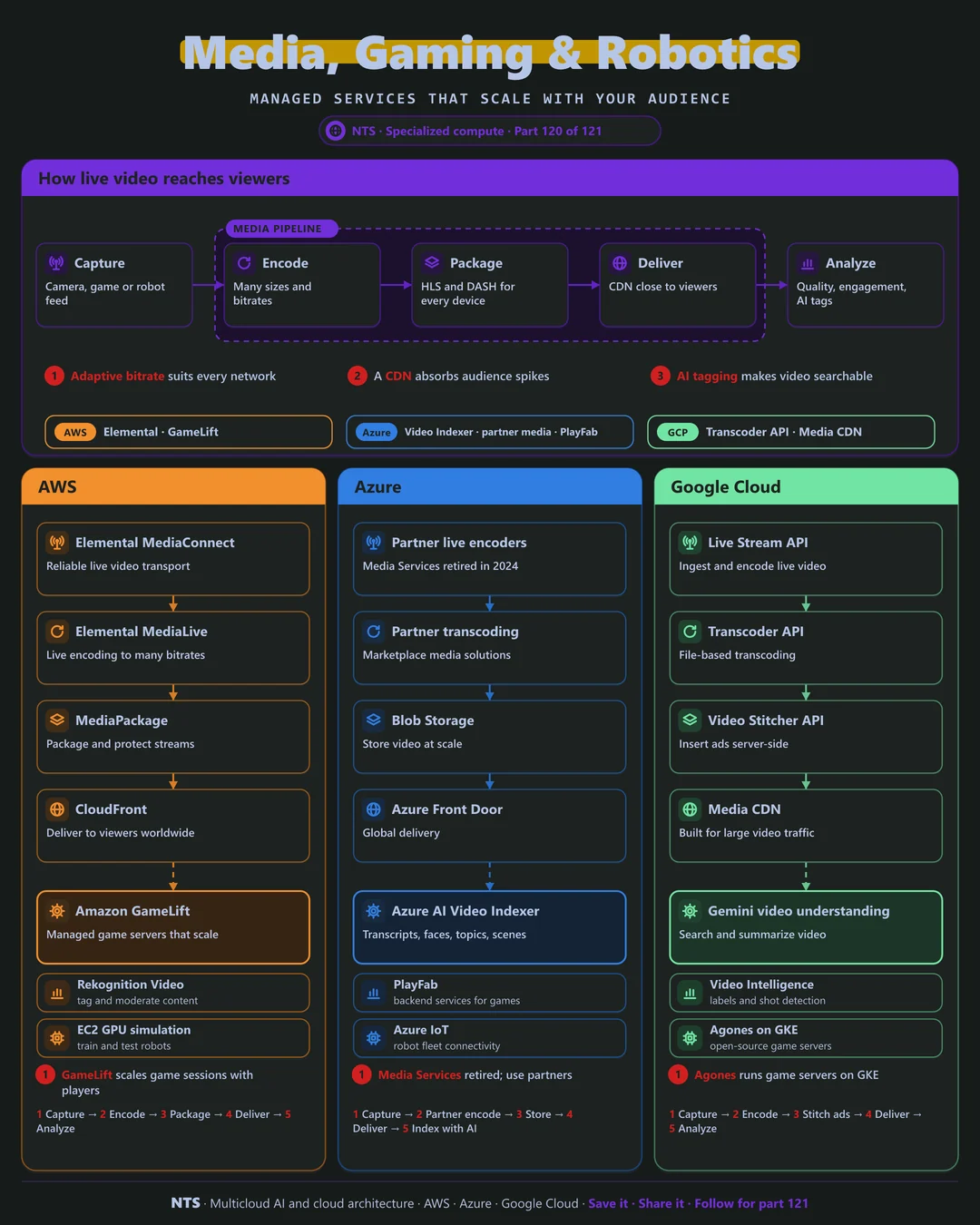
Video is captured, encoded into many sizes and bitrates, packaged for every device, delivered through a CDN close to viewers and analyzed for quality, engagement and AI tags that make it searchable.
AWS, Azure and Google Cloud compared
| AWS | Azure | Google Cloud | |
|---|---|---|---|
| Live video | AWS Elemental MediaLive, MediaConnect | Partner live encoders | Live Stream API |
| Packaging and ads | MediaPackage, MediaTailor | Partner solutions | Video Stitcher API |
| Delivery | CloudFront | Azure Front Door | Media CDN |
| Video AI | Rekognition Video | Azure AI Video Indexer | Gemini video understanding, Video Intelligence |
| Game servers | Amazon GameLift | PlayFab (backend services) | Agones on GKE |
What makes each cloud different
AWS
AWS Elemental services cover live and file-based video end to end, CloudFront delivers it and Amazon GameLift scales game sessions with player demand.
Azure
Azure Media Services retired in 2024, so Azure video workloads now use partner encoders with Blob Storage and Front Door, while Azure AI Video Indexer adds transcripts, faces and topics, and PlayFab provides game backends.
Google Cloud
Google offers the Live Stream, Transcoder and Video Stitcher APIs with Media CDN, built on the infrastructure behind YouTube, and Agones for open-source game servers on GKE.
Design decisions that matter
- 01Managed pipelines over custom encoders
Scale without running servers.
- 02Adaptive bitrate for every device
Smooth playback on any network.
- 03AI tagging at ingest
Searchable, monetizable libraries.
- 04Load test before launches
Prove capacity for the peak.
Common mistakes we see
- Building for average traffic. Launches and live events fail.
- Retired services in production. Azure Media Services is gone.
- Untagged archives. Valuable content nobody can find.
A practical 30-day plan
- Week 1
Map the media or game workload and peaks.
- Week 2
Move encoding and delivery to managed services.
- Week 3
Add AI tagging and analytics.
- Week 4
Load test for the next big event.
How NTS helps
NTS builds media, gaming and robotics platforms on AWS, Azure and Google Cloud, covering video pipelines, AI tagging, game server scaling and migrations off retired services.
What you get
- Managed video pipelines from capture to viewer
- AI tagging and search for media libraries
- Game server scaling for launches
- Load testing for peak events
Typical outcomes
- Smooth streams during peak events
- Faster content search and reuse
- Lower infrastructure costs between events
How we work with you
- 1Assess
A focused review of your media, gaming and robotics platforms across AWS, Azure and Google Cloud. We look for the gaps we find most often: building for average traffic, retired services in production and untagged archives.
- 2Design
A target architecture and roadmap built on the decisions that matter most: managed pipelines over custom encoders, adaptive bitrate for every device, AI tagging at ingest and load test before launches.
- 3Build
Hands-on delivery alongside your team. We map the media or game workload and peaks, move encoding and delivery to managed services, add AI tagging and analytics, and finally load test for the next big event.
- 4Run and improve
We prepare for every major event with load tests and tune pipelines afterward.
Why teams choose NTS for media, gaming and robotics platforms
- Built for spikes
Capacity follows the audience during big events.
- Media workflow experience
We understand encoding, packaging and delivery.
- Content that earns more
AI tagging makes archives searchable and monetizable.
Book a free 30-minute review
Talk to an NTS architect about your media, gaming and robotics platforms on AWS, Azure and Google Cloud.