
Multicloud AI & ERP / Cloud Migration, Integration & AI Operations
Why it matters
Governments, regulated industries and critical infrastructure face rising sovereignty requirements, especially in Europe. Choosing the right level of control for each workload avoids both compliance gaps and needless cost.
How it works
Layers of sovereignty
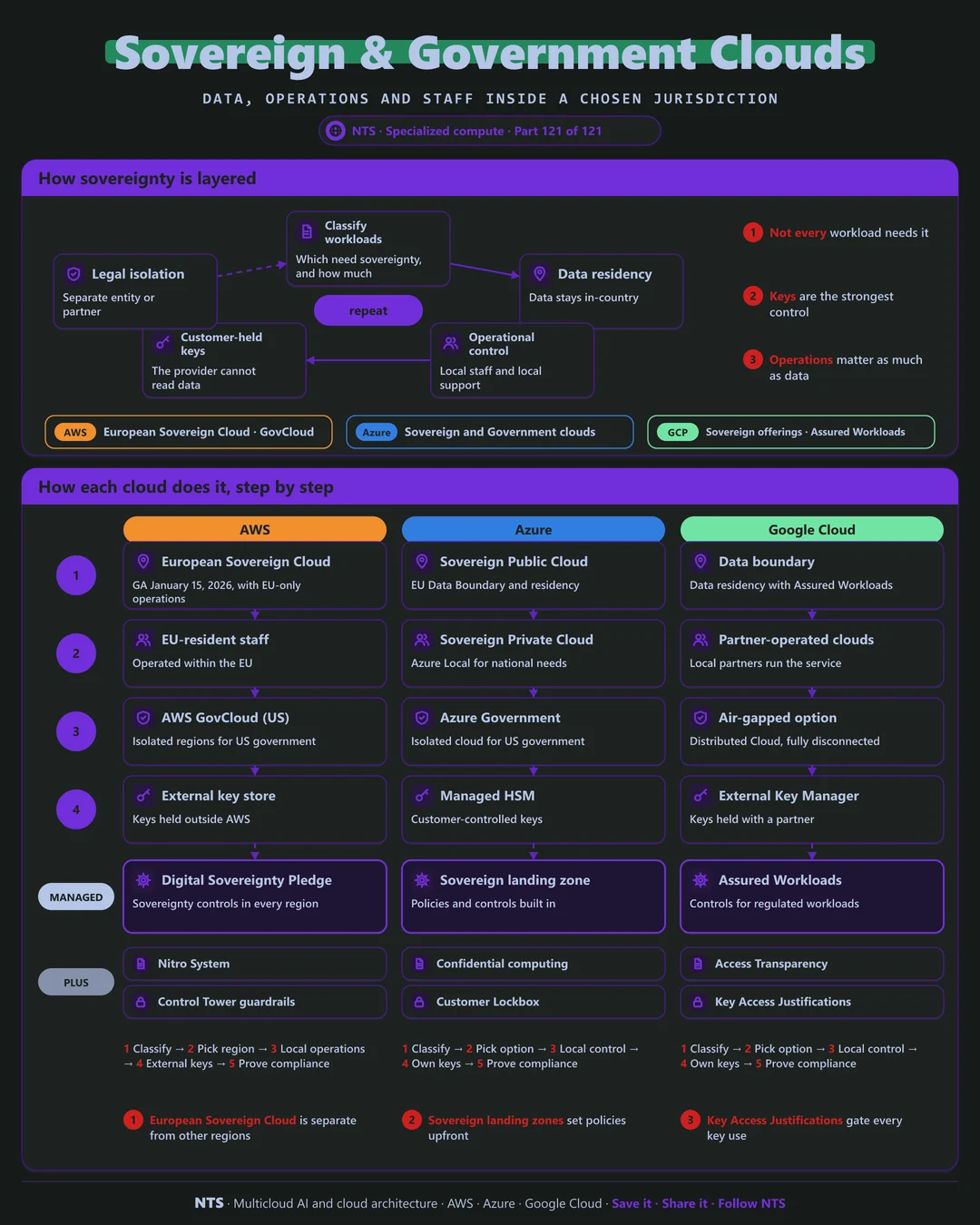
Classify workloads by how much sovereignty they need. Ensure data residency in-country. Add operational control with local staff and support, customer-held keys so the provider cannot read data and, at the highest level, legal isolation through a separate entity or local partner.
AWS, Azure and Google Cloud compared
| AWS | Azure | Google Cloud | |
|---|---|---|---|
| Sovereign offering | AWS European Sovereign Cloud (GA Jan 15, 2026) | Microsoft Sovereign Cloud offerings | Sovereign offerings with local partners |
| Government cloud | AWS GovCloud (US) | Azure Government | Assured Workloads for government |
| Customer-held keys | External key store | Managed HSM | Cloud External Key Manager |
| Provider access control | Nitro System design | Customer Lockbox | Access Approval, Key Access Justifications |
| Disconnected option | Outposts and edge options | Azure Local | Distributed Cloud air-gapped |
What makes each cloud different
AWS
The AWS European Sovereign Cloud, generally available since January 15, 2026, is separate from other AWS regions and operated within the EU, while AWS GovCloud (US) serves US government workloads.
Azure
Microsoft offers sovereign public and private cloud options, including the EU Data Boundary and Azure Local for national needs, Azure Government for the US and sovereign landing zones that set policies upfront.
Google Cloud
Google Cloud combines Assured Workloads controls, partner-operated sovereign clouds and fully air-gapped Distributed Cloud, with Key Access Justifications gating every use of your keys.
Design decisions that matter
- 01Classify before choosing
Not every workload needs a sovereign cloud.
- 02Customer-held keys for the most sensitive data
The strongest technical control.
- 03Check service availability
Sovereign clouds may offer fewer services.
- 04Document the controls
Evidence for regulators and customers.
Common mistakes we see
- Sovereign everything. Higher cost and fewer services for no benefit.
- Residency without operational control. Not enough for some regulators.
- Ignoring AI services. Model availability differs in sovereign regions.
A practical 30-day plan
- Week 1
Classify workloads by sovereignty requirement.
- Week 2
Map requirements to provider options.
- Week 3
Pilot one workload with customer-held keys.
- Week 4
Document controls and the target architecture.
How NTS helps
NTS advises on digital sovereignty across AWS, Azure and Google Cloud, covering workload classification, sovereign and government cloud options, key management and compliance documentation.
What you get
- Workload classification by sovereignty requirement
- Sovereign and government cloud options mapped
- Customer-held key architecture
- Compliance documentation for regulators
Typical outcomes
- Sovereignty requirements met with confidence
- Only the workloads that need it pay the sovereign premium
- Smooth regulatory approvals
How we work with you
- 1Assess
A focused review of your sovereign and government cloud across AWS, Azure and Google Cloud. We look for the gaps we find most often: sovereign everything, residency without operational control and ignoring AI services.
- 2Design
A target architecture and roadmap built on the decisions that matter most: classify before choosing, customer-held keys for the most sensitive data, check service availability and document the controls.
- 3Build
Hands-on delivery alongside your team. We classify workloads by sovereignty requirement, map requirements to provider options, pilot one workload with customer-held keys, and finally document controls and the target architecture.
- 4Run and improve
We track sovereignty rules and provider offerings, and update your architecture as they change.
Why teams choose NTS for sovereign and government cloud
- Right level of control
We avoid both compliance gaps and unnecessary cost.
- Up to date on sovereign options
We know the latest offerings from all three providers.
- Evidence for regulators
We document controls clearly for audits.
Book a free 30-minute review
Talk to an NTS architect about your sovereign and government cloud on AWS, Azure and Google Cloud.