
Multicloud AI & ERP / AI-Ready Cloud Foundations & FinOps
Why it matters
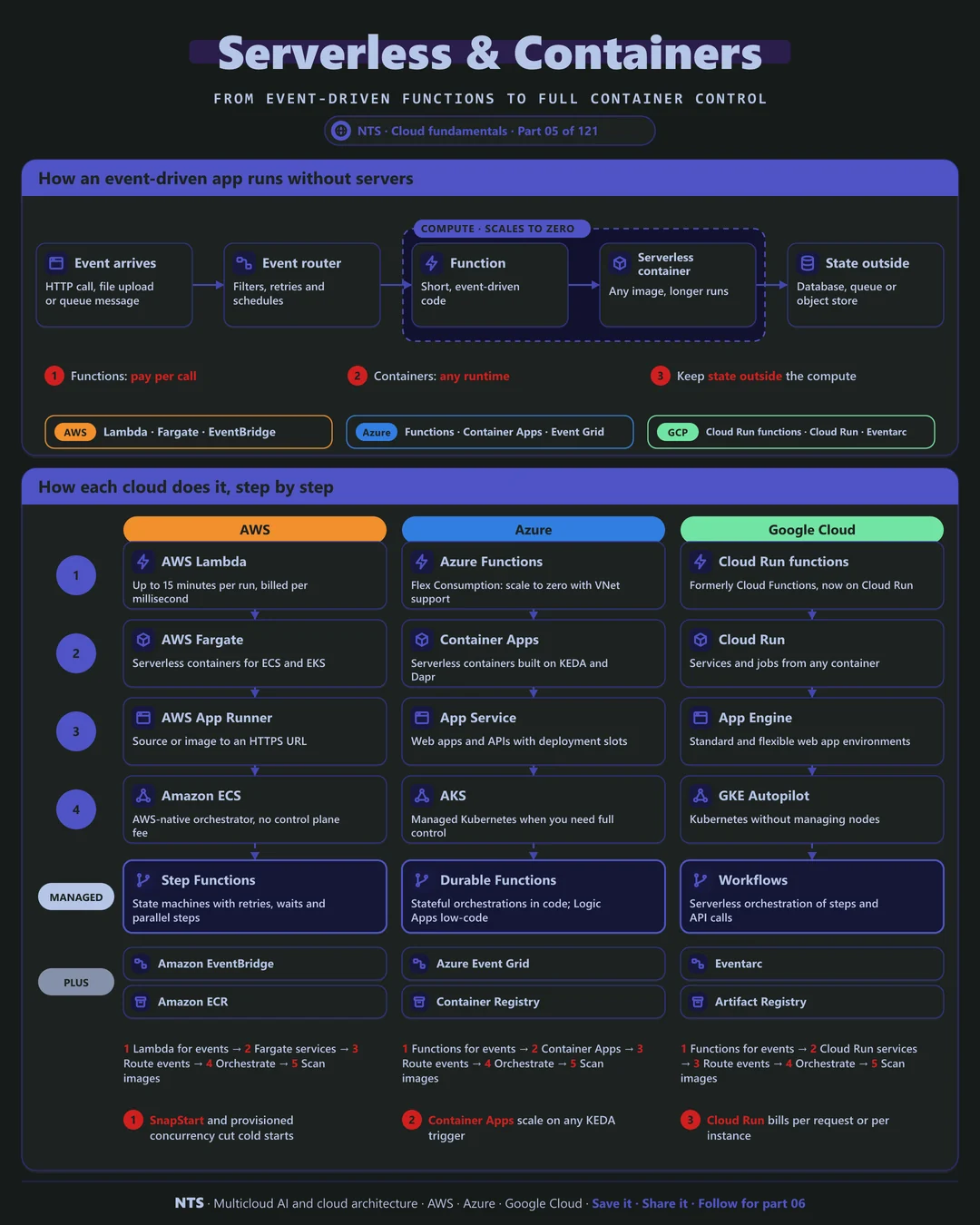
Choosing the right compute model shapes cost, speed of delivery and operations effort for years. Functions remove servers entirely and bill per call; containers bring any runtime and longer jobs; orchestration platforms give full control at the price of more operations.
How it works
How an event-driven app runs
An event arrives: an HTTP request, a file upload or a queue message. An event router filters it and sends it on, with retries and scheduling built in. A function handles short, event-driven work; a serverless container handles anything that needs a custom runtime or runs longer. A workflow engine coordinates multi-step processes, and all state lives outside in databases and queues.
The spectrum of control
From most managed to most control: functions, serverless containers, app platforms, then container orchestration. Moving right adds flexibility and operations work. The rule is to start as far left as the workload allows and move right only when you hit a real limit, such as run time, runtime support or networking needs.
AWS, Azure and Google Cloud compared
| AWS | Azure | Google Cloud | |
|---|---|---|---|
| Functions | AWS Lambda | Azure Functions | Cloud Run functions |
| Serverless containers | AWS Fargate | Azure Container Apps | Cloud Run |
| App platform | AWS App Runner, Elastic Beanstalk | Azure App Service | App Engine |
| Orchestration | Amazon ECS, EKS | Azure Kubernetes Service | GKE Autopilot |
| Event router | Amazon EventBridge | Azure Event Grid | Eventarc |
| Workflows | AWS Step Functions | Durable Functions, Logic Apps | Workflows |
| Image registry | Amazon ECR | Azure Container Registry | Artifact Registry |
What makes each cloud different
AWS
AWS has the most mature serverless ecosystem. Lambda runs up to 15 minutes per invocation with SnapStart and provisioned concurrency to cut cold starts, Fargate runs containers for ECS and EKS without servers, and Step Functions orchestrates hundreds of AWS services directly.
Azure
Azure Functions on the Flex Consumption plan scales to zero with VNet integration, and Azure Container Apps runs containers on a managed Kubernetes base with KEDA autoscaling and Dapr building blocks. Durable Functions write long-running orchestrations in code.
Google Cloud
Google Cloud consolidated on Cloud Run: services and jobs from any container, scaling to zero, with Cloud Run functions (formerly Cloud Functions) on the same platform. Eventarc routes Google and custom events to it, and Workflows orchestrates steps and API calls.
Design decisions that matter
- 01Default to the most managed option
Pick functions or serverless containers until a concrete limit forces a change.
- 02Keep compute stateless
Store state in databases, caches and queues so any instance can be replaced.
- 03Use events, not direct calls, between services
Routers and queues absorb spikes and failures.
- 04Orchestrate long processes
Use a workflow engine for retries, waits and human approvals.
- 05Scan every image
Registries should block images with critical vulnerabilities.
Common mistakes we see
- Chains of functions calling functions. Hard to debug and expensive; use a workflow engine instead.
- Kubernetes for a simple web app. Operations cost outweighs the benefit for small teams.
- Ignoring cold starts. Latency-sensitive paths need warm capacity or a container.
- Unbounded concurrency. A traffic spike can overwhelm a database; set limits.
A practical 30-day plan
- Week 1
Classify workloads by run time, runtime needs and traffic pattern.
- Week 2
Move event-driven tasks to functions and stateless services to serverless containers.
- Week 3
Introduce an event router and a workflow engine for multi-step processes.
- Week 4
Add image scanning, concurrency limits and cost dashboards.
How NTS helps
NTS designs and builds serverless and container platforms on AWS, Azure and Google Cloud, from event-driven architectures and workflow orchestration to container platforms with secure supply chains. We help teams pick the right model per workload instead of one size for all.
What you get
- A clear decision guide for functions, containers and Kubernetes
- A production-ready container platform with CI/CD
- Event-driven patterns with retries, queues and dead-letter handling
- Cost and performance tuning for serverless workloads
Typical outcomes
- Faster delivery of new services
- Lower costs for spiky or low-traffic workloads
- Less time spent managing servers
How we work with you
- 1Assess
A focused review of your serverless and container platforms across AWS, Azure and Google Cloud. We look for the gaps we find most often: chains of functions calling functions, Kubernetes for a simple web app, ignoring cold starts and unbounded concurrency.
- 2Design
A target architecture and roadmap built on the decisions that matter most: default to the most managed option, keep compute stateless, use events, not direct calls, between services, orchestrate long processes and scan every image.
- 3Build
Hands-on delivery alongside your team. We classify workloads by run time, runtime needs and traffic pattern, move event-driven tasks to functions and stateless services to serverless containers, introduce an event router and a workflow engine for multi-step processes, and finally add image scanning, concurrency limits and cost dashboards.
- 4Run and improve
We tune memory, concurrency and scaling settings, and keep runtimes and base images current and secure.
Why teams choose NTS for serverless and container platforms
- The simplest platform that works
We start with serverless where it fits and add Kubernetes only when it earns its complexity.
- Production patterns, not demos
Idempotency, retries, observability and limits are designed in from the start.
- Developers move faster
We give teams templates so a new service goes live in hours.
Book a free 30-minute review
Talk to an NTS architect about your serverless and container platforms on AWS, Azure and Google Cloud.