
Multicloud AI & ERP / AI-Ready Cloud Foundations & FinOps
Why it matters
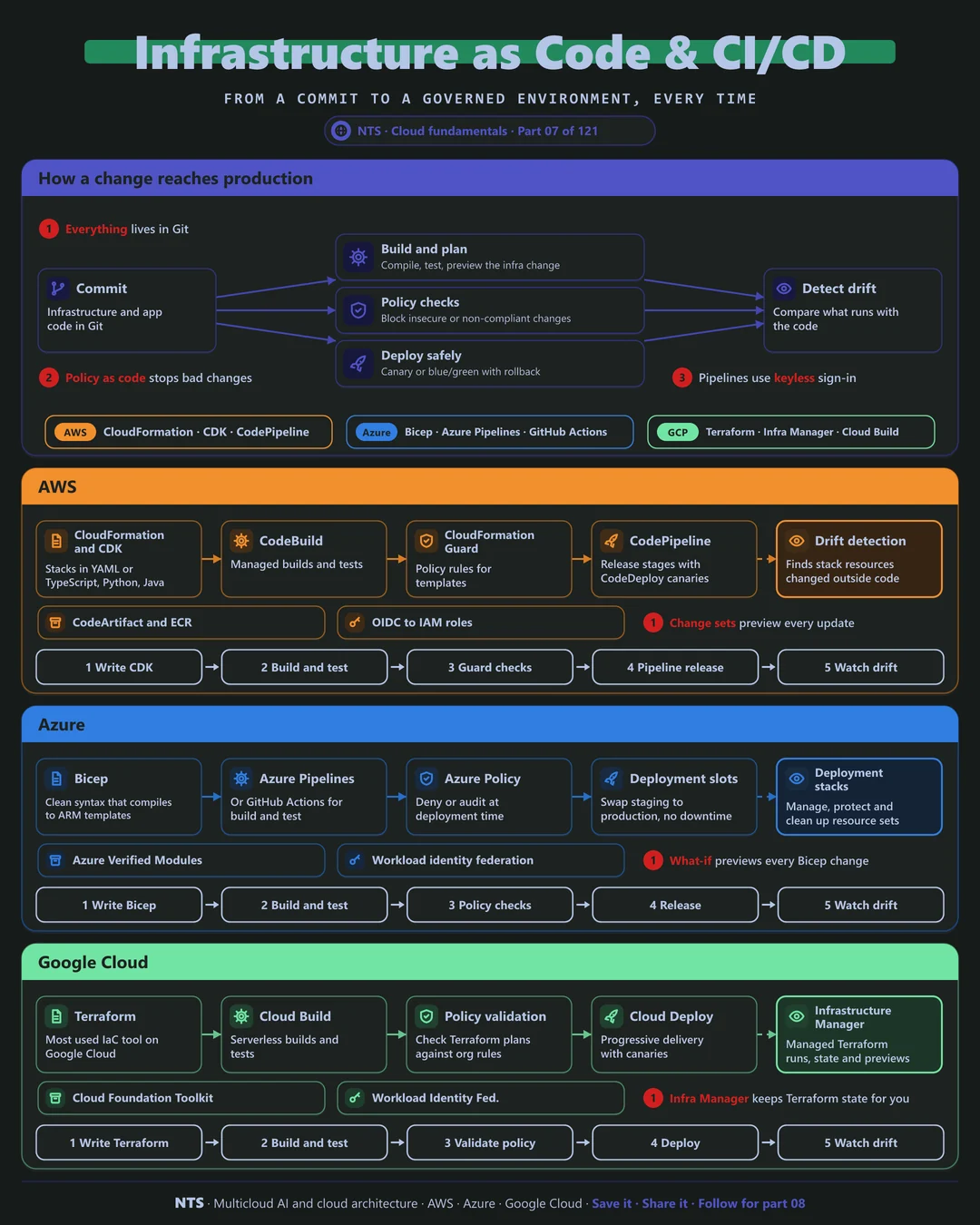
Manual changes cause most configuration drift and many outages. Code makes infrastructure reviewable like software, reproducible in every region and recoverable after a disaster, and pipelines enforce policy before anything reaches production.
How it works
From commit to production
Everything starts in Git: infrastructure definitions and application code. A pipeline builds and plans the change, showing exactly what will be created, modified or destroyed. Policy checks block insecure or non-compliant changes before deployment. Releases roll out safely with canary or blue/green strategies and automatic rollback.
Finally, drift detection compares what is running with what the code says, catching manual changes before they cause surprises.
Keyless pipelines
Pipelines need cloud access, but stored access keys are a top cause of breaches. All three clouds support OIDC federation: the CI system proves its identity and receives a short-lived token, so no secret is ever stored.
AWS, Azure and Google Cloud compared
| AWS | Azure | Google Cloud | |
|---|---|---|---|
| Native IaC | CloudFormation, CDK | Bicep (ARM) | Infrastructure Manager (Terraform) |
| Change preview | Change sets | What-if | Terraform plan, previews |
| Build service | CodeBuild | Azure Pipelines, GitHub Actions | Cloud Build |
| Policy as code | CloudFormation Guard | Azure Policy | Policy validation, Org Policy |
| Progressive delivery | CodeDeploy, CodePipeline | Deployment slots | Cloud Deploy |
| Keyless CI access | OIDC to IAM roles | Workload identity federation | Workload Identity Federation |
| Drift handling | Drift detection | Deployment stacks | Infra Manager state and previews |
What makes each cloud different
AWS
AWS pairs CloudFormation with the CDK, which lets teams define infrastructure in TypeScript, Python or Java. Change sets preview every update, CloudFormation Guard enforces policy rules, and drift detection finds resources changed outside code.
Azure
Azure's Bicep offers clean syntax that compiles to ARM templates, with what-if previews and Azure Verified Modules for tested building blocks. Deployment stacks manage and protect groups of resources, and GitHub Actions or Azure Pipelines run the delivery.
Google Cloud
Google Cloud embraces Terraform as its main IaC language. Infrastructure Manager runs Terraform as a managed service and keeps state for you, the Cloud Foundation Toolkit provides blueprints, and Cloud Deploy handles progressive delivery to GKE and Cloud Run.
Design decisions that matter
- 01No console changes in production
Read-only console access for people; changes only through pipelines.
- 02Preview every change
Require plan or what-if output in every pull request.
- 03Policy as code before deploy
Fail the pipeline on security and compliance violations.
- 04Keyless pipelines
Replace stored cloud keys with OIDC federation.
- 05Small, reversible releases
Use canaries and automatic rollback.
Common mistakes we see
- Click-ops in production. Undocumented changes break the next deployment.
- One giant state file. A single Terraform state for everything slows teams and widens blast radius.
- Secrets in pipeline variables. Long-lived keys leak; use federation and a secrets manager.
- No drift detection. Manual fixes silently diverge from code.
A practical 30-day plan
- Week 1
Pick the IaC tool and module structure; import critical resources.
- Week 2
Build the pipeline with plan, policy checks and approvals.
- Week 3
Switch pipelines to OIDC federation and remove stored keys.
- Week 4
Enable drift detection and lock production consoles to read-only.
How NTS helps
NTS sets up infrastructure as code and delivery pipelines on AWS, Azure and Google Cloud: module libraries, policy as code, keyless CI/CD, progressive delivery and drift detection. We also import existing hand-built estates into code without downtime.
What you get
- Reusable Terraform, Bicep or Pulumi modules for your standards
- CI/CD pipelines with tests, policy checks and approvals
- Keyless deployments using OIDC workload identity
- Drift detection and a clear promotion path to production
Typical outcomes
- Repeatable environments created in minutes
- Fewer failed deployments and faster rollbacks
- A full audit trail for every infrastructure change
How we work with you
- 1Assess
A focused review of your infrastructure as code and CI/CD across AWS, Azure and Google Cloud. We look for the gaps we find most often: click-ops in production, one giant state file, secrets in pipeline variables and no drift detection.
- 2Design
A target architecture and roadmap built on the decisions that matter most: no console changes in production, preview every change, policy as code before deploy, keyless pipelines and small, reversible releases.
- 3Build
Hands-on delivery alongside your team. We pick the IaC tool and module structure; import critical resources, build the pipeline with plan, policy checks and approvals, switch pipelines to OIDC federation and remove stored keys, and finally enable drift detection and lock production consoles to read-only.
- 4Run and improve
We maintain shared modules, pipeline templates and tool versions, and help teams adopt them across the organization.
Why teams choose NTS for infrastructure as code and CI/CD
- Everything as code
We turn manual console work into reviewed, repeatable code that anyone on the team can run.
- Security built into the pipeline
Policy checks and secret scanning stop problems before they reach production.
- Faster with guardrails
Teams ship more often because every change follows the same safe path.
Book a free 30-minute review
Talk to an NTS architect about your infrastructure as code and CI/CD on AWS, Azure and Google Cloud.