
Multicloud AI & ERP / AI-Ready Cloud Foundations & FinOps
Why it matters
Architecture reviews catch the expensive problems early: single points of failure, missing encryption, uncontrolled costs and fragile operations. The frameworks turn years of provider experience into concrete questions you can answer in a few hours.
How it works
The shared pillars
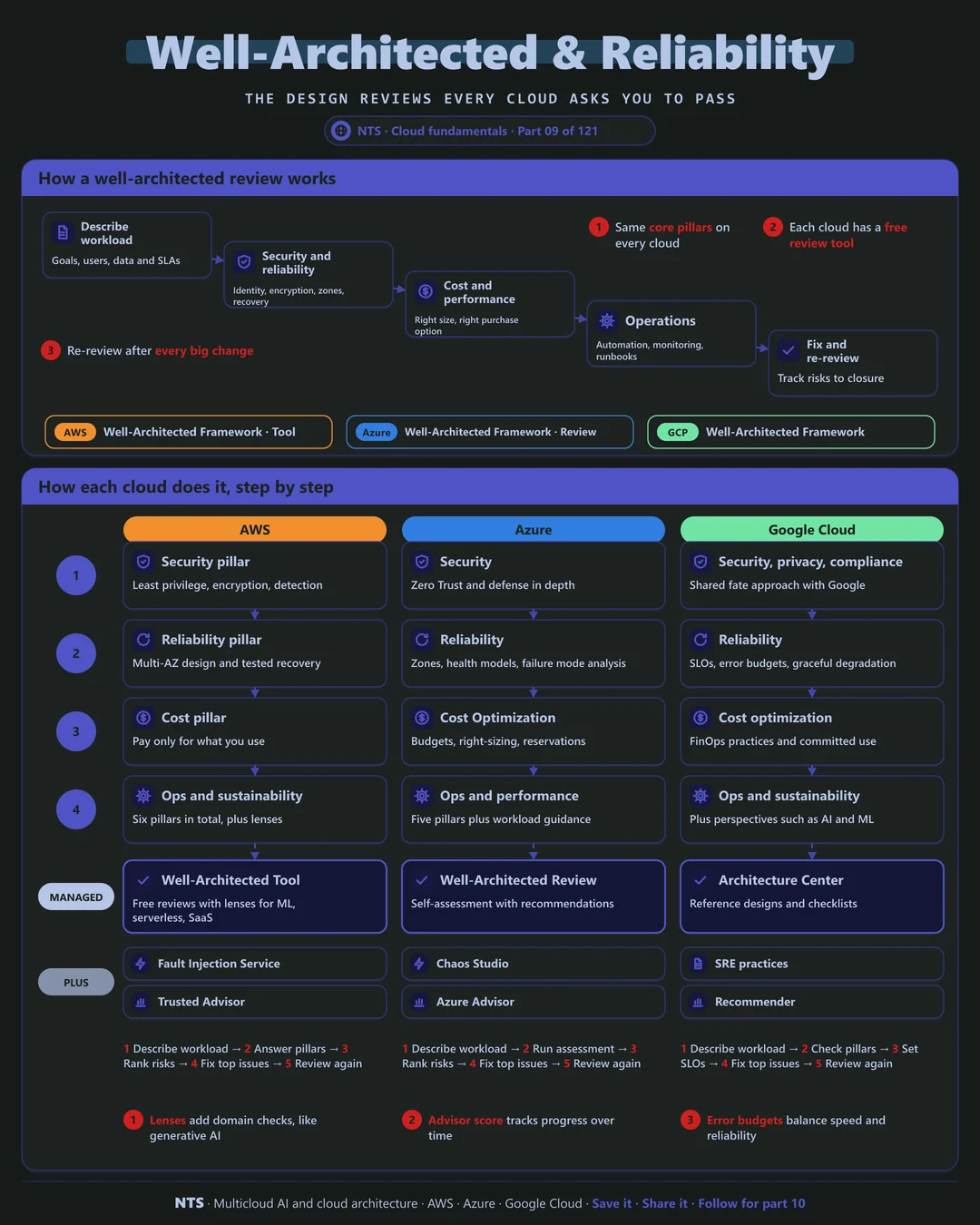
All three frameworks cover the same core: security, reliability, cost optimization, operational excellence and performance efficiency, with sustainability guidance on top. Each pillar comes with design principles, questions and recommended practices.
How a review works
Describe the workload, answer the questions pillar by pillar, then rank the risks found. Fix the high-risk items first and record decisions for the rest. Repeat the review after every major change, not once a year, so findings stay current.
AWS, Azure and Google Cloud compared
| AWS | Azure | Google Cloud | |
|---|---|---|---|
| Framework | AWS Well-Architected Framework | Azure Well-Architected Framework | Google Cloud Well-Architected Framework |
| Pillars | 6 pillars | 5 pillars | Pillars plus perspectives |
| Domain guidance | Lenses (ML, serverless, SaaS) | Workload guidance (AI, mission-critical) | Perspectives (AI and ML, industries) |
| Review tool | Well-Architected Tool | Well-Architected Review | Architecture Center checklists |
| Ongoing advice | Trusted Advisor | Azure Advisor | Recommender |
| Resilience testing | Fault Injection Service | Chaos Studio | Partner tools |
What makes each cloud different
AWS
AWS's framework has six pillars including sustainability, and its lenses add domain-specific questions for areas such as generative AI, machine learning, serverless and SaaS. The free Well-Architected Tool tracks reviews and improvement plans.
Azure
Azure's framework covers five pillars with deep workload guidance for areas such as AI and mission-critical systems. The Well-Architected Review produces recommendations, and Azure Advisor scores your resources against the pillars continuously.
Google Cloud
Google Cloud's framework adds perspectives for areas such as AI and ML and specific industries, and strongly reflects Google's SRE practice: SLOs, error budgets and blameless postmortems. Recommender surfaces cost, security and reliability improvements.
Design decisions that matter
- 01Review before every go-live
Make a Well-Architected review a release gate for production.
- 02Use the domain lenses
AI and serverless workloads need their specific questions.
- 03Track risks to closure
Record each finding with an owner and a date.
- 04Automate the checks
Turn recurring findings into policy and pipeline checks.
- 05Test reliability for real
Run fault injection to prove recovery works.
Common mistakes we see
- A one-time review. Architectures drift; findings expire.
- Reviewing in isolation. Security, operations and finance must be in the room.
- Fixing low risks first. Easy fixes feel productive but leave the big risks open.
- Ignoring cost and sustainability. These pillars often hold the fastest wins.
A practical 30-day plan
- Week 1
Pick the top three workloads and schedule reviews.
- Week 2
Run the reviews with the relevant lenses.
- Week 3
Fix the high-risk findings and assign owners for the rest.
- Week 4
Automate recurring checks and set a review cadence.
How NTS helps
NTS runs Well-Architected reviews on AWS, Azure and Google Cloud and, more importantly, fixes what they find: resilience gaps, security risks, cost waste and operational weak spots. Reviews come with a prioritized roadmap, not just a report.
What you get
- A Well-Architected review of your critical workloads
- A prioritized risk register with clear owners
- Reliability fixes for single points of failure
- Recovery runbooks and a game-day schedule
Typical outcomes
- Fewer high-risk findings over time
- Higher availability for critical services
- Leaders who know exactly where the risks are
How we work with you
- 1Assess
A focused review of your architecture reviews and reliability across AWS, Azure and Google Cloud. We look for the gaps we find most often: a one-time review, reviewing in isolation, fixing low risks first and ignoring cost and sustainability.
- 2Design
A target architecture and roadmap built on the decisions that matter most: review before every go-live, use the domain lenses, track risks to closure, automate the checks and test reliability for real.
- 3Build
Hands-on delivery alongside your team. We pick the top three workloads and schedule reviews, run the reviews with the relevant lenses, fix the high-risk findings and assign owners for the rest, and finally automate recurring checks and set a review cadence.
- 4Run and improve
We repeat reviews every six to twelve months and track progress on every risk until it is closed.
Why teams choose NTS for architecture reviews and reliability
- Independent, three-cloud view
We review against AWS, Azure and Google Cloud frameworks without vendor bias.
- From findings to fixes
We do not just hand over a report; we help close the gaps.
- Business-first priorities
We rank risks by impact on customers and revenue, not by checklist order.
Book a free 30-minute review
Talk to an NTS architect about your architecture reviews and reliability on AWS, Azure and Google Cloud.