
Multicloud AI & ERP / Cloud Networking, Edge & Zero Trust for AI
Why it matters
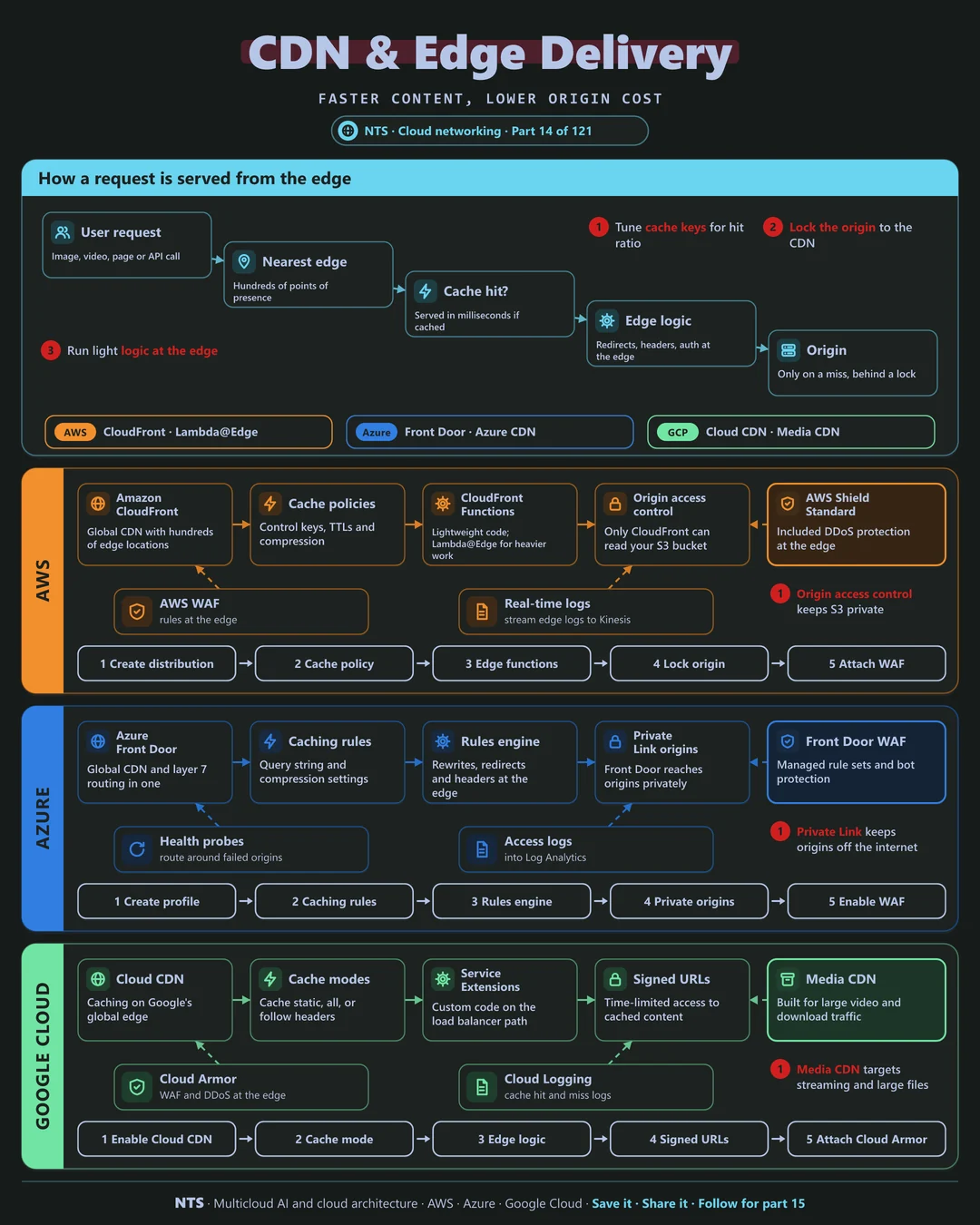
Every request served from the edge is one your origin never sees: faster for users, cheaper for you and more resilient during spikes. A content delivery network is also the first line of defense against DDoS attacks.
How it works
How edge delivery works
A user request reaches the nearest point of presence. On a cache hit, the response returns in milliseconds. On a miss, the CDN fetches from the origin, caches the result according to your rules, and serves the next user from the edge.
Hit ratio and origin protection
The cache key decides what counts as the same object; including unnecessary headers or query strings destroys the hit ratio. Origin protection ensures only the CDN can reach the origin, so attackers cannot bypass the edge. Lightweight edge functions handle redirects, headers and simple authentication close to users.
AWS, Azure and Google Cloud compared
| AWS | Azure | Google Cloud | |
|---|---|---|---|
| CDN | Amazon CloudFront | Azure Front Door | Cloud CDN, Media CDN |
| Edge logic | CloudFront Functions, Lambda@Edge | Rules engine | Service Extensions |
| Origin protection | Origin access control | Private Link origins | Signed requests, private origins |
| Edge WAF | AWS WAF | Front Door WAF | Cloud Armor |
| DDoS protection | Shield Standard included | Built into Front Door | Built into the edge |
| Large video delivery | CloudFront | Front Door | Media CDN |
What makes each cloud different
AWS
CloudFront has a very large edge footprint and two tiers of edge code: lightweight CloudFront Functions and more capable Lambda@Edge. Origin access control keeps S3 buckets private, and AWS Shield Standard protects every distribution at no extra cost.
Azure
Azure Front Door combines CDN, global layer 7 routing and WAF in one service, and can reach origins over Private Link so backends never need public endpoints. A rules engine handles rewrites and redirects at the edge.
Google Cloud
Google offers Cloud CDN on top of its global load balancer and Media CDN, built on the same infrastructure as YouTube, for large video and download workloads. Cloud Armor applies WAF and DDoS policies at the edge.
Design decisions that matter
- 01Design cache keys deliberately
Include only what changes the response.
- 02Lock the origin
Only the CDN may reach it.
- 03WAF at the edge
Stop attacks before they reach the region.
- 04Version static assets
Long cache times with file names that change on release.
Common mistakes we see
- Caching nothing dynamic. Many API responses can be cached for seconds with big gains.
- Open origins. Attackers bypass the CDN and its protections.
- Purging the whole cache on every release. Causes an origin traffic spike every deploy.
A practical 30-day plan
- Week 1
Measure current hit ratio and origin load.
- Week 2
Fix cache keys and add versioned asset names.
- Week 3
Lock origins and attach edge WAF policies.
- Week 4
Move simple logic to edge functions and review latency gains.
How NTS helps
NTS optimizes content delivery on AWS, Azure and Google Cloud: CDN design, cache tuning, origin protection, edge security and edge functions, measured by hit ratio, latency and cost.
What you get
- CDN configuration with caching rules per content type
- WAF and bot protection at the edge
- Origin shielding and failover
- Performance and cache-hit dashboards
Typical outcomes
- Faster page loads worldwide
- Higher cache-hit rates and lower origin load
- Protection from bots and DDoS attacks
How we work with you
- 1Assess
A focused review of your CDN and edge delivery across AWS, Azure and Google Cloud. We look for the gaps we find most often: caching nothing dynamic, open origins and purging the whole cache on every release.
- 2Design
A target architecture and roadmap built on the decisions that matter most: design cache keys deliberately, lock the origin, WAF at the edge and version static assets.
- 3Build
Hands-on delivery alongside your team. We measure current hit ratio and origin load, fix cache keys and add versioned asset names, lock origins and attach edge WAF policies, and finally move simple logic to edge functions and review latency gains.
- 4Run and improve
We tune cache rules, WAF policies and edge functions as your content and threats change.
Why teams choose NTS for CDN and edge delivery
- Faster sites, lower bills
Better caching reduces both page load times and origin costs.
- Security at the edge
We stop attacks before they reach your applications.
- Global audience expertise
We tune delivery for users across regions and devices.
Book a free 30-minute review
Talk to an NTS architect about your CDN and edge delivery on AWS, Azure and Google Cloud.