
Multicloud AI & ERP / Cloud Data, Analytics & BI for AI
Why it matters
Key-value and document databases power shopping carts, user profiles, gaming and IoT, anywhere millisecond responses at huge scale matter. Modeled well, they scale almost without limit; modeled badly, they produce hot partitions, throttling and surprising bills.
How it works
Access patterns first
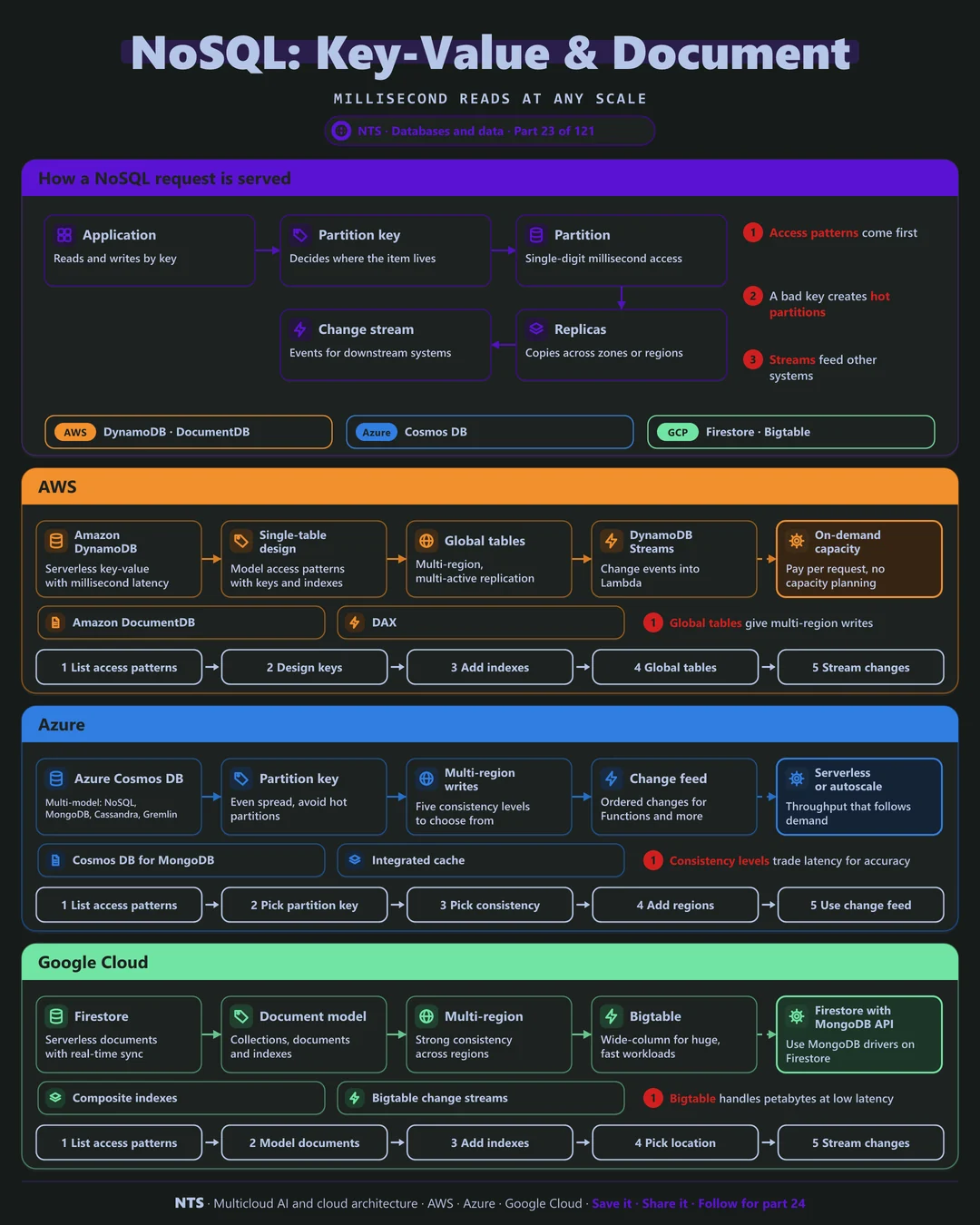
In relational design you model the data, then write queries. In NoSQL you list the queries first, then design keys and indexes that answer each one with a direct lookup. The partition key decides where each item lives; a key with too few values creates hot partitions that throttle under load.
Global scale and change streams
Multi-region replication lets users read and write close to home. Change streams emit every insert and update as an event, feeding search indexes, analytics and downstream services without extra code.
AWS, Azure and Google Cloud compared
| AWS | Azure | Google Cloud | |
|---|---|---|---|
| Key-value / document | Amazon DynamoDB | Azure Cosmos DB | Firestore |
| Wide-column | Amazon Keyspaces | Cosmos DB for Apache Cassandra | Bigtable |
| MongoDB compatible | Amazon DocumentDB | Cosmos DB for MongoDB | Firestore with MongoDB compatibility |
| Multi-region writes | Global tables | Multi-region writes | Multi-region instances |
| Change events | DynamoDB Streams | Change feed | Change streams, Firestore triggers |
| Capacity model | On-demand or provisioned | Serverless, autoscale or provisioned | Serverless |
What makes each cloud different
AWS
DynamoDB is serverless with single-digit millisecond latency at any scale. Single-table design models many access patterns with composite keys and secondary indexes, global tables provide multi-region active-active writes, and DAX adds an in-memory cache.
Azure
Cosmos DB is multi-model, offering NoSQL, MongoDB, Cassandra, Gremlin and Table APIs on one engine, with five consistency levels from strong to eventual so you can trade latency for accuracy per workload. Throughput is measured in request units.
Google Cloud
Google offers Firestore for serverless documents with real-time sync to mobile and web clients, and Bigtable for wide-column workloads at petabyte scale and very high write rates, such as time series and personalization.
Design decisions that matter
- 01Write down access patterns first
Every key and index should answer a known query.
- 02High-cardinality partition keys
Spread load evenly to avoid throttling.
- 03Use change streams instead of dual writes
One source of truth, many consumers.
- 04Choose consistency deliberately
Strong where correctness matters, eventual where speed does.
Common mistakes we see
- Relational habits in NoSQL. Normalized tables need many reads per request.
- Low-cardinality keys. A status or date key creates hot partitions.
- Scans in production code. Full-table reads are slow and expensive.
A practical 30-day plan
- Week 1
List access patterns for the target application.
- Week 2
Design keys and indexes; load test with realistic data.
- Week 3
Set capacity mode and multi-region needs.
- Week 4
Connect change streams to search and analytics.
How NTS helps
NTS designs and migrates NoSQL workloads on DynamoDB, Cosmos DB, Firestore and Bigtable: data modeling, capacity planning, multi-region design and migrations from MongoDB or Cassandra.
What you get
- Data models designed around your access patterns
- Partition keys that avoid hot spots
- Capacity mode and cost tuning
- Global replication where it is needed
Typical outcomes
- Consistent low latency at any scale
- No hot partitions or throttling
- Lower NoSQL costs
How we work with you
- 1Assess
A focused review of your NoSQL databases across AWS, Azure and Google Cloud. We look for the gaps we find most often: relational habits in NoSQL, low-cardinality keys and scans in production code.
- 2Design
A target architecture and roadmap built on the decisions that matter most: write down access patterns first, high-cardinality partition keys, use change streams instead of dual writes and choose consistency deliberately.
- 3Build
Hands-on delivery alongside your team. We list access patterns for the target application, design keys and indexes; load test with realistic data, set capacity mode and multi-region needs, and finally connect change streams to search and analytics.
- 4Run and improve
We review capacity, costs and access patterns as features evolve, and adjust indexes and modes.
Why teams choose NTS for NoSQL databases
- Access patterns first
We design NoSQL tables around how the application reads and writes.
- Scale without surprises
Good keys and capacity plans prevent throttling at peak.
- Cost clarity
We pick on-demand or provisioned capacity based on real usage.
Book a free 30-minute review
Talk to an NTS architect about your NoSQL databases on AWS, Azure and Google Cloud.