
Multicloud AI & ERP / Cloud Data, Analytics & BI for AI
Why it matters
Data used to be copied between lakes, warehouses and tools, each copy drifting and each adding cost. Open table formats add transactions, schema evolution and time travel to files in object storage, so every engine can work on the same tables.
How it works
Medallion layers
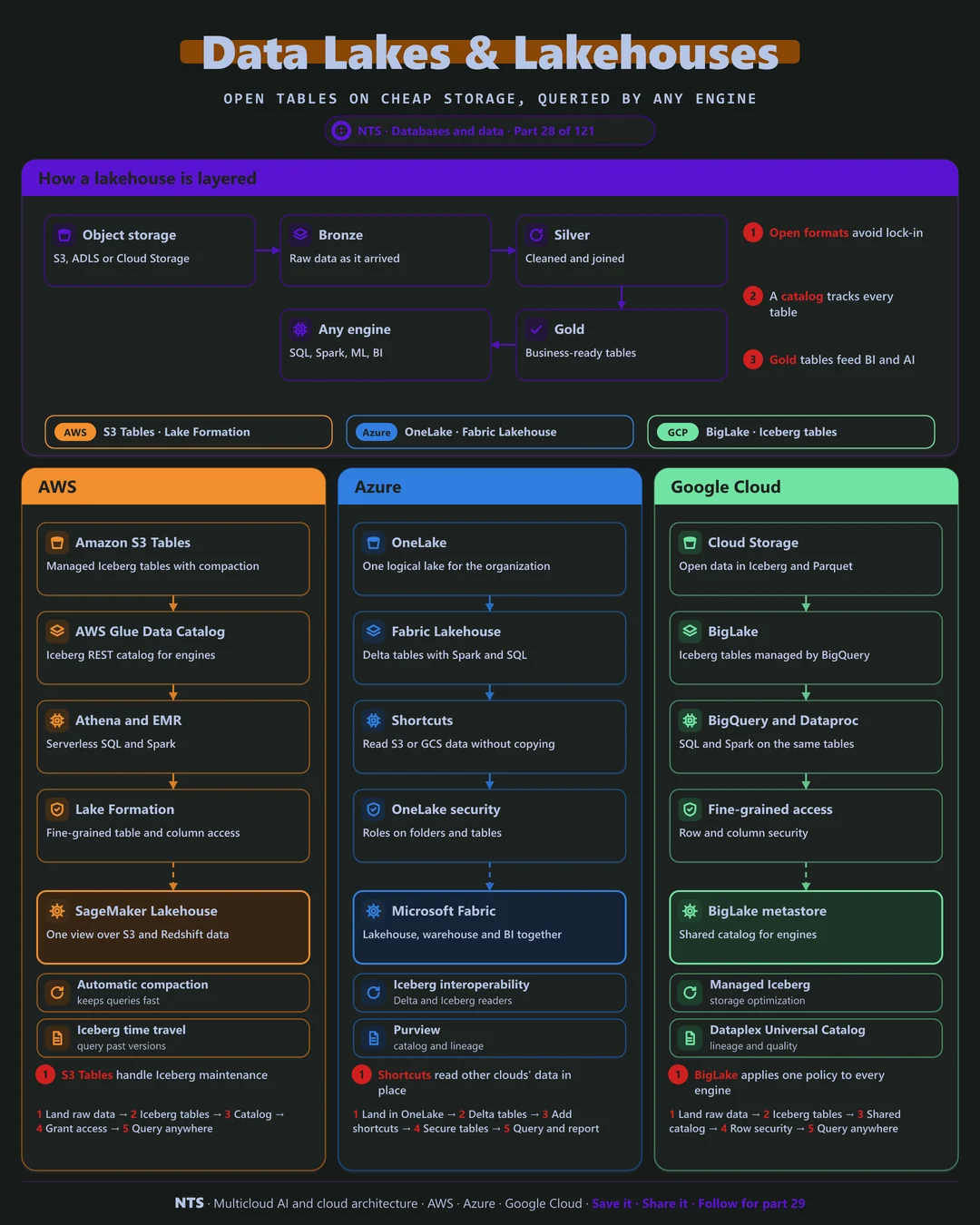
Raw data lands in bronze exactly as it arrived. Silver holds cleaned and joined data. Gold holds business-ready tables for BI and AI. Each layer is an open table, so SQL engines, Spark and ML tools read the same files.
The catalog is the control point
A shared catalog tracks every table, its schema and its permissions. With one catalog, one access policy applies whichever engine runs the query.
AWS, Azure and Google Cloud compared
| AWS | Azure | Google Cloud | |
|---|---|---|---|
| Managed open tables | Amazon S3 Tables (Iceberg) | OneLake (Delta, Iceberg interop) | BigLake Iceberg tables |
| Catalog | Glue Data Catalog | OneLake catalog, Purview | BigLake metastore, Dataplex |
| SQL engine | Athena, Redshift | Fabric SQL | BigQuery |
| Spark | EMR, Glue | Fabric Spark | Dataproc |
| Fine-grained access | Lake Formation | OneLake security | BigLake row and column security |
| Cross-cloud reads | Iceberg REST catalog | Shortcuts to S3 and GCS | BigQuery Omni |
What makes each cloud different
AWS
Amazon S3 Tables store Iceberg tables natively with automatic compaction and maintenance, Glue Data Catalog exposes them to Athena, EMR, Redshift and third-party engines, and Lake Formation applies table, row and column permissions.
Azure
OneLake is Fabric's single lake for the whole organization, storing Delta tables with Iceberg interoperability. Shortcuts read data in S3 or Google Cloud Storage in place, without copying.
Google Cloud
BigLake manages Iceberg tables that BigQuery, Spark and other engines share, with one security policy for all. BigQuery Omni can query data stored on other clouds.
Design decisions that matter
- 01One open format as the standard
Iceberg or Delta, chosen once for the organization.
- 02One catalog, one policy
Permissions apply whichever engine runs the query.
- 03Medallion layers with owners
Each layer has a clear contract and team.
- 04Automate table maintenance
Compaction and snapshot expiry keep queries fast.
Common mistakes we see
- Proprietary formats for core data. Lock-in that blocks new engines later.
- No compaction. Thousands of small files slow every query.
- Several catalogs. Permissions drift and nobody knows the source of truth.
A practical 30-day plan
- Week 1
Choose the table format and catalog.
- Week 2
Land raw data as bronze tables.
- Week 3
Build silver and gold tables for one domain.
- Week 4
Apply fine-grained access and automate maintenance.
How NTS helps
NTS builds lakehouses on AWS, Azure and Google Cloud with Apache Iceberg and Delta Lake: architecture, catalogs, governance and migrations from legacy data lakes and warehouses.
What you get
- A lakehouse on open table formats like Iceberg or Delta
- Bronze, silver and gold data layers
- Catalog and access controls
- Pipelines for batch and streaming data
Typical outcomes
- One copy of data for BI, data science and AI
- Lower storage and compute costs
- Trusted, discoverable datasets
How we work with you
- 1Assess
A focused review of your data lake and lakehouse across AWS, Azure and Google Cloud. We look for the gaps we find most often: proprietary formats for core data, no compaction and several catalogs.
- 2Design
A target architecture and roadmap built on the decisions that matter most: one open format as the standard, one catalog, one policy, medallion layers with owners and automate table maintenance.
- 3Build
Hands-on delivery alongside your team. We choose the table format and catalog, land raw data as bronze tables, build silver and gold tables for one domain, and finally apply fine-grained access and automate maintenance.
- 4Run and improve
We manage table maintenance, quality checks and access as new domains join the platform.
Why teams choose NTS for data lake and lakehouse
- Open formats, no lock-in
We build on Iceberg and Delta so engines and clouds stay interchangeable.
- Data swamps avoided
Layers, catalogs and quality checks keep the lake usable.
- Ready for AI
Clean, governed data feeds both analytics and AI.
Book a free 30-minute review
Talk to an NTS architect about your data lake and lakehouse on AWS, Azure and Google Cloud.