
Multicloud AI & ERP / Cloud Data, Analytics & BI for AI
Why it matters
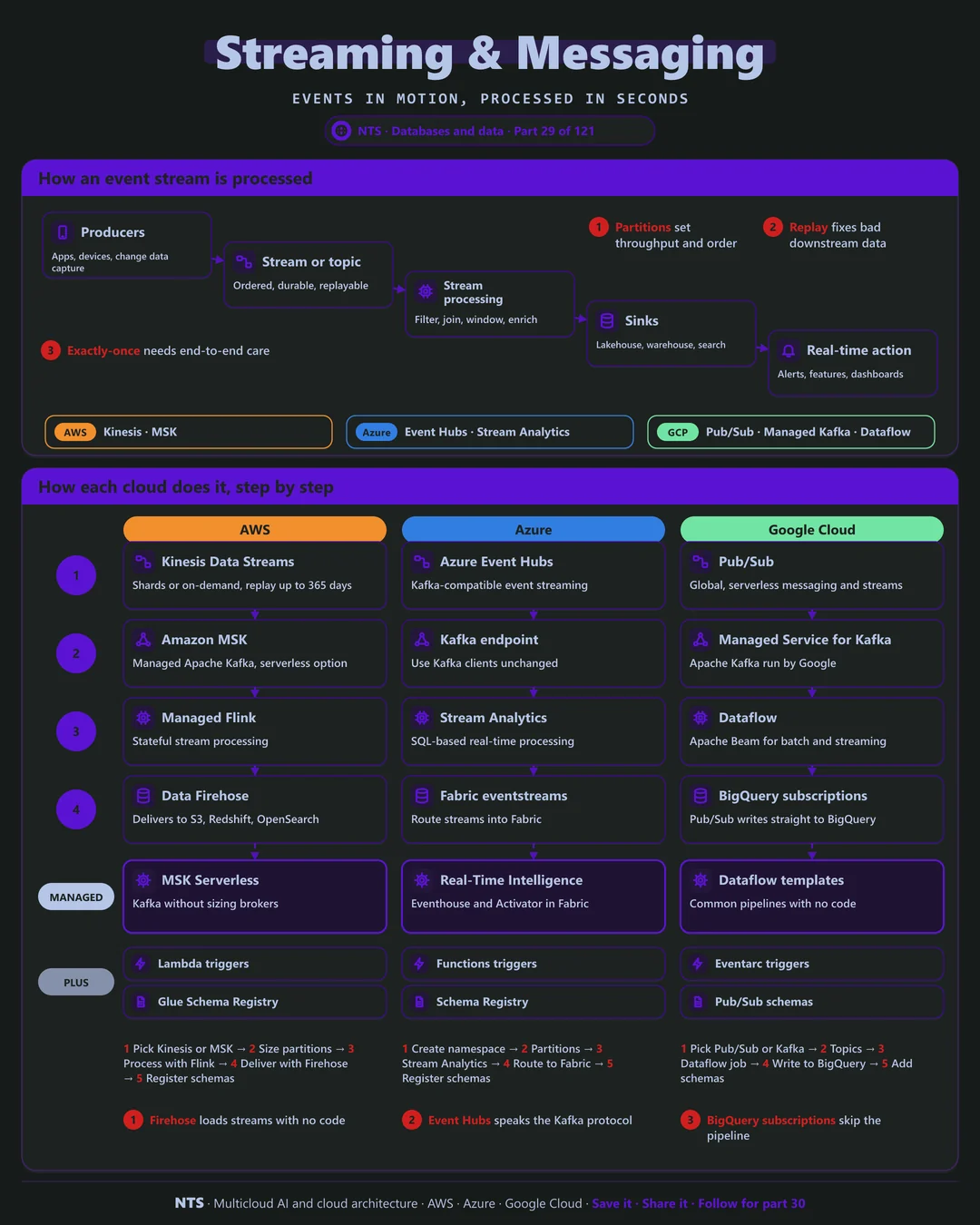
Fraud detection, real-time recommendations, logistics tracking and AI features all depend on fresh data. Nightly batches arrive too late; a streaming backbone delivers events in seconds and lets many systems consume the same data.
How it works
How an event stream is processed
Producers such as apps, devices and database change capture write events to a topic that is ordered, durable and replayable. Stream processing filters, joins and aggregates in flight, and sinks deliver results to lakehouses, warehouses, search and real-time actions.
Partitions and replay
Topics are split into partitions that set throughput and ordering. Because streams are retained, you can replay history to rebuild a downstream system or test a new model.
AWS, Azure and Google Cloud compared
| AWS | Azure | Google Cloud | |
|---|---|---|---|
| Cloud-native streams | Kinesis Data Streams | Azure Event Hubs | Pub/Sub |
| Managed Kafka | Amazon MSK | Event Hubs Kafka endpoint | Managed Service for Apache Kafka |
| Stream processing | Managed Service for Apache Flink | Stream Analytics | Dataflow (Apache Beam) |
| No-code delivery | Data Firehose | Fabric eventstreams | BigQuery subscriptions |
| Schema registry | Glue Schema Registry | Event Hubs schema registry | Pub/Sub schemas |
What makes each cloud different
AWS
AWS offers Kinesis for fully managed streams and Amazon MSK, including a serverless mode, for Kafka. Managed Flink handles stateful processing, and Data Firehose delivers streams to S3, Redshift and OpenSearch without code.
Azure
Azure Event Hubs speaks the Kafka protocol, so Kafka clients connect unchanged. Stream Analytics processes events with SQL, and Fabric Real-Time Intelligence turns streams into eventhouses, dashboards and automated actions.
Google Cloud
Pub/Sub is global and serverless, and Google now runs Managed Service for Apache Kafka. Dataflow runs Apache Beam for unified batch and streaming, and BigQuery subscriptions write messages straight into tables.
Design decisions that matter
- 01Kafka for portability, native for zero operations
Choose per workload, not by habit.
- 02Size partitions for peak throughput
Repartitioning later is disruptive.
- 03Register schemas
Producers and consumers stay compatible.
- 04Keep enough retention to replay
Days or weeks, by recovery need.
Common mistakes we see
- Streaming everything. Some data is fine as a daily batch.
- No schema control. One producer change breaks every consumer.
- Ignoring ordering needs. The wrong partition key scrambles related events.
A practical 30-day plan
- Week 1
Pick the first real-time use case and its sources.
- Week 2
Stand up topics with schemas and retention.
- Week 3
Build the processing job and sinks.
- Week 4
Add monitoring for lag and set up replay procedures.
How NTS helps
NTS builds streaming platforms on AWS, Azure and Google Cloud: Kafka and native streams, change data capture, stream processing and real-time AI features, plus migrations from self-managed Kafka.
What you get
- Event streaming with Kafka, Kinesis, Event Hubs or Pub/Sub
- Schemas and contracts for events
- Exactly-once or idempotent processing patterns
- Lag and throughput monitoring
Typical outcomes
- Real-time data available to every team
- No lost or duplicated events
- Fewer streaming incidents
How we work with you
- 1Assess
A focused review of your streaming and messaging across AWS, Azure and Google Cloud. We look for the gaps we find most often: streaming everything, no schema control and ignoring ordering needs.
- 2Design
A target architecture and roadmap built on the decisions that matter most: Kafka for portability, native for zero operations, size partitions for peak throughput, register schemas and keep enough retention to replay.
- 3Build
Hands-on delivery alongside your team. We pick the first real-time use case and its sources, stand up topics with schemas and retention, build the processing job and sinks, and finally add monitoring for lag and set up replay procedures.
- 4Run and improve
We tune partitions, retention and consumers, and scale the platform as event volumes grow.
Why teams choose NTS for streaming and messaging
- Real-time done reliably
We design for replay, ordering and failure from the start.
- Contracts between teams
Schemas stop one team's change from breaking another's service.
- Managed where possible
We reduce the operational load of running streaming platforms.
Book a free 30-minute review
Talk to an NTS architect about your streaming and messaging on AWS, Azure and Google Cloud.