
Multicloud AI & ERP / Cloud Data, Analytics & BI for AI
Why it matters
Bad data costs more than no data: wrong reports, wrong decisions and AI models trained on errors. Reliable pipelines with quality checks and clear ownership are what make a data platform trusted.
How it works
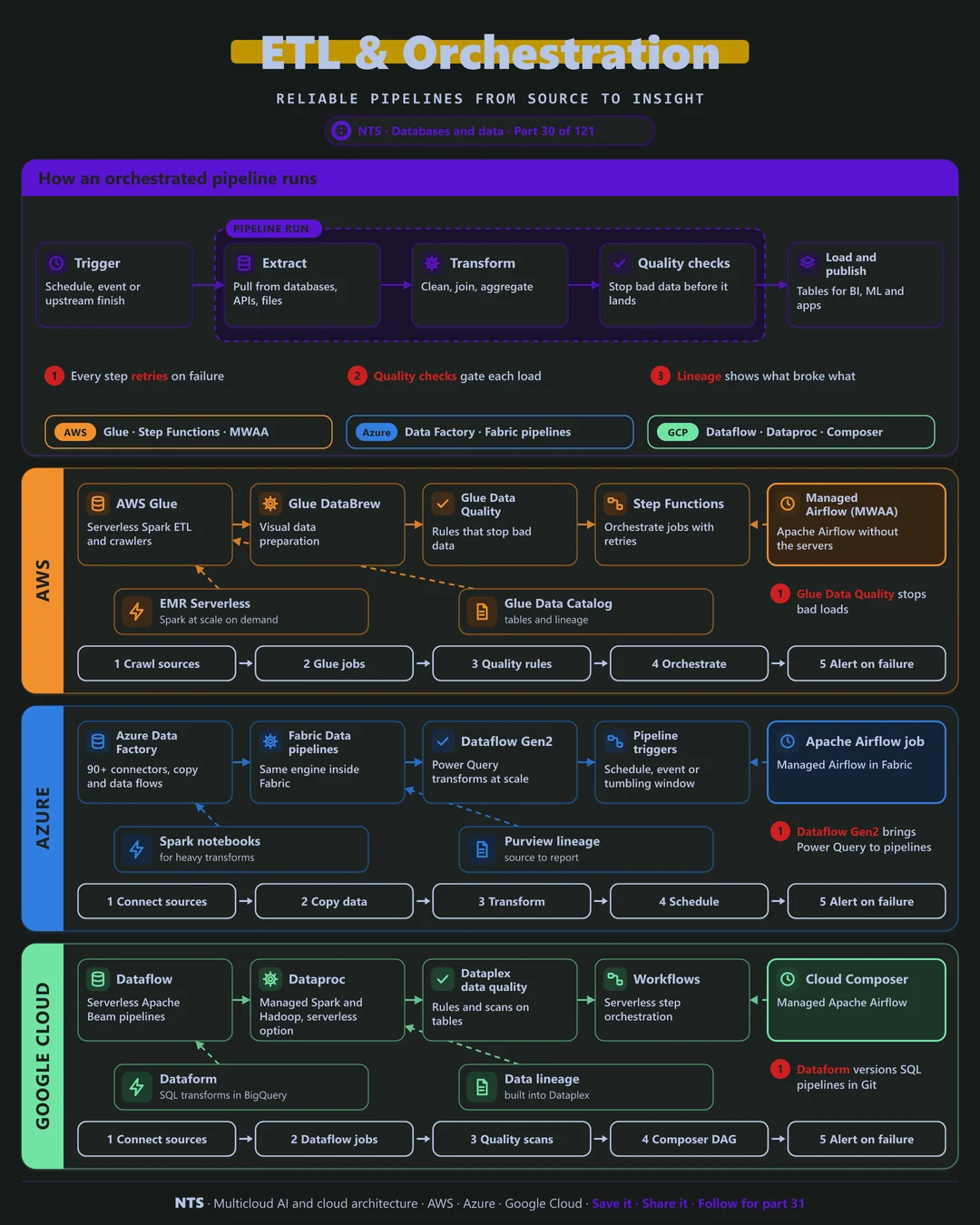
How an orchestrated pipeline runs
A trigger (a schedule, an event or an upstream finish) starts the run. Steps extract from sources, transform the data and run quality checks before anything is loaded. If a check fails, the load stops and the owner is alerted, instead of bad data spreading.
Lineage and ownership
Lineage records which job produced which table from which sources, so when something breaks you can see every affected report. Every pipeline needs a named owner.
AWS, Azure and Google Cloud compared
| AWS | Azure | Google Cloud | |
|---|---|---|---|
| Serverless ETL | AWS Glue | Azure Data Factory, Fabric pipelines | Dataflow |
| Managed Spark | EMR, EMR Serverless | Fabric Spark | Dataproc, Dataproc Serverless |
| Managed Airflow | Amazon MWAA | Apache Airflow job in Fabric | Cloud Composer |
| Data quality | Glue Data Quality | Fabric and Purview data quality | Dataplex data quality |
| SQL transforms | Glue, Redshift | Dataflow Gen2, warehouse | Dataform |
What makes each cloud different
AWS
AWS Glue provides serverless Spark ETL, crawlers and Glue Data Quality rules that stop bad loads. Step Functions and Managed Airflow orchestrate, and EMR Serverless runs heavy Spark jobs on demand.
Azure
Azure Data Factory, also built into Fabric, offers 90-plus connectors for copying and transforming data, with Dataflow Gen2 bringing Power Query transforms at scale. Purview captures lineage from source to report.
Google Cloud
Google's Dataflow runs Apache Beam for batch and streaming, Dataproc runs Spark, Cloud Composer manages Airflow, and Dataform versions SQL transformations in Git inside BigQuery.
Design decisions that matter
- 01Pipelines as code
Versioned, reviewed and deployed through CI/CD.
- 02Quality checks gate every load
Fail fast instead of loading bad data.
- 03Retries with alerting
Transient failures heal; persistent ones page the owner.
- 04Lineage for every table
Know the blast radius before you change anything.
Common mistakes we see
- Cron jobs on a VM. Nobody notices when they stop.
- Quality checks after loading. Bad data has already reached dashboards.
- Pipelines without owners. Failures wait in shared inboxes.
A practical 30-day plan
- Week 1
Inventory pipelines, owners and failure history.
- Week 2
Move the most critical ones to orchestrated, versioned pipelines.
- Week 3
Add quality checks and alerting.
- Week 4
Enable lineage and publish ownership.
How NTS helps
NTS modernizes data pipelines on AWS, Azure and Google Cloud: orchestration, data-quality frameworks, lineage and migrations from legacy ETL tools such as SSIS and Informatica.
What you get
- Pipelines rebuilt as code with tests
- Orchestration with Airflow, Step Functions or Data Factory
- Data quality checks at every stage
- Alerting and retry handling
Typical outcomes
- Fewer broken dashboards
- Faster recovery when pipelines fail
- Trusted data delivered on time
How we work with you
- 1Assess
A focused review of your ETL and orchestration across AWS, Azure and Google Cloud. We look for the gaps we find most often: cron jobs on a VM, quality checks after loading and pipelines without owners.
- 2Design
A target architecture and roadmap built on the decisions that matter most: pipelines as code, quality checks gate every load, retries with alerting and lineage for every table.
- 3Build
Hands-on delivery alongside your team. We inventory pipelines, owners and failure history, move the most critical ones to orchestrated, versioned pipelines, add quality checks and alerting, and finally enable lineage and publish ownership.
- 4Run and improve
We monitor pipeline health, tune schedules and costs, and add sources as the business grows.
Why teams choose NTS for ETL and orchestration
- Reliable pipelines
We make failures visible and recoverable instead of silent.
- Engineering discipline for data
Version control, tests and reviews apply to every pipeline.
- Modern ELT patterns
We push work into scalable engines, not fragile scripts.
Book a free 30-minute review
Talk to an NTS architect about your ETL and orchestration on AWS, Azure and Google Cloud.