
Multicloud AI & ERP / Cloud Data, Analytics & BI for AI
Why it matters
Regulations, customer trust and AI all depend on knowing your data. Without governance, teams cannot find data, sensitive information leaks into analytics and AI, and audits become fire drills.
How it works
Find, classify, control
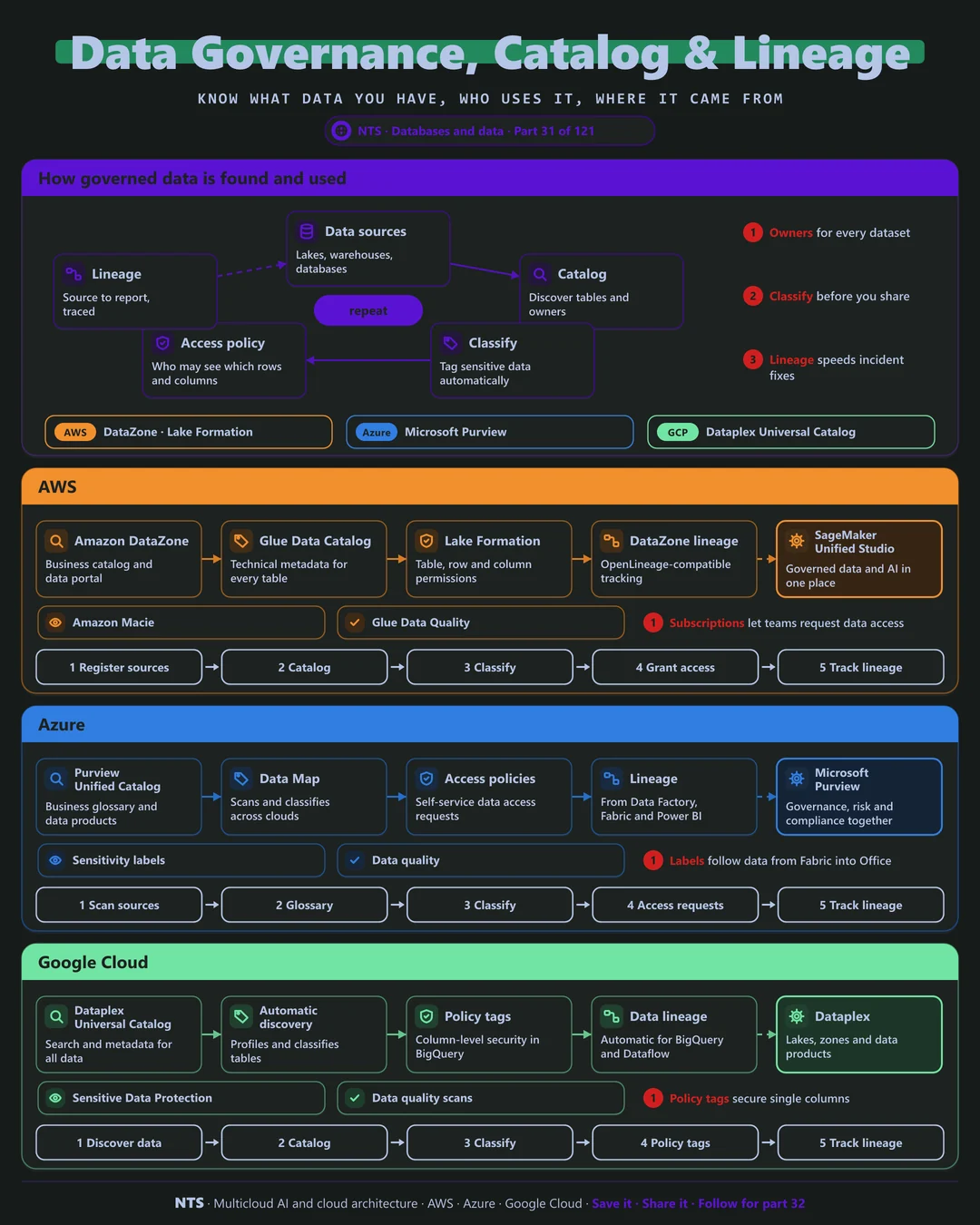
A catalog lets people discover datasets and their owners. Classification tags sensitive data such as personal or financial information automatically. Access policies then decide who sees which tables, rows and columns, and lineage traces each report back to its sources.
Data products and self-service
Mature organizations publish data products: well-documented, owned datasets that others request through a governed workflow, rather than ad-hoc extracts and copies.
AWS, Azure and Google Cloud compared
| AWS | Azure | Google Cloud | |
|---|---|---|---|
| Business catalog | Amazon DataZone | Microsoft Purview Unified Catalog | Dataplex Universal Catalog |
| Technical catalog | Glue Data Catalog | Purview Data Map | Dataplex |
| Fine-grained access | Lake Formation | Purview and OneLake security | BigQuery policy tags |
| Sensitive data discovery | Amazon Macie | Purview classification | Sensitive Data Protection |
| Lineage | DataZone lineage | Purview lineage | Dataplex lineage |
| Data quality | Glue Data Quality | Purview data quality | Dataplex data quality |
What makes each cloud different
AWS
Amazon DataZone provides a business catalog and data portal with subscription workflows, built on the Glue Data Catalog and Lake Formation permissions. SageMaker Unified Studio brings governed data and AI into one environment.
Azure
Microsoft Purview spans governance, data security and compliance, scanning data across Azure, other clouds and on-premises. Sensitivity labels follow data from Fabric into Office documents, a distinctive strength for Microsoft-centric organizations.
Google Cloud
Dataplex Universal Catalog discovers and profiles data automatically, BigQuery policy tags secure individual columns, and lineage is captured automatically for BigQuery and Dataflow jobs.
Design decisions that matter
- 01An owner for every dataset
Named, accountable and visible in the catalog.
- 02Automatic classification
Scan continuously; never rely on manual tagging alone.
- 03Column and row security
Share tables without exposing sensitive fields.
- 04Govern before AI
Classify and control data before it feeds models.
Common mistakes we see
- Catalogs nobody maintains. Stale metadata destroys trust.
- Copies to share data. Each copy escapes governance.
- Governance as a gate only. Make the governed path the fastest path.
A practical 30-day plan
- Week 1
Register core data sources and assign owners.
- Week 2
Turn on automatic classification.
- Week 3
Apply column and row policies to sensitive tables.
- Week 4
Publish the first data products with request workflows.
How NTS helps
NTS implements data governance on AWS, Azure and Google Cloud: catalogs, classification, fine-grained access, lineage and data products, designed so governance speeds teams up rather than slowing them down.
What you get
- A data catalog with owners and descriptions
- Lineage from source to report
- Classification of sensitive data
- Access policies based on data sensitivity
Typical outcomes
- Data people can find and trust
- Clear answers for auditors and regulators
- Safe access to sensitive data
How we work with you
- 1Assess
A focused review of your data governance across AWS, Azure and Google Cloud. We look for the gaps we find most often: catalogs nobody maintains, copies to share data and governance as a gate only.
- 2Design
A target architecture and roadmap built on the decisions that matter most: an owner for every dataset, automatic classification, column and row security and govern before AI.
- 3Build
Hands-on delivery alongside your team. We register core data sources and assign owners, turn on automatic classification, apply column and row policies to sensitive tables, and finally publish the first data products with request workflows.
- 4Run and improve
We keep the catalog current, review access and extend governance to new data sources.
Why teams choose NTS for data governance
- Governance people actually use
We embed governance into daily tools instead of extra paperwork.
- Automated classification
We find sensitive data automatically across clouds.
- Ready for AI
Governed data is safe to use in AI assistants and models.
Book a free 30-minute review
Talk to an NTS architect about your data governance on AWS, Azure and Google Cloud.