
Multicloud AI & ERP / Cloud AI: Machine Learning & Generative AI
Why it matters
Foundation model platforms are where enterprise generative AI runs. Choosing one shapes security, compliance, available models and cost, and most organizations end up using more than one.
How it works
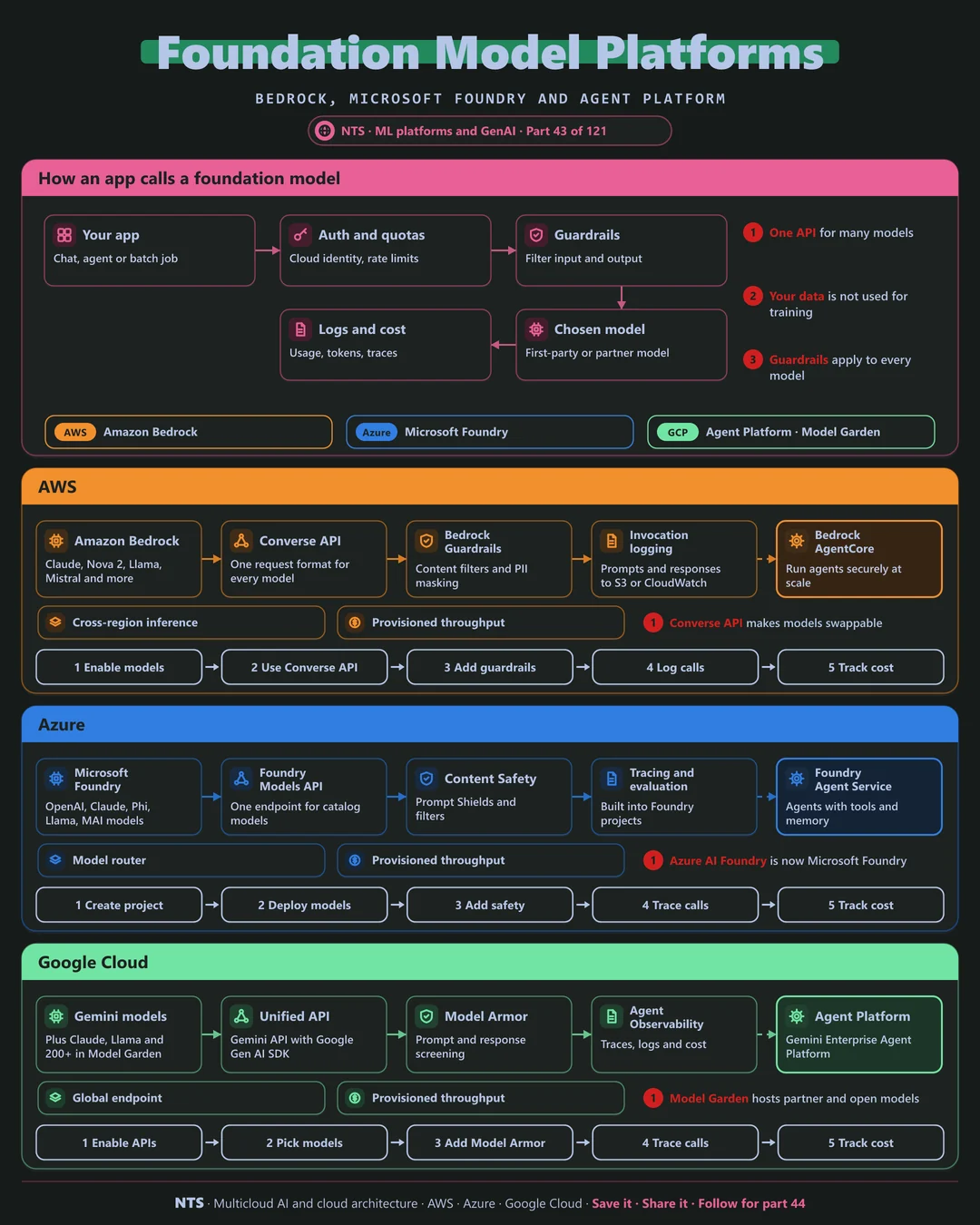
How a governed model call works
An application authenticates with cloud identity and quotas apply. Guardrails filter the input. The chosen model, first-party or partner, generates the answer, guardrails check the output, and logs record usage, tokens and traces. Your prompts and data are not used to train the providers' models.
AWS, Azure and Google Cloud compared
| AWS | Azure | Google Cloud | |
|---|---|---|---|
| Platform | Amazon Bedrock | Microsoft Foundry (formerly Azure AI Foundry) | Agent Platform and Model Garden |
| Unified API | Converse API | Foundry Models API | Gemini API, Google Gen AI SDK |
| Guardrails | Bedrock Guardrails | Content Safety, Prompt Shields | Model Armor |
| Agent runtime | Bedrock AgentCore | Foundry Agent Service | Agent Runtime |
| Reserved capacity | Provisioned throughput | Provisioned throughput units | Provisioned throughput |
What makes each cloud different
AWS
Amazon Bedrock's Converse API gives one request format across Claude, Nova 2, Llama, Mistral and more, making models swappable. Guardrails work even for models outside Bedrock, and AgentCore runs agents at scale.
Azure
Microsoft Foundry combines OpenAI models with Claude, Phi, MAI and open models, a model router, Content Safety and the generally available Foundry Agent Service, all tied into Entra ID and Azure networking.
Google Cloud
Google's Agent Platform offers Gemini plus 200-plus partner and open models in Model Garden, a global endpoint for capacity, Model Armor for screening and built-in agent observability.
Design decisions that matter
- 01Pick by where data and identity live
Then pick models per task.
- 02Write to a unified API
Keep models swappable.
- 03Guardrails on every call
Input and output, all models.
- 04Private networking
No public paths to model endpoints.
Common mistakes we see
- One model for everything. Overpaying for simple tasks.
- Direct provider SDK lock-in. Switching models becomes a rewrite.
- No usage logging. No cost control and no audit trail.
A practical 30-day plan
- Week 1
Enable the platform with private networking and identity.
- Week 2
Wrap calls in a unified API layer with logging.
- Week 3
Add guardrails and quotas.
- Week 4
Benchmark two models on your real tasks.
How NTS helps
NTS designs enterprise generative AI platforms on Bedrock, Microsoft Foundry and Agent Platform: secure access, guardrails, model selection, cost tracking and multi-model architectures that avoid lock-in.
What you get
- A platform on Bedrock, Microsoft Foundry or Vertex AI
- A model gateway with routing and quotas
- Private networking and data controls
- Usage and cost dashboards by team
Typical outcomes
- Teams building with GenAI safely and quickly
- Freedom to switch models as better ones launch
- Controlled, predictable AI spending
How we work with you
- 1Assess
A focused review of your foundation model platform across AWS, Azure and Google Cloud. We look for the gaps we find most often: one model for everything, direct provider SDK lock-in and no usage logging.
- 2Design
A target architecture and roadmap built on the decisions that matter most: pick by where data and identity live, write to a unified API, guardrails on every call and private networking.
- 3Build
Hands-on delivery alongside your team. We enable the platform with private networking and identity, wrap calls in a unified API layer with logging, add guardrails and quotas, and finally benchmark two models on your real tasks.
- 4Run and improve
We add new models, update routing and review usage and costs every month.
Why teams choose NTS for foundation model platform
- Model choice without chaos
One gateway gives teams many models with consistent controls.
- Enterprise-ready security
Private access, logging and data protection are built in.
- Costs you can see
Every team's usage is tracked and budgeted.
Book a free 30-minute review
Talk to an NTS architect about your foundation model platform on AWS, Azure and Google Cloud.