
Multicloud AI & ERP / Cloud AI: Machine Learning & Generative AI
Why it matters
Model choice drives answer quality, speed and cost, often by an order of magnitude. New models arrive every few months, so a repeatable way to compare them matters more than any single choice.
How it works
A simple selection method
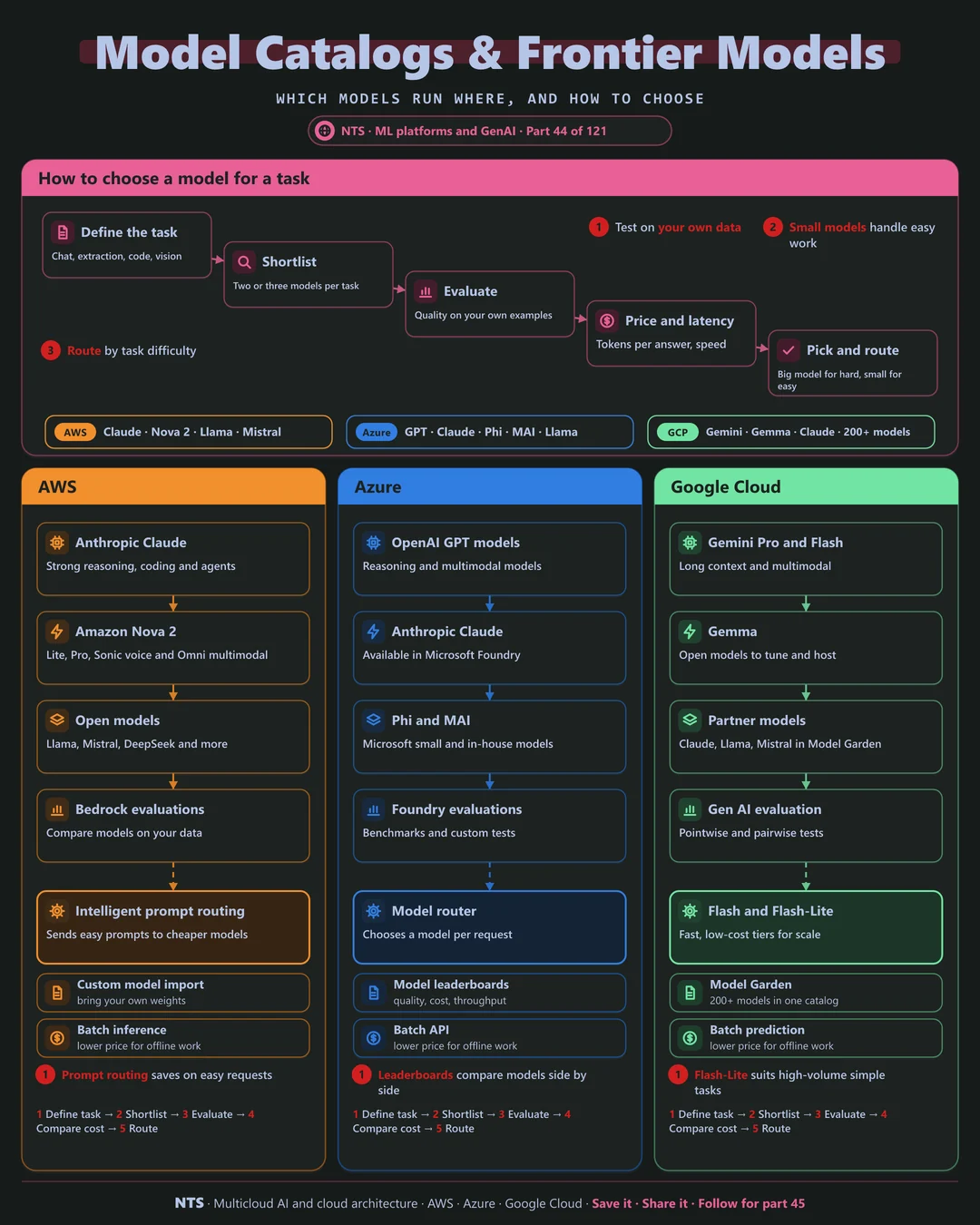
Define the task precisely. Shortlist two or three models. Evaluate them on your own examples, not public benchmarks. Compare price and latency per answer. Then route: a large model for hard cases, a small one for easy ones.
AWS, Azure and Google Cloud compared
| AWS | Azure | Google Cloud | |
|---|---|---|---|
| First-party models | Amazon Nova 2 (Lite, Pro, Sonic, Omni) | Phi, MAI | Gemini Pro, Flash, Flash-Lite; Gemma |
| Frontier partners | Anthropic Claude | OpenAI GPT, Anthropic Claude | Anthropic Claude |
| Open models | Llama, Mistral, DeepSeek and more | Llama, Mistral and more | Llama, Mistral and 200+ in Model Garden |
| Routing | Intelligent prompt routing | Model router | Tier selection, Apigee routing |
| Batch pricing | Batch inference | Batch API | Batch prediction |
What makes each cloud different
AWS
Bedrock carries Anthropic Claude, Amazon's Nova 2 family including Sonic for voice and Omni for multimodal, and many open models, with intelligent prompt routing to send easy prompts to cheaper models.
Azure
Microsoft Foundry is the home of OpenAI's models on Azure and also offers Claude, Microsoft's small Phi models and in-house MAI models, with leaderboards comparing quality, cost and throughput.
Google Cloud
Google's Gemini models lead on long context and native multimodality, Flash-Lite serves high-volume simple tasks cheaply, and Model Garden adds Claude, Llama and many others.
Design decisions that matter
- 01Evaluate on your own data
Public benchmarks rarely match your tasks.
- 02Route by difficulty
Big models only where they earn it.
- 03Re-test quarterly
New models change the answer.
- 04Use batch for offline work
Large discounts for non-urgent jobs.
Common mistakes we see
- Choosing by brand or hype. The obvious winner is often not the best fit.
- Hard-coding one model. Upgrades become rewrites.
- Ignoring latency. A great answer that arrives too late is a bad answer.
A practical 30-day plan
- Week 1
Build an evaluation set from real requests.
- Week 2
Test three models for quality, cost and latency.
- Week 3
Introduce routing between a large and a small model.
- Week 4
Move offline workloads to batch pricing.
How NTS helps
NTS runs model evaluations and builds model-routing architectures across Bedrock, Microsoft Foundry and Agent Platform, giving you the best answer per dollar and the freedom to switch as models improve.
What you get
- A model shortlist for each use case
- Benchmarks on your own tasks and data
- Cost and latency comparisons
- A routing plan across models
Typical outcomes
- The best model for each job
- Lower costs by using smaller models where possible
- Confidence in model choices
How we work with you
- 1Assess
A focused review of your model selection across AWS, Azure and Google Cloud. We look for the gaps we find most often: choosing by brand or hype, hard-coding one model and ignoring latency.
- 2Design
A target architecture and roadmap built on the decisions that matter most: evaluate on your own data, route by difficulty, re-test quarterly and use batch for offline work.
- 3Build
Hands-on delivery alongside your team. We build an evaluation set from real requests, test three models for quality, cost and latency, introduce routing between a large and a small model, and finally move offline workloads to batch pricing.
- 4Run and improve
We re-benchmark when important new models launch and update your routing.
Why teams choose NTS for model selection
- Vendor-neutral evaluation
We compare models from every major provider fairly.
- Your tasks, not leaderboards
We test with your real prompts and documents.
- Always current
We track new model releases so you do not have to.
Book a free 30-minute review
Talk to an NTS architect about your model selection on AWS, Azure and Google Cloud.