
Multicloud AI & ERP / Cloud AI: Machine Learning & Generative AI
Why it matters
Prompts are code that business logic depends on. Vague prompts give inconsistent answers, and free-text output breaks the systems that parse it. Disciplined prompting and schemas make AI features reliable.
How it works
Anatomy of a prompt
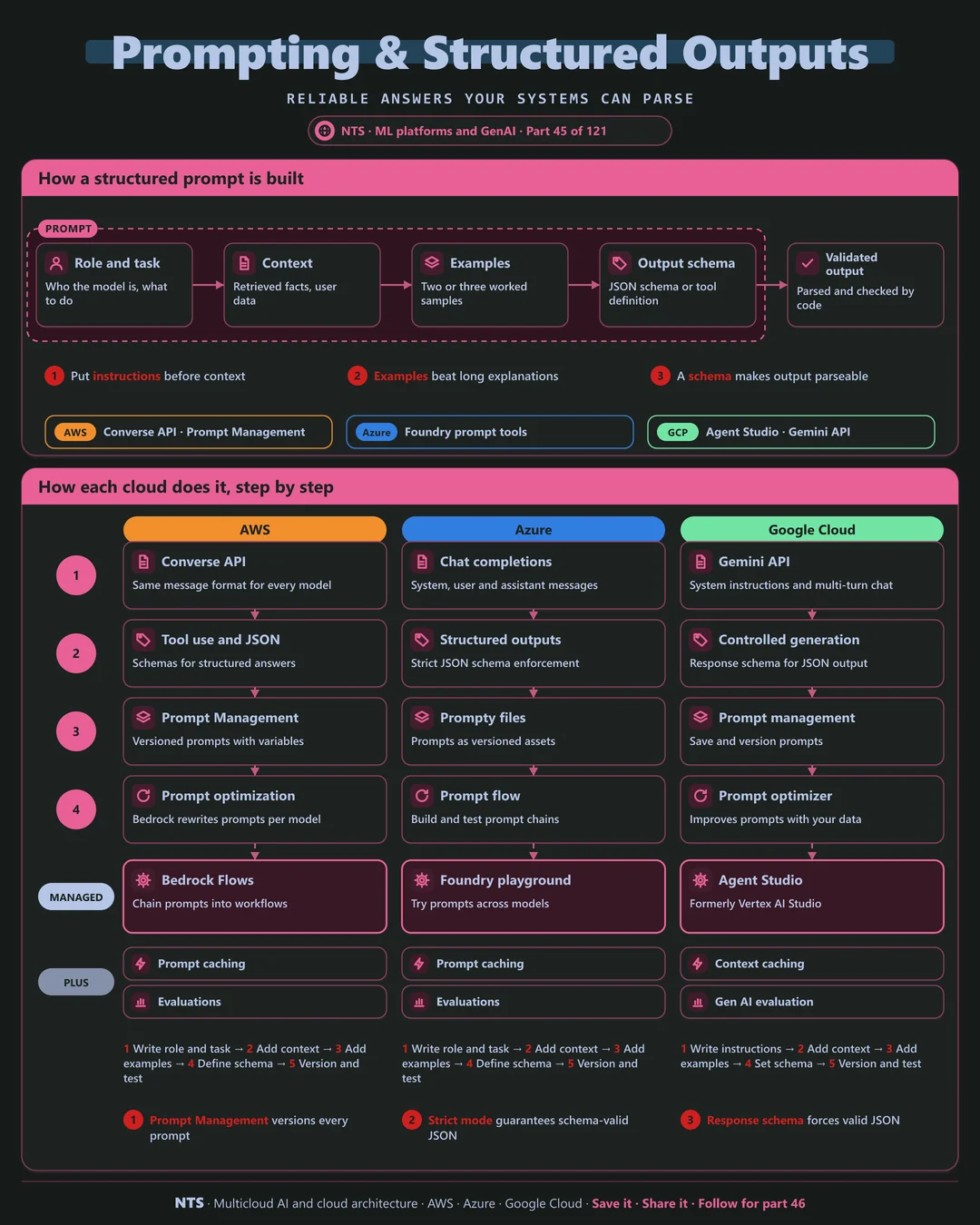
State the role and task clearly, provide the context the model needs, show two or three examples, and define the output schema. Code then validates the result before using it.
Structured outputs
All three platforms can constrain responses to a JSON schema or a tool definition, so the answer always parses. Prompts should be versioned and tested like any other code.
AWS, Azure and Google Cloud compared
| AWS | Azure | Google Cloud | |
|---|---|---|---|
| Unified chat API | Converse API | Chat completions | Gemini API |
| Schema enforcement | Tool use and JSON output | Structured outputs (strict mode) | Controlled generation (response schema) |
| Prompt management | Bedrock Prompt Management | Prompty, prompt flow | Prompt management in Agent Studio |
| Prompt optimization | Prompt optimization | Prompt tools in Foundry | Prompt optimizer |
| Caching | Prompt caching | Prompt caching | Context caching |
What makes each cloud different
AWS
Bedrock's Converse API keeps one message format across models, Prompt Management versions prompts with variables, and prompt optimization rewrites prompts for a chosen model.
Azure
Azure's structured outputs in strict mode guarantee schema-valid JSON, Prompty files treat prompts as versioned assets, and Foundry's playground compares prompts across models.
Google Cloud
Gemini's controlled generation enforces a response schema, Agent Studio (formerly Vertex AI Studio) manages prompts, and the prompt optimizer improves prompts using your examples.
Design decisions that matter
- 01Schemas for anything code reads
Never parse free text.
- 02Version prompts like code
Reviewed, tested and released.
- 03Examples over explanations
Two good examples beat a page of rules.
- 04Test prompts on every change
With a fixed evaluation set.
Common mistakes we see
- Prompts edited in production. No history, no rollback.
- Regex parsing of model output. Breaks on the first unexpected answer.
- Instructions buried after context. Models follow what they see first and last.
A practical 30-day plan
- Week 1
Move prompts into version control.
- Week 2
Add schemas to every structured response.
- Week 3
Build an evaluation set per prompt.
- Week 4
Enable caching for long, stable prompts.
How NTS helps
NTS brings engineering discipline to prompts on Bedrock, Microsoft Foundry and Gemini: prompt libraries, structured outputs, evaluation suites and release processes that keep AI features reliable.
What you get
- Prompt templates under version control
- Structured outputs with schema validation
- Test sets for every prompt
- Prompt caching to cut costs
Typical outcomes
- Consistent, reliable AI responses
- Fewer failures in AI-powered workflows
- Lower token costs
How we work with you
- 1Assess
A focused review of your prompting and structured outputs across AWS, Azure and Google Cloud. We look for the gaps we find most often: prompts edited in production, regex parsing of model output and instructions buried after context.
- 2Design
A target architecture and roadmap built on the decisions that matter most: schemas for anything code reads, version prompts like code, examples over explanations and test prompts on every change.
- 3Build
Hands-on delivery alongside your team. We move prompts into version control, add schemas to every structured response, build an evaluation set per prompt, and finally enable caching for long, stable prompts.
- 4Run and improve
We maintain prompt test suites and tune prompts as models and requirements change.
Why teams choose NTS for prompting and structured outputs
- Prompts as code
We test and version prompts like any other software.
- Reliable outputs
Schemas make AI responses safe to use in applications.
- Cheaper at scale
Caching and shorter prompts reduce token bills.
Book a free 30-minute review
Talk to an NTS architect about your prompting and structured outputs on AWS, Azure and Google Cloud.