
Multicloud AI & ERP / Cloud AI: Machine Learning & Generative AI
Why it matters
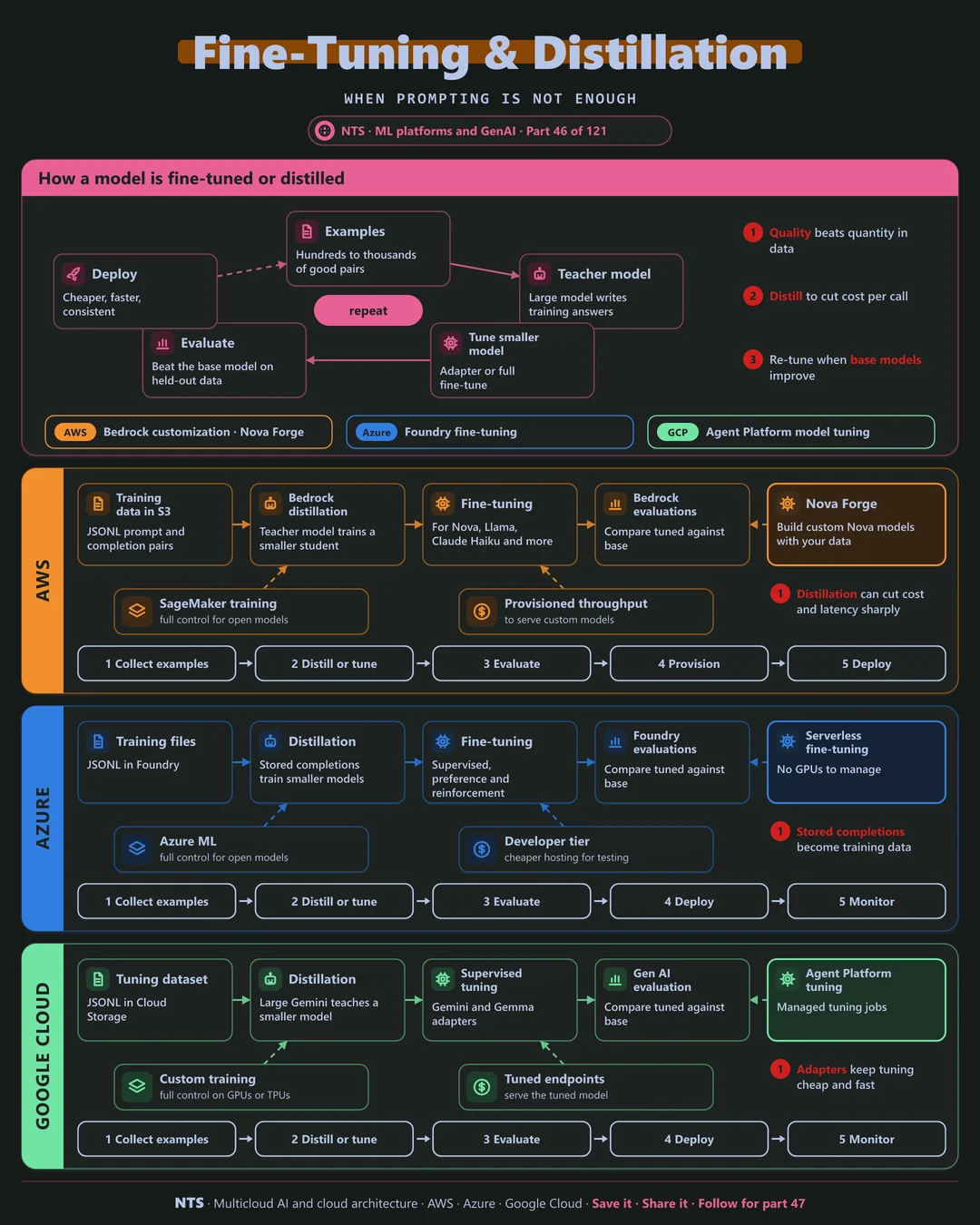
Prompting and retrieval solve most problems. Tuning makes sense when you need consistent formats at scale, lower latency, lower cost per call or behavior that examples in a prompt cannot teach.
How it works
Two tuning paths
Fine-tuning trains a model on hundreds or thousands of good input-output pairs, usually with lightweight adapters. Distillation uses a large teacher model to generate high-quality answers, then trains a smaller student model on them, keeping much of the quality at a fraction of the cost.
Prove it, then deploy
Evaluate the tuned model against the base model on held-out data. Re-tune when base models improve, because a new base model can beat yesterday's tuned one.
AWS, Azure and Google Cloud compared
| AWS | Azure | Google Cloud | |
|---|---|---|---|
| Managed fine-tuning | Bedrock model customization | Foundry fine-tuning | Agent Platform supervised tuning |
| Distillation | Bedrock Model Distillation | Distillation from stored completions | Distillation with Gemini |
| Custom model builds | Nova Forge | Azure ML | Custom training |
| Open model tuning | SageMaker training | Azure ML | Gemma tuning |
| Serving tuned models | Provisioned throughput | Serverless or provisioned deployments | Tuned endpoints |
What makes each cloud different
AWS
Bedrock supports fine-tuning and Model Distillation, where a teacher such as a larger Nova or Claude model trains a smaller student. Nova Forge lets organizations build custom Nova models with their own data.
Azure
Foundry offers serverless fine-tuning with no GPUs to manage, plus distillation using stored completions from production traffic as training data.
Google Cloud
Agent Platform tunes Gemini and Gemma with adapters, supports distillation from larger Gemini models, and Gemma's open weights allow full control when needed.
Design decisions that matter
- 01Prompting and RAG first
Tune only what they cannot fix.
- 02Distill to cut cost
Small models for high-volume tasks.
- 03Curate training data
Quality beats quantity.
- 04Re-evaluate on new base models
Tuning is not a one-time event.
Common mistakes we see
- Fine-tuning for knowledge. Facts belong in retrieval, not weights.
- Noisy training data. Models learn the mistakes too.
- No baseline comparison. Paying for tuning that adds nothing.
A practical 30-day plan
- Week 1
Confirm prompting and RAG limits with evaluations.
- Week 2
Curate or generate training examples.
- Week 3
Run fine-tuning or distillation.
- Week 4
Compare against the base model and deploy if it wins.
How NTS helps
NTS runs fine-tuning and distillation projects on Bedrock, Microsoft Foundry and Agent Platform, from data curation to evaluation, typically cutting cost per call while keeping quality.
What you get
- A clear decision on whether fine-tuning is needed
- Training data curation and preparation
- Fine-tuned or distilled models with evaluation
- Deployment and cost comparison
Typical outcomes
- Higher quality on specialized tasks
- Lower inference costs from smaller models
- Evidence-based training decisions
How we work with you
- 1Assess
A focused review of your fine-tuning and distillation across AWS, Azure and Google Cloud. We look for the gaps we find most often: fine-tuning for knowledge, noisy training data and no baseline comparison.
- 2Design
A target architecture and roadmap built on the decisions that matter most: prompting and RAG first, distill to cut cost, curate training data and re-evaluate on new base models.
- 3Build
Hands-on delivery alongside your team. We confirm prompting and RAG limits with evaluations, curate or generate training examples, run fine-tuning or distillation, and finally compare against the base model and deploy if it wins.
- 4Run and improve
We retrain with new data, re-evaluate and retire models when better options appear.
Why teams choose NTS for fine-tuning and distillation
- Fine-tune only when it pays
We try prompting and retrieval first.
- Data quality focus
Better examples matter more than more examples.
- Smaller, cheaper models
Distillation can cut serving costs significantly.
Book a free 30-minute review
Talk to an NTS architect about your fine-tuning and distillation on AWS, Azure and Google Cloud.