
Multicloud AI & ERP / Agentic AI & Cloud AI Infrastructure
Why it matters
For most AI products, inference is the bulk of lifetime cost. Over-provisioned endpoints waste money, under-provisioned ones throttle users, and the wrong hosting model makes both happen at different times of day.
How it works
The serving stack
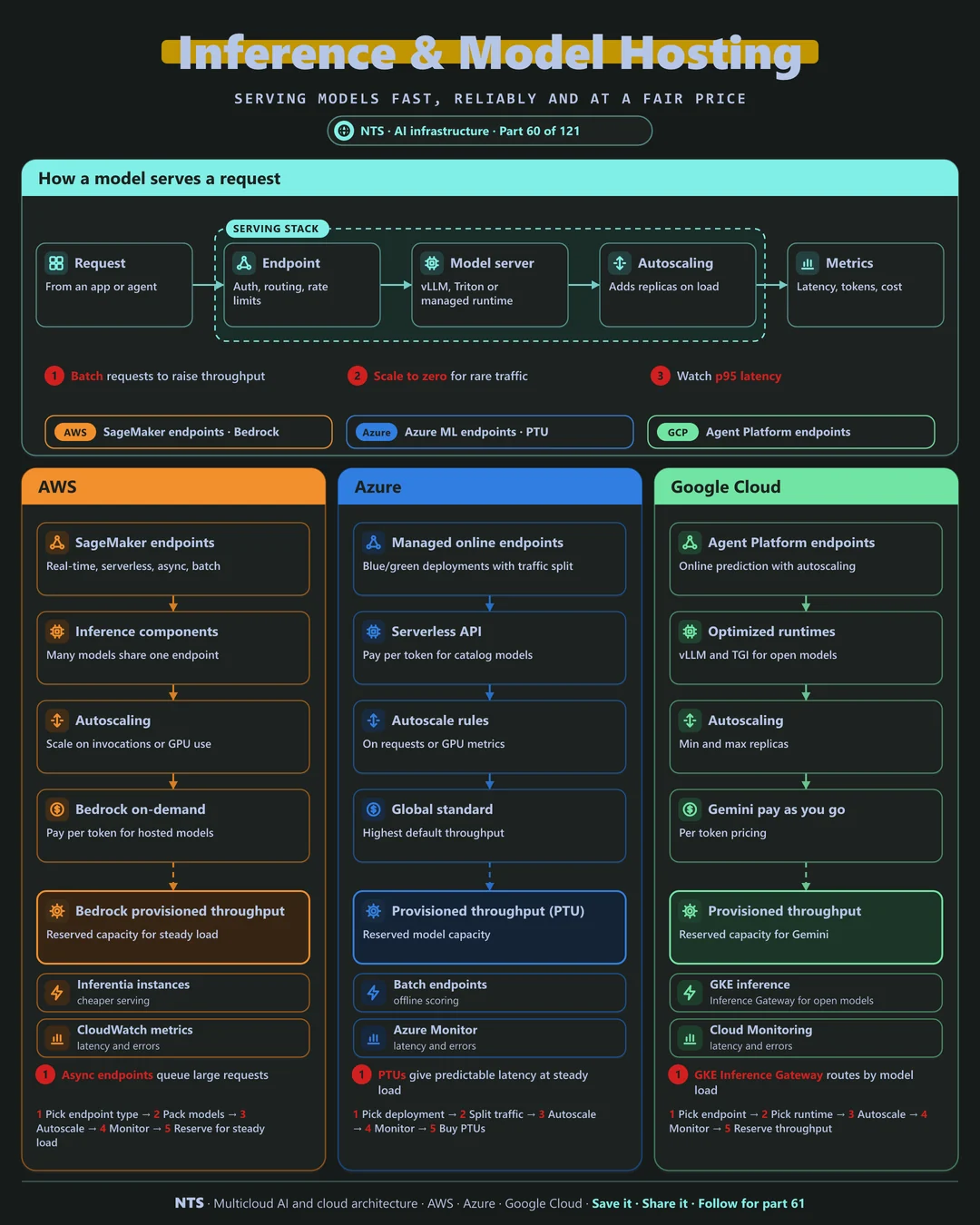
A request hits an endpoint that handles authentication, routing and rate limits. A model server such as vLLM or a managed runtime generates the answer, autoscaling adds replicas under load and metrics track latency, tokens and cost.
Serverless versus provisioned
Serverless per-token pricing suits spiky or low-volume traffic. Provisioned throughput suits steady high volume with predictable latency. Many teams use both, with overflow from provisioned to serverless.
AWS, Azure and Google Cloud compared
| AWS | Azure | Google Cloud | |
|---|---|---|---|
| Hosted model APIs | Bedrock on-demand | Foundry serverless and global deployments | Gemini pay-as-you-go |
| Reserved capacity | Bedrock provisioned throughput | Provisioned throughput units (PTU) | Provisioned throughput |
| Custom model endpoints | SageMaker endpoints | Managed online endpoints | Agent Platform endpoints |
| Kubernetes serving | EKS with vLLM | AKS with KAITO | GKE Inference Gateway |
| Batch inference | Bedrock batch, SageMaker batch | Batch endpoints, Batch API | Batch prediction |
What makes each cloud different
AWS
AWS offers Bedrock on-demand and provisioned throughput for hosted models, and SageMaker endpoints in real-time, serverless, asynchronous and batch modes. Inference components pack several models onto one endpoint.
Azure
Azure serves models through Foundry with pay-as-you-go, global deployments and provisioned throughput units for steady load, plus managed online endpoints with blue/green traffic splitting for custom models.
Google Cloud
Google offers Gemini pay-as-you-go and provisioned throughput, Agent Platform endpoints with optimized runtimes for open models, and the GKE Inference Gateway that routes requests by model server load.
Design decisions that matter
- 01Serverless for spiky traffic
Pay only for what you use.
- 02Provisioned for steady volume
Predictable latency and cost.
- 03Scale on the right signal
Queue depth or tokens, not CPU.
- 04Track p95 latency and cost per request
Both matter to users and finance.
Common mistakes we see
- Always-on GPUs for occasional traffic. Paying for idle accelerators.
- No batching. Throughput far below what the hardware can do.
- Real-time for offline work. Batch pricing is far cheaper.
A practical 30-day plan
- Week 1
Map traffic patterns per model.
- Week 2
Move offline jobs to batch inference.
- Week 3
Right-size endpoints and tune autoscaling.
- Week 4
Buy provisioned capacity for steady workloads.
How NTS helps
NTS designs model serving on AWS, Azure and Google Cloud, choosing hosting modes, tuning autoscaling and batching, and planning reserved capacity to cut cost per request without hurting latency.
What you get
- Hosting design for APIs, managed endpoints or self-hosted models
- Autoscaling and batching for throughput
- Latency and cost optimization
- Monitoring of quality, latency and spend
Typical outcomes
- Fast, reliable AI responses
- Lower inference costs
- Capacity that scales with demand
How we work with you
- 1Assess
A focused review of your inference and model hosting across AWS, Azure and Google Cloud. We look for the gaps we find most often: always-on GPUs for occasional traffic, no batching and real-time for offline work.
- 2Design
A target architecture and roadmap built on the decisions that matter most: serverless for spiky traffic, provisioned for steady volume, scale on the right signal and track p95 latency and cost per request.
- 3Build
Hands-on delivery alongside your team. We map traffic patterns per model, move offline jobs to batch inference, right-size endpoints and tune autoscaling, and finally buy provisioned capacity for steady workloads.
- 4Run and improve
We tune scaling, upgrade serving engines and optimize costs as traffic grows.
Why teams choose NTS for inference and model hosting
- The right hosting for each model
We choose between APIs and self-hosting based on volume and control.
- Performance tuning
Batching, quantization and caching speed up responses.
- Cost per request tracked
You know exactly what each AI feature costs.
Book a free 30-minute review
Talk to an NTS architect about your inference and model hosting on AWS, Azure and Google Cloud.