
Multicloud AI & ERP / Agentic AI & Cloud AI Infrastructure
Why it matters
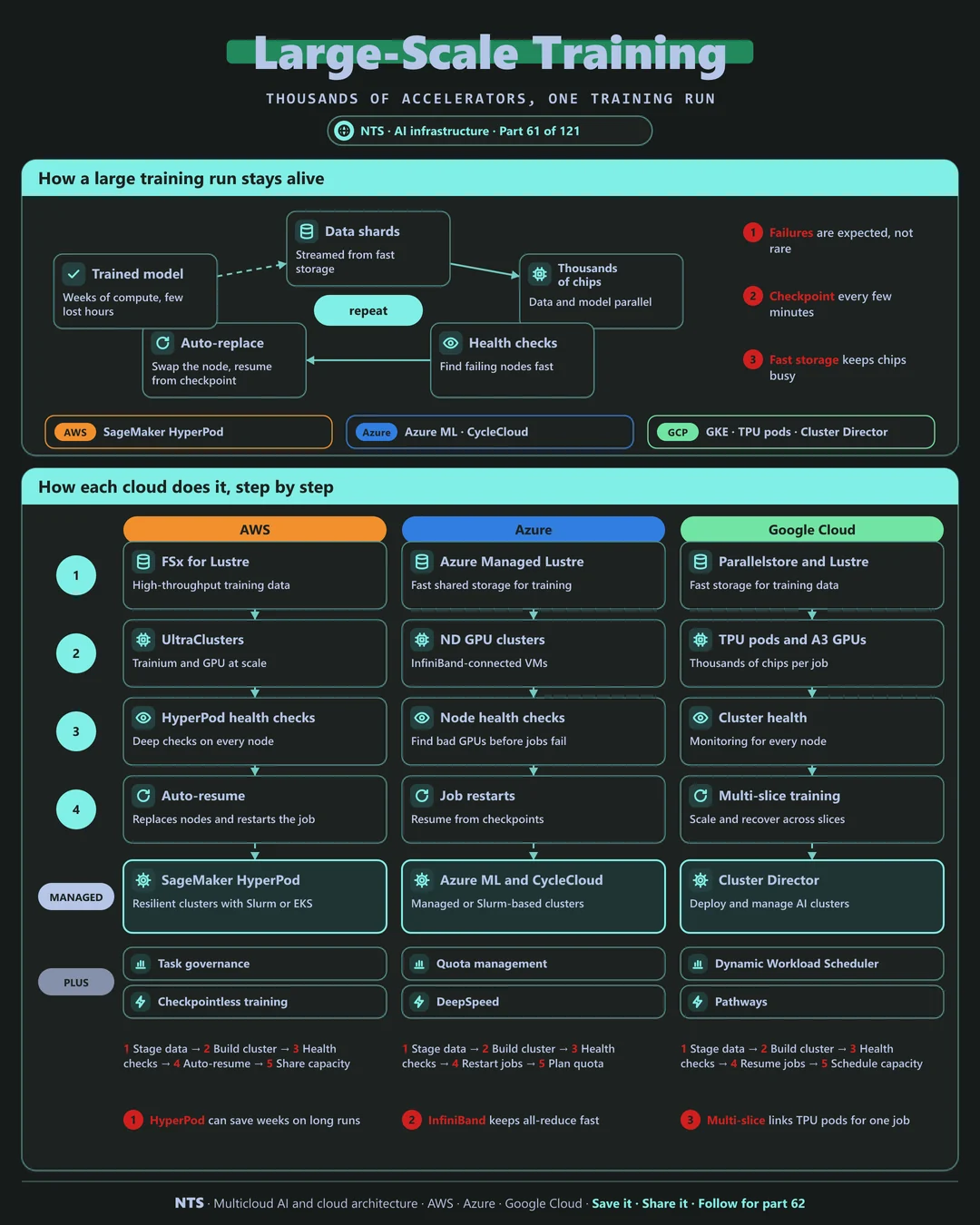
Training a large model can occupy thousands of accelerators for weeks. Without automated recovery, a single failing node stalls the whole job, and without fast storage, expensive chips sit idle waiting for data.
How it works
Keeping a long run alive
Data shards stream from fast shared storage to thousands of chips running data and model parallelism. Health checks spot failing nodes, the cluster replaces them automatically and the job resumes from the latest checkpoint, losing minutes instead of days.
AWS, Azure and Google Cloud compared
| AWS | Azure | Google Cloud | |
|---|---|---|---|
| Resilient training clusters | SageMaker HyperPod | Azure ML, CycleCloud | Cluster Director, GKE |
| Fast shared storage | FSx for Lustre | Azure Managed Lustre | Parallelstore, Managed Lustre |
| Schedulers | Slurm or EKS on HyperPod | Slurm via CycleCloud, Azure ML | Slurm, GKE, Kueue |
| Capacity access | Capacity Blocks, training plans | Reservations, quotas | Dynamic Workload Scheduler |
| Scale-out runtime | HyperPod recipes | DeepSpeed | Pathways, multi-slice |
What makes each cloud different
AWS
SageMaker HyperPod runs Slurm or EKS-based clusters with deep health checks, automatic node replacement and job auto-resume, which AWS reports can save weeks on long runs. Task governance shares GPUs across teams.
Azure
Azure's InfiniBand-connected ND-series clusters run through Azure ML or CycleCloud with Slurm, with node health checks and Azure Managed Lustre for fast shared storage.
Google Cloud
Google's Cluster Director deploys and manages AI clusters, multi-slice training spans TPU pods for one job and Pathways, Google's distributed runtime, powers very large runs.
Design decisions that matter
- 01Automate node replacement
Humans should not babysit runs.
- 02Checkpoint every few minutes
To fast storage, asynchronously.
- 03Size storage to feed the chips
Throughput, not just capacity.
- 04Share capacity across teams
Queues and quotas over private clusters.
Common mistakes we see
- Manual failure handling. Nights lost restarting jobs.
- Checkpoints to slow storage. Training pauses on every save.
- Idle reserved capacity. Expensive clusters waiting for the next job.
A practical 30-day plan
- Week 1
Measure failure rates and recovery time on current runs.
- Week 2
Move to a resilient cluster service.
- Week 3
Add async checkpointing to fast storage.
- Week 4
Set up queues to share capacity between teams.
How NTS helps
NTS builds large-scale training environments on AWS, Azure and Google Cloud, including resilient clusters, storage throughput, checkpointing and capacity sharing, so long runs finish on time and on budget.
What you get
- Training cluster design with the right accelerators and storage
- Distributed training setup and tuning
- Checkpointing and fault recovery
- Cost tracking per training run
Typical outcomes
- Faster training runs
- Fewer failed or restarted jobs
- Lower cost per trained model
How we work with you
- 1Assess
A focused review of your large-scale AI training across AWS, Azure and Google Cloud. We look for the gaps we find most often: manual failure handling, checkpoints to slow storage and idle reserved capacity.
- 2Design
A target architecture and roadmap built on the decisions that matter most: automate node replacement, checkpoint every few minutes, size storage to feed the chips and share capacity across teams.
- 3Build
Hands-on delivery alongside your team. We measure failure rates and recovery time on current runs, move to a resilient cluster service, add async checkpointing to fast storage, and finally set up queues to share capacity between teams.
- 4Run and improve
We tune cluster utilization, storage throughput and capacity plans for each new training cycle.
Why teams choose NTS for large-scale AI training
- Scale without waste
We keep expensive accelerators busy instead of waiting on data.
- Resilient training
Checkpoints and auto-recovery protect long runs.
- Cost transparency
Every run has a clear price tag.
Book a free 30-minute review
Talk to an NTS architect about your large-scale AI training on AWS, Azure and Google Cloud.