
Multicloud AI & ERP / Agentic AI & Cloud AI Infrastructure
Why it matters
Models drift as the world changes, and regulators increasingly ask how a decision was made. Reproducible pipelines, registries and monitoring turn ML from one-off projects into a reliable capability.
How it works
How a model ships
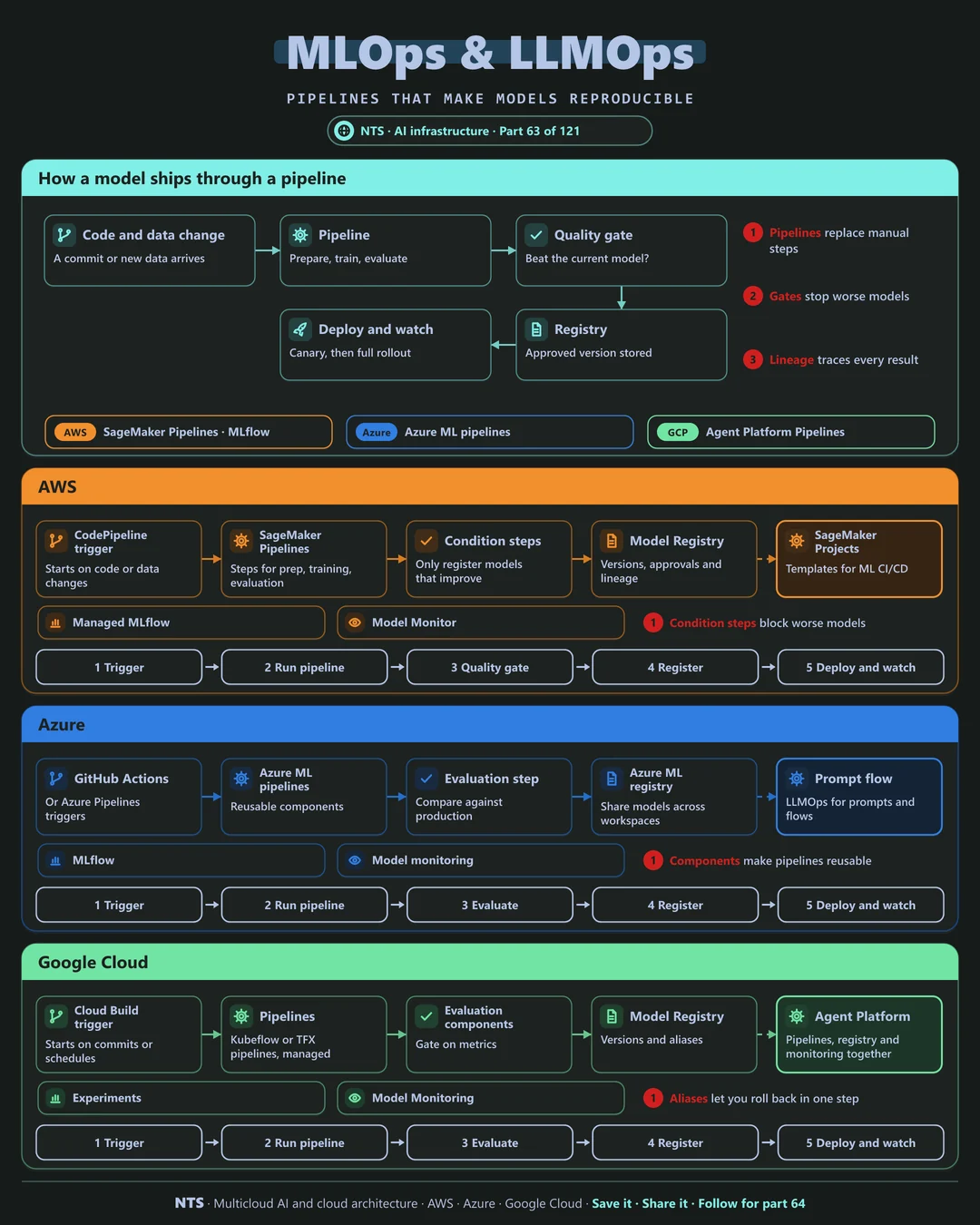
A code or data change triggers a pipeline that prepares data, trains and evaluates. A quality gate compares the candidate with the current model. Approved versions go to the registry, then deploy with a canary and are watched for drift. LLM applications follow the same path for prompts and retrieval settings.
AWS, Azure and Google Cloud compared
| AWS | Azure | Google Cloud | |
|---|---|---|---|
| Pipelines | SageMaker Pipelines | Azure ML pipelines | Agent Platform Pipelines |
| Experiment tracking | Managed MLflow | MLflow | Experiments, metadata |
| Registry | SageMaker Model Registry | Azure ML registries | Model Registry |
| LLMOps | Bedrock evaluations, prompt management | Prompt flow, Foundry evaluations | Gen AI evaluation, prompt management |
| Monitoring | Model Monitor | Model monitoring | Model Monitoring |
What makes each cloud different
AWS
SageMaker Pipelines uses condition steps to register only models that improve, Projects provide CI/CD templates and Managed MLflow tracks experiments and prompts.
Azure
Azure ML pipelines are built from reusable components, MLflow tracking is native and registries share models across workspaces; prompt flow extends the same discipline to LLM applications.
Google Cloud
Google's managed pipelines run Kubeflow or TFX definitions, Model Registry aliases allow one-step rollback, and experiments capture metadata and lineage.
Design decisions that matter
- 01Version data, code and models together
Every result reproducible.
- 02Automated quality gates
No worse model reaches production.
- 03Canary deployments
Real traffic before full rollout.
- 04Monitor drift
Retrain on evidence, not on a calendar alone.
Common mistakes we see
- Notebooks as production. No tests, no lineage.
- Manual promotion. Releases depend on one person.
- No rollback path. Bad models stay live too long.
A practical 30-day plan
- Week 1
Put one model's training into a pipeline.
- Week 2
Add evaluation and a quality gate.
- Week 3
Register and deploy with a canary.
- Week 4
Turn on drift monitoring and retraining triggers.
How NTS helps
NTS implements MLOps and LLMOps on SageMaker, Azure Machine Learning and Agent Platform, covering pipelines, quality gates, registries, deployment strategies and monitoring.
What you get
- CI/CD pipelines for models and prompts
- Model and prompt registries
- Automated evaluation gates
- Rollback and versioning for every release
Typical outcomes
- Faster, safer AI releases
- Fewer production regressions
- Audit-ready AI operations
How we work with you
- 1Assess
A focused review of your MLOps and LLMOps across AWS, Azure and Google Cloud. We look for the gaps we find most often: notebooks as production, manual promotion and no rollback path.
- 2Design
A target architecture and roadmap built on the decisions that matter most: version data, code and models together, automated quality gates, canary deployments and monitor drift.
- 3Build
Hands-on delivery alongside your team. We put one model's training into a pipeline, add evaluation and a quality gate, register and deploy with a canary, and finally turn on drift monitoring and retraining triggers.
- 4Run and improve
We maintain pipelines and gates, and improve them as your AI portfolio grows.
Why teams choose NTS for MLOps and LLMOps
- Software discipline for AI
We apply proven DevOps practices to models and prompts.
- Releases without fear
Evaluation gates catch problems before users do.
- Full traceability
You always know which model and prompt is live.
Book a free 30-minute review
Talk to an NTS architect about your MLOps and LLMOps on AWS, Azure and Google Cloud.