
Multicloud AI & ERP / Agentic AI & Cloud AI Infrastructure
Why it matters
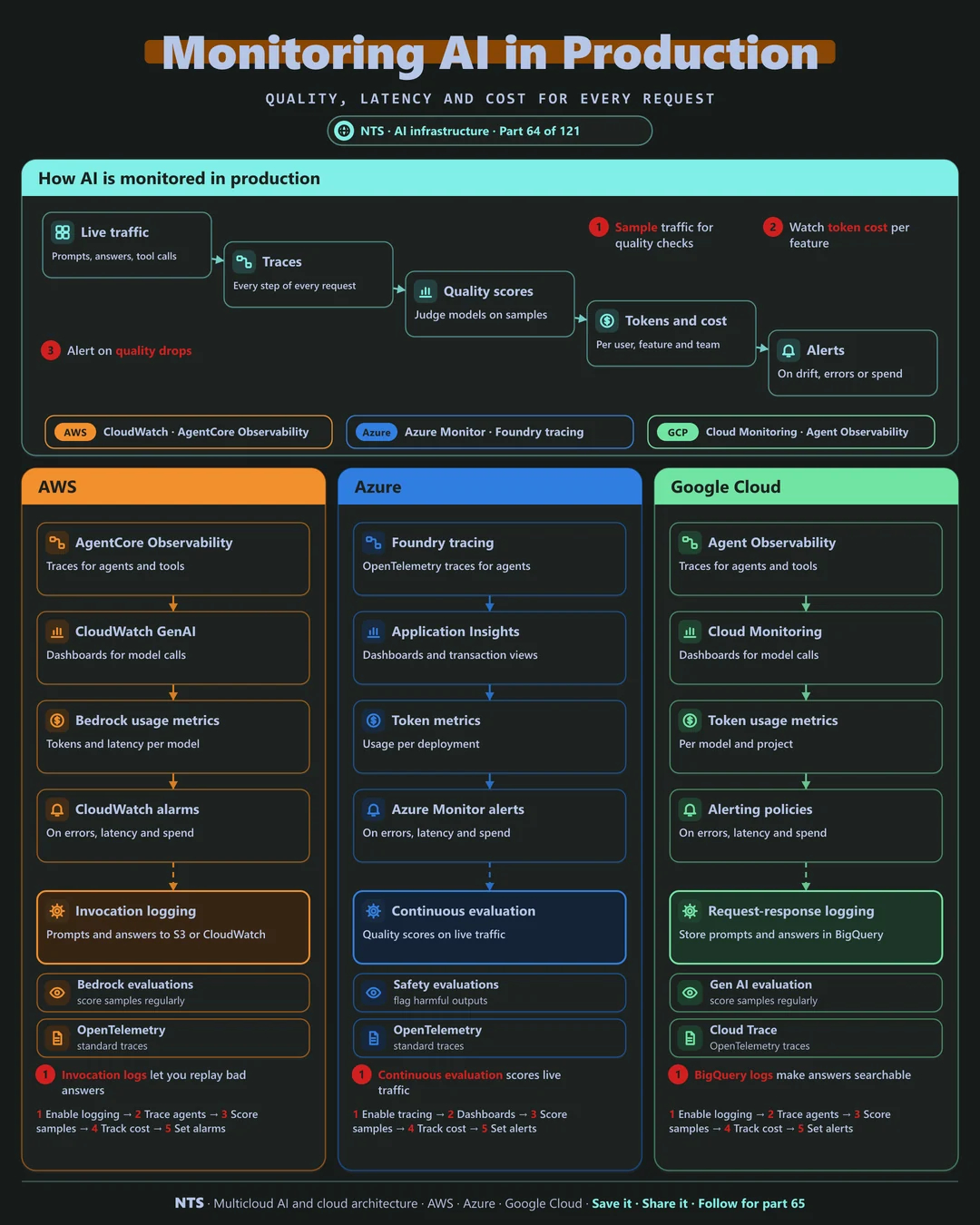
AI systems fail quietly: answers degrade, retrieval drifts, costs creep and agents take odd paths, all while dashboards stay green. Monitoring must cover quality and cost, not just availability.
How it works
What to watch
Capture traces of every prompt, retrieval, tool call and answer. Score a sample with judge models for quality. Track tokens and cost per user, feature and team. Alert on quality drops, error spikes and spend anomalies.
AWS, Azure and Google Cloud compared
| AWS | Azure | Google Cloud | |
|---|---|---|---|
| Traces | AgentCore Observability, X-Ray | Foundry tracing, Application Insights | Agent Observability, Cloud Trace |
| Prompt and answer logs | Bedrock invocation logging | Diagnostic logs | Request-response logging to BigQuery |
| Quality scoring | Bedrock evaluations | Continuous evaluation | Gen AI evaluation |
| Usage metrics | Bedrock CloudWatch metrics | Token metrics | Token usage metrics |
| Standard | OpenTelemetry | OpenTelemetry | OpenTelemetry |
What makes each cloud different
AWS
AWS provides invocation logging of prompts and answers, CloudWatch metrics for Bedrock, generative AI dashboards and AgentCore Observability for agent traces.
Azure
Foundry offers OpenTelemetry tracing for agents, Application Insights dashboards and continuous evaluation that scores live traffic for quality and safety.
Google Cloud
Google logs requests and responses to BigQuery for analysis, Agent Observability traces agents and Cloud Monitoring tracks usage and latency.
Design decisions that matter
- 01Trace every AI request
Prompt, retrieval, tools and answer.
- 02Score a sample continuously
Quality trends, not one-off tests.
- 03Cost per feature
Tag usage to owners.
- 04Alert on quality, not just errors
Silent failures are the dangerous ones.
Common mistakes we see
- Monitoring only uptime. Wrong answers look healthy.
- Logging prompts with PII. Monitoring data becomes a privacy risk.
- No owner for alerts. Signals nobody acts on.
A practical 30-day plan
- Week 1
Enable tracing and logging with PII masking.
- Week 2
Build dashboards for latency, tokens and cost.
- Week 3
Add sampled quality scoring.
- Week 4
Set alerts and owners.
How NTS helps
NTS builds AI observability on AWS, Azure and Google Cloud, including tracing, quality scoring, cost attribution and alerting, so you see problems before your users do.
What you get
- Monitoring of quality, latency, cost and safety
- Drift detection for models and data
- Tracing of prompts, tools and responses
- Alerts and response runbooks
Typical outcomes
- AI quality problems caught early
- Faster root-cause analysis
- Confidence in AI running at scale
How we work with you
- 1Assess
A focused review of your AI production monitoring across AWS, Azure and Google Cloud. We look for the gaps we find most often: monitoring only uptime, logging prompts with PII and no owner for alerts.
- 2Design
A target architecture and roadmap built on the decisions that matter most: trace every AI request, score a sample continuously, cost per feature and alert on quality, not just errors.
- 3Build
Hands-on delivery alongside your team. We enable tracing and logging with PII masking, build dashboards for latency, tokens and cost, add sampled quality scoring, and finally set alerts and owners.
- 4Run and improve
We review monitoring data, tune alerts and feed findings back into evaluation sets.
Why teams choose NTS for AI production monitoring
- Beyond uptime
We monitor whether AI answers are actually good.
- Early warnings
Drift detection catches decline before customers complain.
- Clear diagnosis
Tracing shows exactly why a response went wrong.
Book a free 30-minute review
Talk to an NTS architect about your AI production monitoring on AWS, Azure and Google Cloud.