
Multicloud AI & ERP / Cloud AI Applications & Industry AI Solutions
Why it matters
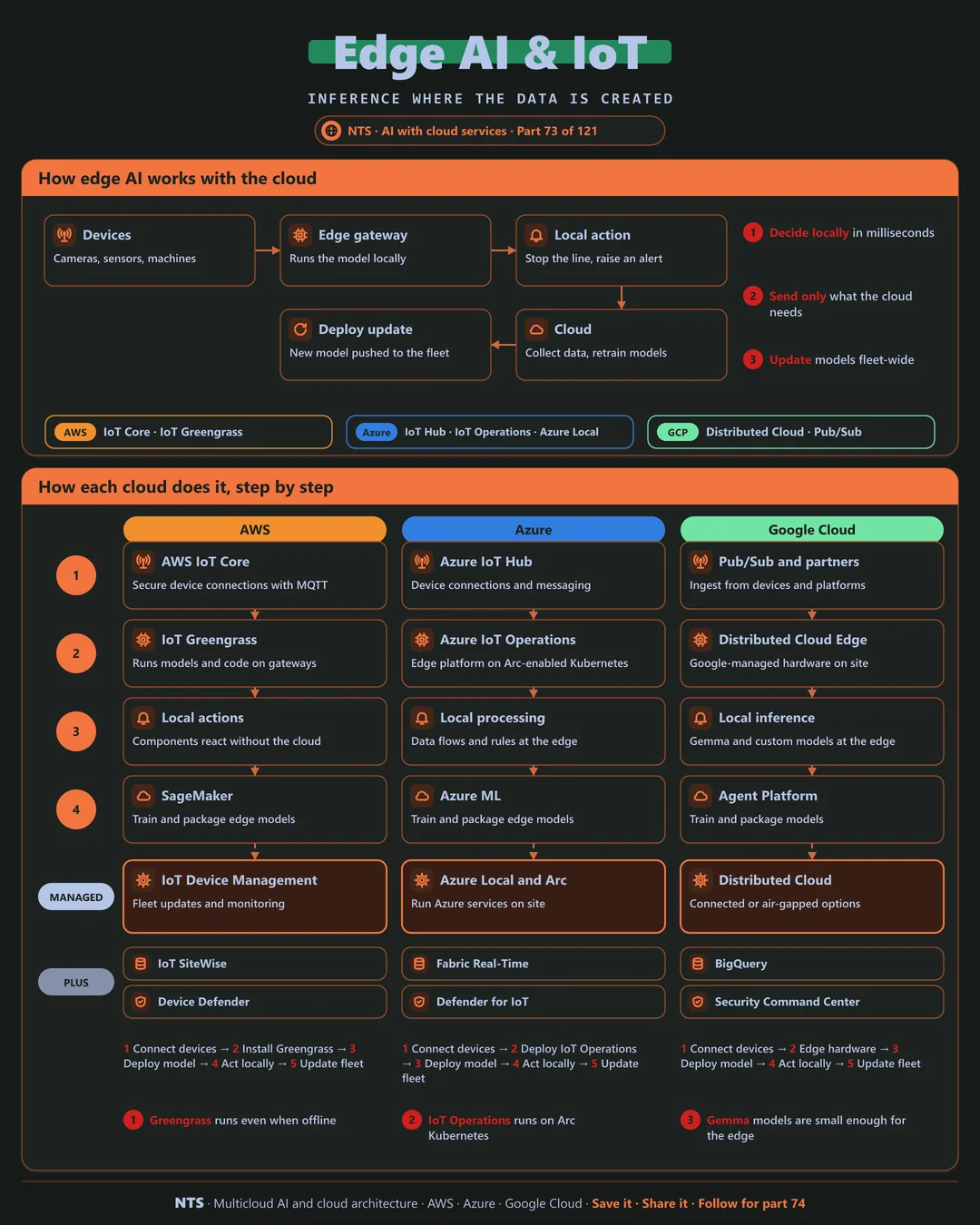
Factories, stores, vehicles and remote sites need decisions in milliseconds, often with limited connectivity or strict privacy. Running inference locally solves that, while the cloud keeps models improving.
How it works
Edge and cloud together
Devices such as cameras and sensors feed an edge gateway that runs the model locally and takes immediate action. Selected data goes to the cloud for analysis and retraining, and updated models are pushed back to the whole fleet.
AWS, Azure and Google Cloud compared
| AWS | Azure | Google Cloud | |
|---|---|---|---|
| Device connectivity | AWS IoT Core | Azure IoT Hub | Pub/Sub and partners |
| Edge runtime | IoT Greengrass | Azure IoT Operations on Arc | Distributed Cloud |
| On-site cloud hardware | Outposts | Azure Local | Distributed Cloud connected |
| Industrial data | IoT SiteWise | IoT Operations, Fabric | Manufacturing Data Engine |
| Small edge models | SageMaker-trained models | Phi models | Gemma models |
What makes each cloud different
AWS
IoT Greengrass runs models and code on gateways, even offline, with IoT Core for device connectivity and fleet updates through IoT Device Management.
Azure
Azure IoT Operations is an edge data platform on Arc-enabled Kubernetes, and Azure Local runs Azure services on site, with Phi small models suited to edge hardware.
Google Cloud
Google Distributed Cloud provides Google-managed hardware at the edge, including air-gapped options, and Gemma models are small enough to run on edge devices.
Design decisions that matter
- 01Decide locally, learn centrally
Edge for action, cloud for training.
- 02Send only what matters
Filter and summarize at the edge.
- 03Fleet-wide model updates
Versioned, staged and reversible.
- 04Design for offline operation
The site keeps working without the cloud.
Common mistakes we see
- Streaming raw video to the cloud. Bandwidth and cost explode.
- Manual device updates. Fleets drift onto many versions.
- Ignoring device security. Edge devices become entry points.
A practical 30-day plan
- Week 1
Pick one site and one real-time decision.
- Week 2
Deploy the edge runtime and model.
- Week 3
Connect cloud telemetry and retraining.
- Week 4
Automate fleet updates and roll out to more sites.
How NTS helps
NTS builds edge AI solutions with AWS IoT, Azure IoT Operations and Google Distributed Cloud, covering device connectivity, edge runtimes, model deployment and fleet management.
What you get
- Edge device and gateway architecture
- Optimized models for edge hardware
- Secure device fleet management
- Cloud sync for data and model updates
Typical outcomes
- Real-time decisions at the edge
- Lower bandwidth and cloud costs
- Secure, manageable device fleets
How we work with you
- 1Assess
A focused review of your edge AI and IoT across AWS, Azure and Google Cloud. We look for the gaps we find most often: streaming raw video to the cloud, manual device updates and ignoring device security.
- 2Design
A target architecture and roadmap built on the decisions that matter most: decide locally, learn centrally, send only what matters, fleet-wide model updates and design for offline operation.
- 3Build
Hands-on delivery alongside your team. We pick one site and one real-time decision, deploy the edge runtime and model, connect cloud telemetry and retraining, and finally automate fleet updates and roll out to more sites.
- 4Run and improve
We roll out model updates, monitor devices and scale the fleet safely.
Why teams choose NTS for edge AI and IoT
- Edge and cloud together
We design the full path from device to cloud.
- Works offline
Edge AI keeps running without connectivity.
- Secure fleets
Devices are identified, updated and monitored.
Book a free 30-minute review
Talk to an NTS architect about your edge AI and IoT on AWS, Azure and Google Cloud.