
Multicloud AI & ERP / Cloud AI Applications & Industry AI Solutions
Why it matters
Enterprises want AI assistants over their own documents but cannot risk data leaving their control. A private reference architecture answers security reviews upfront and lets teams build quickly on a trusted foundation.
How it works
The private assistant pattern
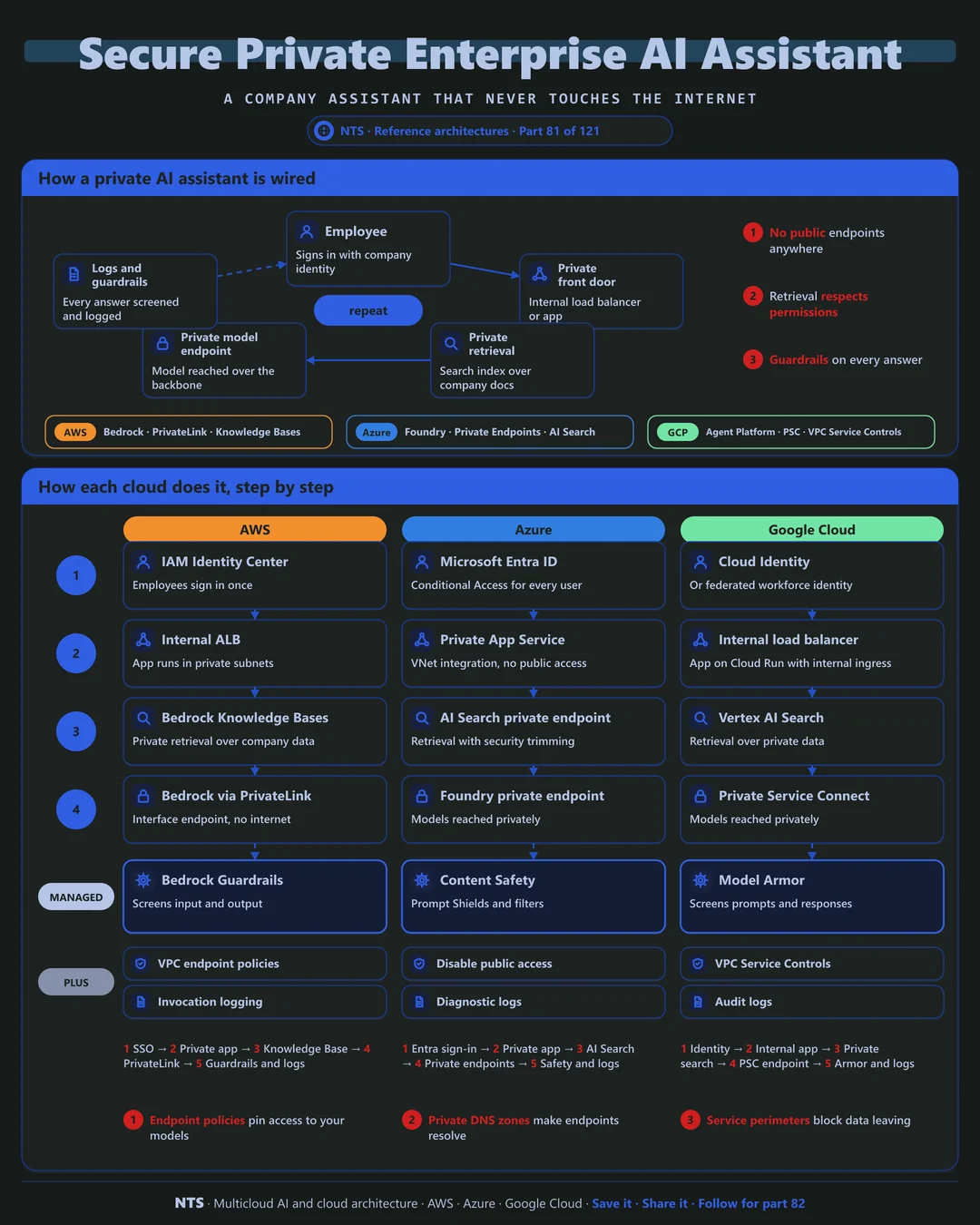
Employees sign in with company identity. The app runs behind a private front door. A private search index retrieves only documents the user may see, the model is reached over a private endpoint and every answer passes guardrails and is logged.
AWS, Azure and Google Cloud compared
| AWS | Azure | Google Cloud | |
|---|---|---|---|
| Model platform | Amazon Bedrock | Microsoft Foundry | Agent Platform |
| Private model access | PrivateLink interface endpoint | Private endpoint | Private Service Connect |
| Retrieval | Bedrock Knowledge Bases | Azure AI Search | Vertex AI Search |
| Exfiltration control | VPC endpoint policies | Disabled public access, policy | VPC Service Controls |
| Guardrails | Bedrock Guardrails | Content Safety | Model Armor |
What makes each cloud different
AWS
On AWS the app runs in private subnets behind an internal load balancer, Bedrock and Knowledge Bases are reached through PrivateLink, endpoint policies pin access to approved resources and invocation logs go to a private bucket.
Azure
On Azure, App Service uses VNet integration, Foundry and AI Search have private endpoints with their DNS zones and public access disabled, and Entra Conditional Access protects sign-in.
Google Cloud
On Google Cloud, Cloud Run with internal ingress calls models over Private Service Connect, and VPC Service Controls draws a perimeter that stops data leaving even with valid credentials.
Design decisions that matter
- 01Private from the first prototype
Retrofitting private networking is painful.
- 02Permission-aware retrieval
Users only see what they could open.
- 03Guardrails and logging on every answer
For safety and audit.
- 04Reusable as a pattern
Every new assistant starts from the template.
Common mistakes we see
- Public endpoints in the prototype. Become permanent by accident.
- One index for everyone. Confidential content leaks across teams.
- Logs with raw sensitive data. Mask before storing.
A practical 30-day plan
- Week 1
Deploy the private network and identity foundation.
- Week 2
Set up private model and search endpoints.
- Week 3
Build the assistant with permission-aware retrieval.
- Week 4
Add guardrails, logging and a security review.
How NTS helps
NTS delivers secure private AI assistants on AWS, Azure and Google Cloud as a reusable reference architecture: private networking, identity, permission-aware RAG, guardrails and audit logging, ready for security review.
What you get
- A private AI assistant on your own cloud
- Secure connections to company documents and systems
- Permission-aware answers with citations
- Usage analytics and feedback loops
Typical outcomes
- Employees save time on everyday questions
- No company data sent to public AI tools
- Measurable productivity gains
How we work with you
- 1Assess
A focused review of your private enterprise AI assistant across AWS, Azure and Google Cloud. We look for the gaps we find most often: public endpoints in the prototype, one index for everyone and logs with raw sensitive data.
- 2Design
A target architecture and roadmap built on the decisions that matter most: private from the first prototype, permission-aware retrieval, guardrails and logging on every answer and reusable as a pattern.
- 3Build
Hands-on delivery alongside your team. We deploy the private network and identity foundation, set up private model and search endpoints, build the assistant with permission-aware retrieval, and finally add guardrails, logging and a security review.
- 4Run and improve
We add knowledge sources, improve answers with feedback and track adoption across teams.
Why teams choose NTS for private enterprise AI assistant
- Your data stays private
The assistant runs in your cloud, under your controls.
- Built for the enterprise
Single sign-on, permissions and audit are included from day one.
- Adoption focused
We help people actually use it, not just deploy it.
Book a free 30-minute review
Talk to an NTS architect about your private enterprise AI assistant on AWS, Azure and Google Cloud.